
Key Takeaways
- The 2026 maximum monthly CPP survivor pension is $803.54 for recipients under 65 and $904.59 for those aged 65 or older.
- Receiving your own CPP retirement or disability pension changes how the survivor benefit is calculated because the payments are combined.
- Applying promptly matters because Service Canada generally limits retroactive survivor pension payments to 12 months.
What Are CPP Survivor Benefits in Canada?
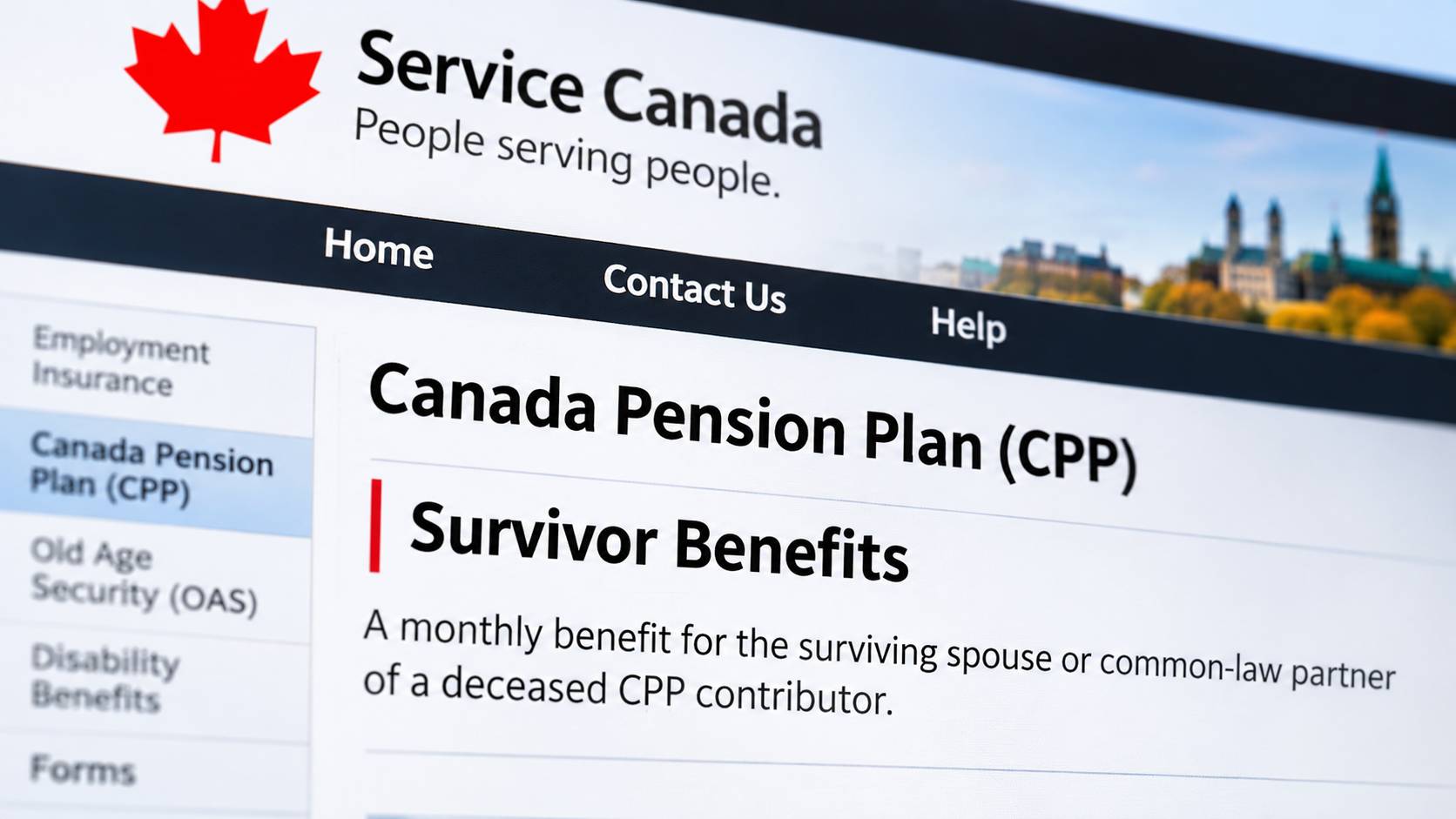
Losing a spouse can create an emotional and financial shock at the same time. For eligible Canadians, the Canada Pension Plan (CPP) offers a monthly survivor's pension to help replace part of the retirement income that disappeared when a contributor died.
CPP survivor benefits are paid to the legal spouse or qualifying common-law partner of someone who contributed sufficiently to the plan. The amount depends mainly on the deceased person's contribution history and the surviving partner's age.
It is important to understand that this is not automatically a continuation of the deceased person's entire CPP retirement payment. Service Canada uses a separate calculation to determine the survivor's entitlement.
How Much Can a Spouse Receive in 2026?
The maximum monthly survivor pension depends on whether the surviving partner is younger than 65 or at least 65 years old.
| Survivor's age | Average monthly payment for new beneficiaries (July 2026) | Maximum monthly amount |
|---|---|---|
| Under 65 | $555.70 | $803.54 |
| 65 and older | $336.91 | $904.59 |
These figures come from the Government of Canada's 2026 payment information. The average reflects new beneficiaries in July 2026, while maximum amounts apply to benefits beginning in January 2026.
Your actual payment could be lower or higher than the average, depending on the deceased contributor's earnings and CPP contributions. The maximum is not an amount every surviving spouse automatically receives.
How Is the CPP Survivor Pension Calculated?
Service Canada first calculates the retirement pension the deceased contributor would have received at age 65. It then applies a different formula based on the surviving partner's age.
If you are 65 or older and are not receiving another CPP benefit, the survivor pension is generally 60% of the deceased contributor's calculated retirement pension.
For someone younger than 65, the calculation generally includes a flat-rate portion plus 37.5% of the contributor's calculated retirement pension.
For example, assume the deceased person's calculated CPP retirement pension would have been $1,200 per month at age 65.
A survivor aged 65 or older could receive approximately $720 monthly (60% of $1,200), assuming no other CPP benefit affects the calculation.
For a survivor under 65, using the 2026 flat-rate portion of $238.17, the illustrative amount would be $688.17 ($238.17 plus $450).
These are simplified examples, not individual benefit estimates. Actual calculations can include CPP enhancement components and other adjustments.
Who Qualifies for CPP Survivor Benefits?
You may qualify if you were legally married to the deceased CPP contributor or were their common-law partner.
For CPP purposes, a common-law partner generally means someone who lived with the contributor in a conjugal relationship for at least one continuous year.
A separated legal spouse may also qualify if the deceased did not have a common-law partner. However, special restrictions apply to certain CPP credit-splitting arrangements approved from January 2025 onward.
The deceased person must also have made sufficient CPP contributions. Service Canada assesses the contribution record when determining eligibility.
One detail many families appreciate knowing: your survivor pension can continue even if you remarry.
Can You Receive Your Own CPP and a Survivor Pension?
Yes, but you cannot simply add two full CPP pensions together.
If you already receive a CPP retirement or disability pension, Service Canada combines the eligible benefits into one monthly payment. The combined amount is subject to applicable maximums and calculation rules.
For example, the maximum combined survivor and retirement pension at age 65 is $1,531.56 per month in 2026. The enhanced CPP component is handled separately under the applicable rules.
This matters for retirement planning. Someone already receiving CPP should request an estimate of the combined amount rather than assuming the survivor payment will be added in full.
Is the CPP Survivor Pension Taxable?
Yes. CPP survivor payments are generally taxable income for the recipient.
Service Canada issues a T4A(P) tax slip showing CPP payments. The survivor benefit is identified in Box 15 and is included in the total CPP benefits reported in Box 20.
If you also receive employment income, a workplace pension, RRSP withdrawals or other taxable income, the survivor pension may affect your overall tax situation.
Our guide to RRSP vs TFSA in Canada explains why understanding taxable and tax-free income sources matters during retirement.
How Do You Apply for CPP Survivor Benefits?
The surviving partner is generally responsible for applying. You can submit an application through My Service Canada Account or complete the paper application, form ISP1300.
You should apply as soon as possible after the contributor's death. Service Canada generally limits retroactive payments to 12 months, including the month of application.
The pension can begin as early as the month after the contributor's death. Service Canada estimates that the first payment usually takes approximately six to 12 weeks after receiving a completed application.
TwikUp's Perspective: Look Beyond the Monthly Pension Amount
A survivor's pension can provide an important source of ongoing income, but families should not treat it as a complete replacement for the deceased partner's earnings.
Check whether you may also qualify for the CPP children's benefit, a separate death benefit or other income support. These programs have different eligibility conditions and payment structures.
It is also worth reviewing how your other retirement income will interact with the new pension. Our guide to pension splitting in Canada explains which pension payments qualify for income splitting and why CPP benefits follow separate rules.
The most useful first step is to obtain an official estimate from Service Canada. A clear picture of your combined income, taxes and available benefits can make financial decisions a little easier during an already difficult period.
Disclaimer
This article is for general educational purposes and does not constitute personalized financial, retirement or tax advice. CPP survivor eligibility and payment amounts depend on individual circumstances, contribution records and applicable legislation. Confirm your entitlement directly with Service Canada.