
Key Takeaways
- Collateral can strengthen a loan application, but it gives the lender a claim against a specified asset if you default.
- An unsecured loan avoids pledging property, although missed payments can still lead to collection activity and legal consequences.
- A meaningful comparison should include interest, fees, repayment length and the financial value of the asset being pledged.
Secured vs Unsecured Personal Loans: What Is the Difference?
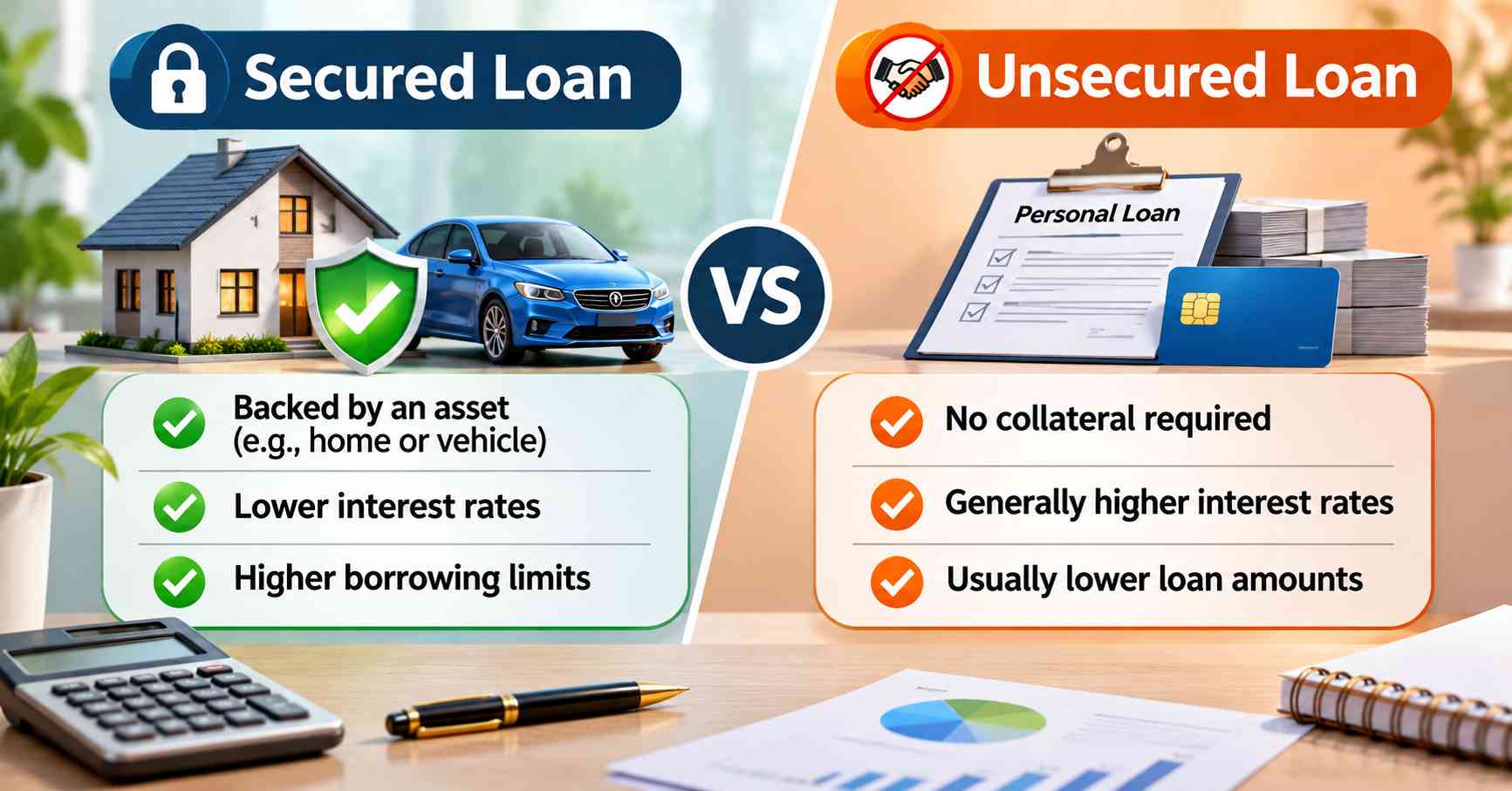
The main difference between secured and unsecured personal loans is collateral. A secured loan requires you to pledge an asset, such as a vehicle or savings account, as security for the money you borrow. An unsecured loan does not require a specific asset to back the debt.
A secured loan may come with a lower interest rate because the lender has an asset to recover if you default. An unsecured loan places more emphasis on your credit history, income and ability to repay. However, neither option is automatically cheaper or safer for every borrower.
How Does a Secured Personal Loan Work?
When you take out a secured personal loan, you agree to let the lender register or otherwise establish a claim over an asset. The exact arrangement depends on the loan and local law.
For example, a lender might accept a vehicle or eligible savings as collateral. If you fail to meet the repayment terms, the lender may be able to seize or sell the pledged asset to recover the outstanding debt.
Collateral can improve your chances of approval or help you qualify for a more competitive rate. But the asset must be worth the risk. Pledging a vehicle you need to commute to work could create a serious problem if you later cannot repay.
How Does an Unsecured Personal Loan Work?
An unsecured personal loan does not use a particular asset as collateral. Instead, the lender evaluates your financial profile, including income, existing debt, credit history and repayment capacity.
Because the lender has no pledged asset to claim under the loan agreement, it may charge a higher interest rate or approve a smaller amount. Borrowers with strong credit and stable income may still qualify for competitive offers.
Unsecured does not mean consequence-free. If you stop paying, the lender may report missed payments, send the debt to collections or pursue legal remedies available under the applicable law.
Secured vs Unsecured Loans: A Side-by-Side Comparison
| Feature | Secured personal loan | Unsecured personal loan |
|---|---|---|
| Collateral | Required | Not required |
| Interest rate | May be lower | May be higher |
| Approval | Asset may support eligibility | Credit and income carry greater weight |
| Default risk | Pledged asset may be seized | Collection or legal action may follow |
| Loan amount | May be higher, depending on collateral | Depends on credit and income |
| Processing | Asset verification may take time | Often simpler |
Actual terms depend on the lender, loan product and borrower.
Which Loan Costs Less? A Practical Example
Imagine borrowing $10,000 for three years. For illustration, assume a secured offer has a 12% annual interest rate and an unsecured offer has a 15% rate. Both use fixed monthly payments and the same repayment period.
At 12%, the estimated monthly payment is about $332, with approximately $1,957 in interest over 36 months. At 15%, the monthly payment is about $347, with approximately $2,480 in interest.
The secured option appears to save roughly $523 in interest. But suppose the secured loan also involves a $200 appraisal or setup cost. The estimated saving falls to about $323.
These figures are illustrative, not actual lender quotes. They also do not assign a dollar value to the risk of losing the pledged asset. A lower rate is useful only when the full arrangement makes financial sense.
Canada and USA: What Borrowers Should Know
Canada
The Financial Consumer Agency of Canada explains that a secured personal loan may use an asset such as a car as collateral. If payments are not made, the lender may take the asset. An unsecured lender may still pursue legal action or other permitted collection methods.
Federally regulated lenders must disclose important loan details, including the amount, interest rate, term, payment amount and applicable fees. Canada's federal rules also limit the annual interest and associated borrowing costs a lender may charge on a personal loan to 35%, subject to the legal definition and applicable exceptions.
United States
The basic distinction is similar: secured loans use collateral, while unsecured loans rely on the borrower's promise and financial ability to repay. The FDIC explains that lenders may charge more for unsecured borrowing because it exposes them to greater risk.
State laws and the loan contract influence collection and repossession procedures. Review the agreement carefully rather than assuming that every lender follows identical rules.
How to Choose the Right Personal Loan
Start by deciding whether you can comfortably repay the loan from regular income. Next, compare the annual percentage rate, total interest, origination or administration fees, repayment schedule and early-payment conditions.
For a secured offer, identify exactly what asset is being pledged and what the lender can do after default. Consider whether losing that asset would affect your ability to work, earn money or manage everyday responsibilities.
For an unsecured offer, check whether the higher rate is reasonable for the amount and term. If the difference in total cost is small, avoiding collateral may be worth paying a little more.
TwikUp's Perspective
A loan should solve a financial problem without creating a larger one. Pledging an asset to obtain a lower rate can be sensible when repayments are comfortably affordable and the collateral is not essential to your livelihood.
But borrowing decisions should also account for the people who depend on your income. If a personal loan is part of a household's wider financial responsibilities, understanding term life vs whole life insurance and which policy makes more financial sense can help you evaluate how life insurance may fit into a broader plan for protecting dependants against financial uncertainty.
Using a valuable asset to make an unaffordable loan appear cheaper is a dangerous trade. Borrowers should judge the offer by the financial consequences of both successful repayment and a possible setback. The strongest borrowing decision is not necessarily the loan with the lowest advertised rate. It is the one whose cost, repayment schedule and risks remain manageable even when life does not go according to plan.
Disclaimer
This article is for general educational purposes and is not personal financial or legal advice. Loan terms, collateral rights, default procedures and consumer protections vary by lender and jurisdiction. Review your agreement and consider independent advice before pledging an asset.