
Quick Answer
Internationally educated nurses can pursue permanent residence in Alberta through several routes, but the most direct provincial option is usually the Alberta Advantage Immigration Program Dedicated Health Care Pathway.
Registered nurses, nurse practitioners and licensed practical nurses may qualify when they have:
- A valid job offer from an eligible Alberta health-sector employer
- Proof that they meet the applicable Alberta nursing regulator’s minimum requirements to practise
- The required immigration status, work experience and documentation
- A genuine intention to live and work permanently in Alberta
The Dedicated Health Care Pathway has both Express Entry and Non-Express Entry options. Nurses may also qualify through federal Express Entry healthcare draws, the Alberta Opportunity Stream or the Rural Renewal Stream, depending on their licensing status, employment, location and work history.
However, nursing registration and permanent residence are two separate processes. Being eligible to work as a nurse does not automatically grant PR, and receiving immigration approval does not automatically authorize someone to practise nursing in Alberta.
TwikUp Insight
For most internationally educated nurses, the biggest challenge is not identifying an immigration program. It is getting three separate pieces aligned at the same time:
- Alberta nursing registration or acceptable proof of ability to practise
- A qualifying Alberta nursing job offer
- Eligibility for an appropriate federal or provincial immigration pathway
This means the smartest strategy is usually to start the nursing assessment process early rather than waiting until after arriving in Alberta.
A nurse who can demonstrate registration progress, provide the regulator’s required proof and secure an eligible job offer may have significantly more options than someone who focuses only on improving their Comprehensive Ranking System score.
Can Internationally Educated Nurses Get PR in Alberta?
Yes. Internationally educated nurses may qualify for permanent residence in Alberta through provincial or federal economic immigration programs.
Alberta’s healthcare immigration pathway specifically includes several nursing professions:
| Nursing occupation | NOC 2021 | TEER |
|---|---|---|
| Nursing coordinators and supervisors | 31300 | 1 |
| Registered nurses and registered psychiatric nurses | 31301 | 1 |
| Nurse practitioners | 31302 | 1 |
| Licensed practical nurses | 32101 | 2 |
These occupations are also included in the federal Express Entry healthcare and social services occupations category.
That does not mean every nurse will automatically receive an invitation. Candidates must still meet the complete eligibility requirements of the immigration program through which they apply.
Alberta Nurse PR Pathway at a Glance
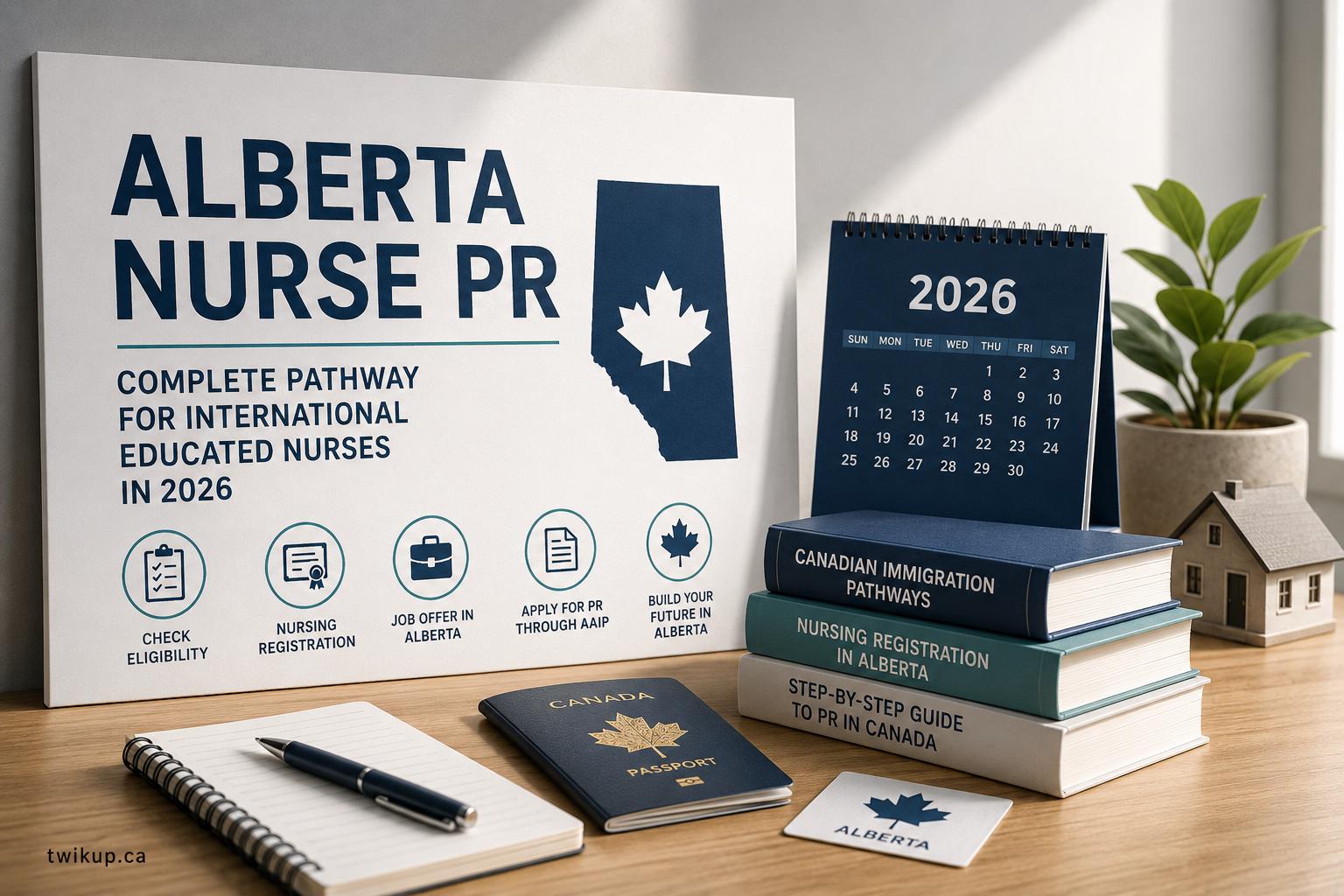
A typical pathway for an internationally educated nurse may look like this:
Foreign nursing education and experience
↓
Apply for assessment with the appropriate Alberta nursing regulator
↓
Complete document verification, competency assessment, language testing, examinations or bridging education if required
↓
Obtain proof of eligibility, provisional authorization or registration to practise
↓
Secure a qualifying Alberta nursing job offer
↓
Choose the strongest immigration pathway
↓
Receive an Alberta nomination or federal invitation
↓
Submit the permanent residence application
The exact order can vary. Some employers may interview internationally educated nurses while their licensing assessment is underway, but the nurse must meet regulatory and immigration requirements before beginning unauthorized nursing work.
Step 1: Identify Your Nursing Profession in Alberta
Before choosing an immigration program, determine which Alberta profession matches your education, training and scope of practice.
Registered Nurse
Registered nurses generally fall under NOC 31301. Internationally educated registered nurses must be assessed by Alberta’s registered nursing regulator before they can practise as RNs in the province.
Nurse Practitioner
Nurse practitioners fall under NOC 31302. Because nurse practitioner practice involves an advanced scope of nursing, additional education, experience, registration and examination requirements may apply.
Licensed Practical Nurse
Licensed practical nurses fall under NOC 32101. An internationally educated nurse whose education does not meet Alberta’s RN requirements may not automatically qualify as an LPN. A separate assessment by the applicable practical-nursing regulator may be required.
Registered Psychiatric Nurse
Registered psychiatric nurses are generally included under NOC 31301, but they follow the registration requirements of the regulator responsible for psychiatric nursing practice in Alberta.
The title you held outside Canada does not by itself determine the nursing category for which you will qualify in Alberta. The regulator considers factors such as education, clinical training, recent practice, competencies and professional history.
Step 2: Begin Alberta Nursing Registration
Nursing is a regulated profession in Alberta. A person cannot simply use a foreign nursing credential to begin working as an RN, NP, LPN or registered psychiatric nurse.
The applicable professional regulatory organization assesses whether the applicant’s international qualifications meet Alberta’s standards.
The assessment may consider:
- Nursing education
- Course content and clinical hours
- Previous nursing registration
- Recent nursing practice
- Employment history
- English-language proficiency
- Professional conduct
- Criminal record or background checks
- Entry-to-practice competencies
- Required registration examinations
The regulator may determine that an applicant is eligible to continue directly, must complete an examination, requires a competency assessment or needs additional education.
Step 3: Confirm Nursing Competency
Internationally educated nurses may be asked to demonstrate that their education and experience are substantially equivalent to Alberta’s entry-to-practice requirements.
Depending on the applicant’s background, competency may be confirmed through one or more of the following:
- Review of education and clinical experience
- Competency-based assessment
- Registration examination
- Bridging or transition program
- Supervised clinical education
- Evidence of recent nursing practice
- Additional coursework
- Language-proficiency testing
Not every nurse will be required to complete the same process.
A nurse with recent experience, complete documentation and education closely aligned with Canadian standards may have a different assessment outcome from someone who has been away from nursing for several years.
Step 4: Meet the Language Requirements
Language requirements for nursing registration and immigration must be considered separately.
Nursing regulator language requirement
The nursing regulator may require acceptable proof that the applicant can safely communicate in English in a professional healthcare environment.
Accepted tests, exemptions, minimum scores and validity periods depend on the regulator and application pathway.
Immigration language requirement
The immigration program may require an approved immigration language test, such as:
- IELTS General Training
- CELPIP-General
- PTE Core
- TEF Canada
- TCF Canada
An academic nursing-language test may not automatically satisfy IRCC’s immigration-language requirement.
Similarly, a valid immigration test does not necessarily satisfy the nursing regulator. Applicants should confirm both requirements before booking an examination.
Step 5: Obtain Proof That You Can Practise in Alberta
Alberta’s Dedicated Health Care Pathway requires applicants to provide verifiable proof that they meet the minimum requirements prescribed by the applicable regulatory organization to practise the eligible healthcare profession in Alberta.
The required document will depend on the profession and the applicant’s assessment stage.
It may involve:
- Active registration
- A valid practice permit
- Provisional authorization
- Confirmation of eligibility for registration
- Another document accepted by the AAIP as proof of ability to practise
An application receipt or evidence that someone has merely started the licensing process may not be sufficient.
Applicants should confirm exactly which regulatory document the AAIP will accept before submitting an immigration application.
Step 6: Secure an Eligible Alberta Nursing Job Offer
The Dedicated Health Care Pathway is job-offer based.
The applicant must have a valid and verifiable job offer from an Alberta employer in the health sector for an eligible healthcare profession.
The offer must correspond with the applicant’s occupation and regulatory authorization. For example, an RN immigration application should be supported by employment that genuinely matches the duties and requirements of registered nursing.
A qualifying offer will generally need to satisfy AAIP employer and job-offer requirements, including requirements related to:
- The Alberta employer’s operations
- Workers’ compensation coverage
- Employment location
- Employment conditions
- Wages
- Job duties
- Full-time employment
- The genuineness of the position
A casual expression of interest, staffing-agency registration or interview invitation is not necessarily a qualifying job offer.
Potential employers may include:
- Public hospitals
- Continuing-care facilities
- Primary-care organizations
- Community healthcare providers
- Mental-health facilities
- Rehabilitation providers
- Eligible private healthcare employers
- Rural and regional healthcare facilities
Applicants should never pay an employer for a job offer. Purchasing an employment offer or submitting false employment information can lead to refusal, inadmissibility findings and immigration consequences.
Pathway 1: Alberta Dedicated Health Care Pathway — Express Entry
For many eligible nurses, the Express Entry option may be the strongest Alberta pathway.
To qualify, an applicant generally must:
- Have a valid, verifiable Alberta job offer in an eligible healthcare occupation
- Provide acceptable proof of meeting the nursing regulator’s minimum requirements to practise in Alberta
- Have an active federal Express Entry profile
- List an eligible healthcare occupation as the primary occupation in the Express Entry profile
- Have a minimum CRS score of 300
- Qualify for at least one Express Entry program
- Intend and be able to live and work permanently in Alberta
The federal Express Entry programs are:
- Canadian Experience Class
- Federal Skilled Worker Program
- Federal Skilled Trades Program
Most internationally educated RNs and LPNs would normally qualify through the Federal Skilled Worker Program or Canadian Experience Class rather than the Federal Skilled Trades Program.
Why an Alberta nomination is powerful
An Express Entry-aligned provincial nomination normally adds 600 CRS points to the candidate’s profile.
For example:
| CRS before nomination | Provincial nomination | New CRS |
|---|---|---|
| 335 | 600 | 935 |
| 410 | 600 | 1,010 |
| 465 | 600 | 1,065 |
A nomination does not itself grant permanent residence. It substantially increases the likelihood of receiving an invitation, after which the applicant must submit a complete federal PR application and pass admissibility checks.
Pathway 2: Alberta Dedicated Health Care Pathway — Non-Express Entry
Alberta also offers a Non-Express Entry option under the Dedicated Health Care Pathway.
This option may be available when the nurse:
- Has a qualifying Alberta healthcare job offer
- Meets the applicable regulatory requirements
- Satisfies the Non-Express Entry pathway criteria
- Does not qualify for the Alberta Express Entry option
Alberta states that applicants who can create an Express Entry profile with a CRS score of at least 300 must use the Express Entry option rather than choosing the Non-Express Entry route.
After receiving a nomination through the Non-Express Entry pathway, the applicant applies to IRCC through the Provincial Nominee Program’s Non-Express Entry process.
This route does not provide 600 Express Entry points because the application is processed outside Express Entry.
Express Entry vs Non-Express Entry Healthcare Pathway
| Factor | Express Entry option | Non-Express Entry option |
|---|---|---|
| Active Express Entry profile | Required | Not required |
| Minimum CRS for Alberta pathway | 300 | Not applicable |
| Alberta nursing job offer | Required | Required |
| Proof of ability to practise | Required | Required |
| Provincial nomination | Yes | Yes |
| PR application system | Express Entry | Non-Express Entry PNP |
| 600 CRS points | Yes, after nomination acceptance | No |
| Intended applicant | Candidate who qualifies for Express Entry | Candidate who cannot qualify for the Express Entry option |
The Express Entry option is not automatically available merely because someone creates a profile. The candidate must qualify for one of the federal programs and satisfy the complete Alberta pathway criteria.
Pathway 3: Federal Express Entry Healthcare Category
Nurses may also receive a federal invitation through Express Entry’s healthcare and social services occupations category without first receiving an Alberta nomination.
In 2026, the category includes:
- Nursing coordinators and supervisors
- Registered nurses and registered psychiatric nurses
- Nurse practitioners
- Licensed practical nurses
To qualify for the healthcare category, a candidate must generally:
- Have a valid Express Entry profile
- Qualify for at least one Express Entry program
- Have at least 12 months of full-time work experience, or an equivalent amount of part-time experience
- Have gained that experience within the previous three years
- Have worked in one eligible occupation
- Meet the instructions issued for the invitation round
The qualifying experience may have been obtained in Canada or outside Canada.
However, being included in the healthcare category does not guarantee an invitation. Eligible candidates are ranked by CRS score, and IRCC invites the highest-ranking candidates in each applicable round.
Readers trying to understand federal score requirements can also review Canada PR in 2026: What CRS Score Is Really Needed.
Pathway 4: Alberta Opportunity Stream
The Alberta Opportunity Stream may be relevant to nurses who are already lawfully working in Alberta.
Applicants generally need:
- Valid temporary resident status
- An eligible work permit
- An eligible Alberta occupation
- Required licensing or registration
- Qualifying work experience
- A full-time job offer from an eligible Alberta employer
- Required language ability
- Required education
At the time of application, an applicant generally needs either:
- At least 12 months of full-time work experience in the current occupation in Alberta during the previous 18 months, or
- At least 24 months of full-time experience in the current occupation in Canada, abroad or a combination of both during the previous 30 months
Eligible Post-Graduation Work Permit holders may qualify with at least six months of full-time Alberta experience in the current occupation, provided the other PGWP-specific requirements are met.
Work experience must generally be:
- Full-time
- At least 30 hours per week
- In the same occupation as the applicant’s current occupation
- Properly authorized when gained in Canada
A nurse cannot qualify based on unauthorized work or by performing regulated nursing duties without the required registration.
Pathway 5: Rural Renewal Stream
Internationally educated nurses who are willing to work outside Alberta’s largest urban centres may also explore the Rural Renewal Stream.
This community-driven pathway normally requires:
- A qualifying job offer in a designated Alberta community
- An endorsement from that community
- Eligible work experience
- Required language proficiency
- Required education
- Settlement funds when applicable
- Intention to live and work in the designated community
A rural nursing job does not automatically qualify for this stream. The community must be officially designated, and the applicant must receive the required endorsement.
The pathway may be worth considering for nurses who are flexible about location and are prepared to establish themselves in a smaller Alberta community.
For a broader comparison, see Easiest Province to Get Canada PR in 2026: Lowest CRS Scores and Best Provinces Compared.
Pathway 6: Canadian Experience Class
A nurse who accumulates eligible skilled Canadian work experience may qualify for the Canadian Experience Class.
CEC generally requires at least one year of qualifying Canadian work experience during the applicable eligibility period.
The work must be:
- Paid
- Authorized
- Gained in Canada
- In an eligible TEER occupation
- Consistent with the claimed NOC duties
For regulated nursing work, the applicant must also have held the required provincial authorization while performing those duties.
CEC does not require a provincial nomination or permanent job offer, although both can affect the candidate’s overall immigration strategy.
Pathway 7: Federal Skilled Worker Program
A nurse outside Canada may be able to enter the Express Entry pool through the Federal Skilled Worker Program.
Important factors include:
- At least one year of continuous eligible skilled work experience
- Approved language-test results
- Educational Credential Assessment for foreign education
- Meeting the Federal Skilled Worker selection threshold
- Sufficient settlement funds, unless exempt
- Admissibility to Canada
The Educational Credential Assessment used for immigration is different from professional nursing recognition.
An ECA may confirm the Canadian equivalency of an academic credential for immigration points, but it does not authorize the applicant to work as a nurse in Alberta.
Do Nurses Need a High CRS Score for Alberta PR?
Not necessarily, but a stronger CRS score creates more possibilities.
The Alberta Dedicated Health Care Pathway’s Express Entry option requires a minimum CRS score of 300. However, reaching 300 does not guarantee selection or nomination.
A nurse with a higher CRS may have access to:
- General Express Entry rounds
- Canadian Experience Class rounds
- Healthcare-category rounds
- Alberta Express Entry selection
- Other provincial nomination programs
CRS can be affected by:
- Age
- Education
- Language scores
- Canadian work experience
- Foreign work experience
- Spouse qualifications
- French-language proficiency
- Provincial nomination
Candidates relying only on a low CRS score may have fewer options than candidates who combine strong language results, nursing registration, a genuine job offer and provincial eligibility.
Is an Alberta Job Offer Mandatory?
It depends on the pathway.
| Immigration pathway | Alberta job offer required? |
|---|---|
| AAIP Dedicated Health Care Pathway | Yes |
| Alberta Opportunity Stream | Yes |
| Rural Renewal Stream | Yes |
| Federal healthcare category | No |
| Federal Skilled Worker Program | No |
| Canadian Experience Class | No, but Canadian work experience is required |
| General Express Entry invitation | No |
Although a job offer is not mandatory for every federal pathway, internationally educated nurses still need provincial registration before practising as nurses in Alberta.
Can a Nurse Apply From Outside Canada?
Yes. A nurse living outside Canada may potentially:
- Begin the Alberta nursing assessment
- Take required language or registration examinations
- Complete document verification
- Search for Alberta nursing employment
- Create an Express Entry profile if eligible
- Apply through the Dedicated Health Care Pathway after securing the required job offer and regulatory proof
However, the ability to complete every registration step from abroad depends on the regulator’s requirements. Clinical assessments, examinations or bridging education may require the applicant to be physically present in Canada.
Applicants should also be cautious about job advertisements promising guaranteed PR before regulatory assessment.
Can an International Nurse Get PR Before Becoming Fully Licensed?
Potentially, but it depends on the pathway and the documentation available.
Federal Express Entry healthcare-category eligibility is based largely on eligible work experience and Express Entry requirements. Full Alberta registration is not required simply to enter the federal pool.
The Alberta Dedicated Health Care Pathway is different. It requires verifiable proof that the applicant meets the applicable regulator’s minimum requirements to practise the profession in Alberta.
Therefore, merely holding a foreign nursing licence may not be enough for Alberta’s healthcare pathway.
The safest approach is to obtain written clarification from the AAIP or the nursing regulator concerning the exact document required for the applicant’s situation.
Bridging Programs and Financial Support
Some internationally educated nurses may be directed to complete a bridging or transition program before becoming fully eligible to practise.
Alberta has offered a return-of-service bursary of up to $30,000 for eligible internationally educated nurses enrolled in approved full-time bridging programs.
The support may contribute toward:
- Assessments and examinations
- Tuition
- Program fees
- Licensing expenses
- Living costs
Participants must meet the bursary conditions and agree to work in rural Alberta after completing the program and obtaining professional certification.
The government states that the bursary does not cover immigration or travel costs.
Because funding availability and conditions can change, applicants should verify the current program before making enrolment or financial decisions.
Documents Internationally Educated Nurses May Need
The exact documents vary, but an applicant may need:
Nursing registration documents
- Passport or identity documents
- Nursing diploma or degree
- Academic transcripts
- Detailed course descriptions
- Clinical-placement records
- Verification of nursing registration
- Professional standing certificate
- Employer reference letters
- Evidence of recent practice
- Language-test results
- Criminal record check
- Registration-examination results
- Competency-assessment results
Immigration documents
- Passport
- Language-test results accepted by IRCC
- Educational Credential Assessment
- Employment letters
- Proof of work experience
- Alberta job offer
- Employment contract
- Nursing regulator documentation
- Express Entry profile information
- Police certificates
- Medical examination
- Proof of settlement funds, when required
- Marriage and dependent documents, when applicable
Employment letters should describe actual duties, working hours, wages and dates of employment. A job title alone may not establish that the experience matches the claimed NOC.
Common Reasons Alberta Nurse PR Applications Can Fail
1. Confusing licensing with immigration
Nursing registration does not provide immigration status. Immigration approval does not provide a nursing practice permit.
2. Applying with the wrong NOC
Applicants should select the NOC that matches their actual duties—not simply the title printed on their employment letter.
3. Incomplete employment evidence
Reference letters without duties, hours, salary or dates may not adequately prove qualifying work experience.
4. Assuming an ECA provides nursing registration
An Educational Credential Assessment is primarily an immigration document. It does not replace the professional regulator’s assessment.
5. Using the wrong language test
IELTS Academic and IELTS General Training serve different purposes. Applicants must take the test required by the organization reviewing the results.
6. Claiming unauthorized nursing work
Regulated nursing experience performed without the required authorization can create serious licensing and immigration issues.
7. Submitting a non-qualifying job offer
A job offer must satisfy AAIP requirements. A temporary placement, subcontracting arrangement or agency listing may not qualify.
8. Letting documents expire
Language tests, police certificates, immigration profiles, work permits and professional documents can have expiry dates.
9. Assuming a minimum CRS guarantees nomination
A CRS score of 300 is an eligibility threshold for the applicable Alberta Express Entry healthcare option, not a guarantee of selection.
10. Paying for employment or immigration promises
No legitimate employer or representative can guarantee provincial nomination or permanent residence.
Alberta Nurse PR Strategy by Applicant Type
Nurse currently outside Canada
A practical strategy may be:
- Start the Alberta nursing assessment
- Complete an immigration ECA
- Take the required language tests
- Collect detailed work-experience evidence
- Create an Express Entry profile if eligible
- Apply for Alberta nursing positions
- Pursue the Dedicated Health Care Pathway after obtaining a qualifying job offer and regulatory proof
International student completing a nursing bridging program
The strategy may include:
- Complete the approved program
- Meet the regulator’s examination requirements
- Obtain registration and a practice permit
- Secure authorized nursing employment
- Accumulate qualifying Canadian experience
- Compare CEC, AAIP healthcare and Alberta Opportunity Stream eligibility
Readers moving from temporary status toward permanent residence may also find PGWP to PR in Ontario: Complete Pathways Explained for 2026 useful for understanding how work permits, Canadian experience and provincial nominations interact, although Alberta’s rules are different.
Nurse already working in Alberta
The nurse should compare:
- Dedicated Health Care Pathway
- Alberta Opportunity Stream
- Canadian Experience Class
- Federal healthcare-category draws
- Rural Renewal Stream, when working in an eligible community
The best option may depend on the nurse’s CRS score, work-permit validity, duration of Alberta experience and job-offer conditions.
Nurse with a low CRS score
The strongest areas to improve may include:
- Language results
- French-language ability
- Additional eligible work experience
- Spouse factors
- Education
- Provincial nomination eligibility
- Alberta registration progress
- A qualifying healthcare job offer
Candidates should not assume that moving to a supposedly easier province will automatically result in PR. Provincial programs select applicants based on local economic needs and can change their requirements or priorities.
For a national overview, read Provinces Offering the Most Immigration Opportunities.
Alberta vs Ontario for Internationally Educated Nurses
Both Alberta and Ontario offer opportunities for internationally educated nurses, but the immigration structures are different.
Alberta has a clearly identified Dedicated Health Care Pathway requiring an eligible Alberta healthcare job offer and proof of ability to practise.
Ontario may invite healthcare workers through Ontario Immigrant Nominee Program streams, including occupation-targeted selections when issued, but selection patterns and eligibility conditions can change.
Nurses comparing the two provinces should consider:
- Licensing timelines
- Availability of bridging education
- Employer demand
- Provincial immigration pathways
- Cost of living
- Rural employment opportunities
- Work-permit status
- Family settlement needs
- CRS score
For a detailed comparison with Ontario, see Ontario Nurse PR: Complete Pathway for Internationally Educated Nurses in 2026.
Alberta Nurse PR Checklist
Before applying, confirm that you have:
- Identified the correct nursing occupation and NOC
- Started or completed the applicable Alberta registration process
- Obtained acceptable proof of ability to practise
- Taken the correct nursing and immigration language tests
- Completed an ECA when required
- Collected detailed employment-reference letters
- Created an Express Entry profile, when applicable
- Reached at least 300 CRS for the Express Entry healthcare pathway
- Obtained a valid Alberta healthcare job offer
- Verified the employer’s eligibility
- Maintained valid immigration status in Canada
- Selected the correct provincial or federal pathway
- Prepared settlement funds when required
- Reviewed all requirements immediately before submission
Final Takeaway
Alberta offers one of Canada’s clearest provincial immigration routes for eligible internationally educated nurses, but there is no single-step “nurse PR program.”
A successful Alberta nurse PR strategy normally requires the applicant to coordinate:
- Professional nursing recognition
- Language and competency requirements
- An eligible Alberta job offer
- Federal Express Entry eligibility or Non-Express Entry eligibility
- Complete and verifiable documentation
For nurses who qualify for Express Entry, have at least 300 CRS points, obtain an eligible Alberta healthcare job offer and provide acceptable proof of ability to practise, the AAIP Dedicated Health Care Pathway — Express Entry option may be especially valuable because a provincial nomination can add 600 CRS points.
Nurses who do not qualify for that option may still have alternatives through the Non-Express Entry healthcare pathway, Alberta Opportunity Stream, Rural Renewal Stream, Canadian Experience Class, Federal Skilled Worker Program or federal healthcare-category draws.
Immigration programs, annual allocations, selection priorities and professional-registration requirements can change. Applicants should always verify the latest requirements before applying.
Important Disclaimer
This article provides general educational information and does not constitute legal, immigration, employment or professional-licensing advice. Eligibility depends on individual circumstances and current program requirements. Applicants should confirm information directly with Immigration, Refugees and Citizenship Canada, the Alberta Advantage Immigration Program and the appropriate Alberta nursing regulator. Consider obtaining advice from an authorized Canadian immigration representative when necessary.
Official Government Sources
-
Government of Alberta — Alberta Advantage Immigration Program
-
Government of Alberta — Alberta Opportunity Stream Eligibility
-
Alberta Student Aid — Bursary for Internationally Educated Nurses
-
Government of Canada — Express Entry Category-Based Selection
-
Government of Canada — Provincial Nominee Program: Non-Express Entry Process