
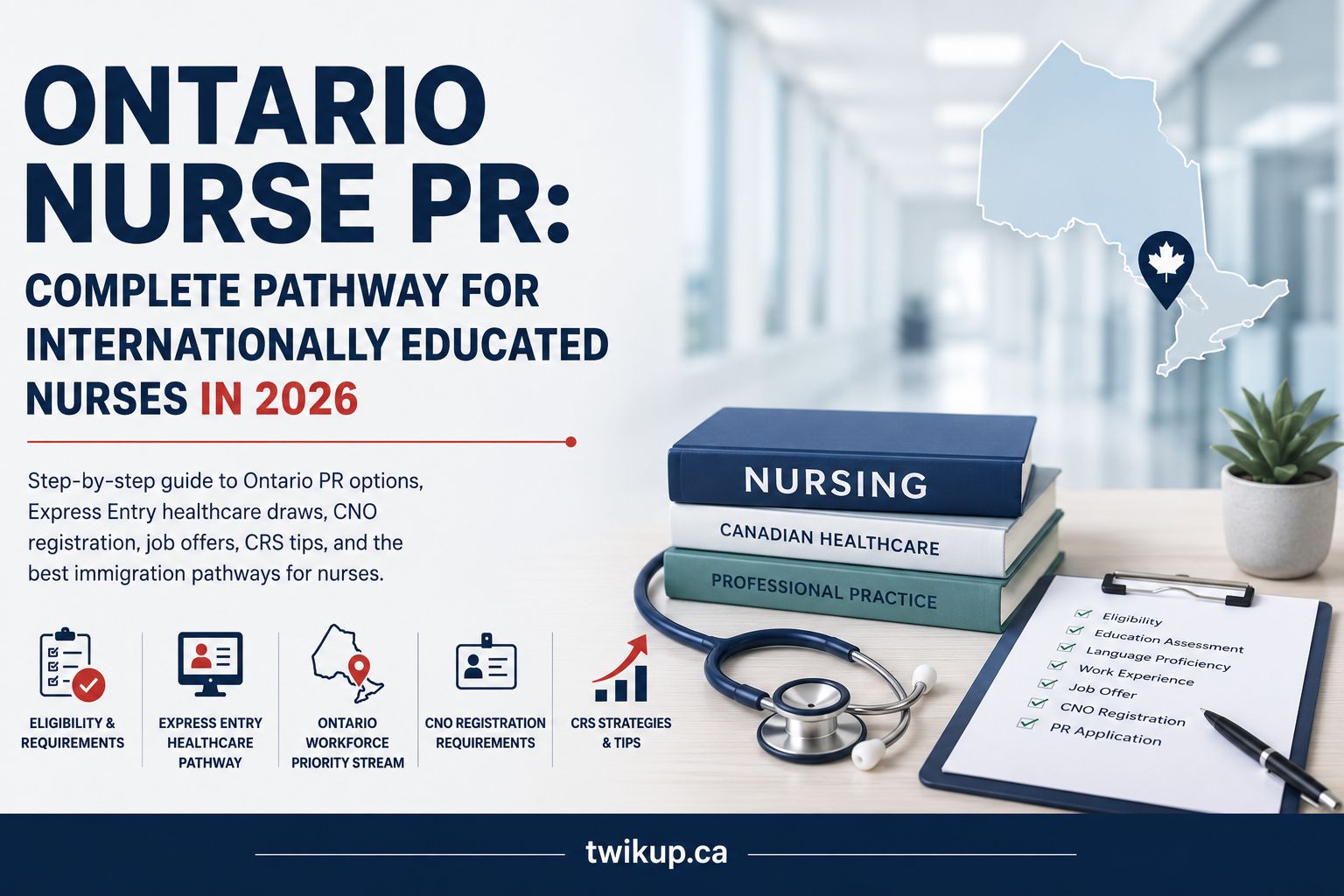
Quick Answer
Internationally educated nurses can puh several routes in 2026, but nursing credentials and immigration eligibility are assessed separately.
The strongest potential pathways are:
- Express Entry healthcare and social services category-based selection, which can consider eligible nursing experience gained in Canada or abroad.
- Ontario’s new Workforce Priority stream, expected to open later in summer 2026 for candidates with eligible Ontario job offers.
- Canadian Experience Class, for nurses and other eligible healthcare workers who obtain sufficient authorized skilled work experience in Canada.
- Federal Skilled Worker Program, particularly for nurses with foreign work experience, strong language scores and recognized education.
- French-language Express Entry selection, for nurses who achieve the required French-language results.
- Regional immigration programs outside Ontario, which may be worth considering when an applicant cannot secure an Ontario nomination or competitive Express Entry score.
However, obtaining permanent residence does not automatically authorize someone to work as a nurse. Registered nurses, nurse practitioners and registered practical nurses must separately satisfy the College of Nurses of Ontario’s registration requirements.
TwikUp Insight
The most important strategy for an internationally educated nurse in 2026 is not simply choosing “OINP or Express Entry.”
It is building two files at the same time:
- an immigration file, covering language results, education assessment, work experience and Express Entry eligibility; and
- a professional licensing file, covering nursing education, recent practice, examinations, language proficiency and registration with Ontario’s nursing regulator.
Nurses who wait for full Ontario registration before creating an immigration strategy may lose valuable time. At the same time, candidates should not assume that receiving PR means they can immediately work as an RN or RPN.
For many applicants, the strongest plan is to enter the Express Entry pool using eligible foreign nursing experience, begin the Ontario registration process, improve language scores and pursue an Ontario healthcare job offer simultaneously.
Can an Internationally Educated Nurse Get PR in Ontario in 2026?
Yes. Nursing remains one of the most strategically important occupational groups within Canada’s economic immigration system.
Registered nurses, nurse practitioners, registered practical nurses and several nursing-support occupations may qualify through federal or provincial pathways, depending on their:
- National Occupational Classification code;
- work experience;
- language test results;
- education;
- professional registration;
- Express Entry eligibility;
- CRS score;
- Ontario job offer; and
- current immigration status.
There is no single automatic “Ontario nurse PR program.” Instead, applicants must match their circumstances with an available immigration pathway.
Ontario also introduced a major OINP redesign in June 2026. The province removed its former eight-stream structure and announced a new Ontario Workforce Priority stream. Its expression-of-interest system is expected to open later in summer 2026.
That means older articles describing the Employer Job Offer: Foreign Worker, International Student, In-Demand Skills, Human Capital Priorities, Masters Graduate and other former streams may no longer reflect the current system for new candidates.
Applications submitted under the former framework will continue to be assessed under the rules that applied when they were filed.
Nursing Occupations and NOC Codes in Canada
Choosing the correct NOC code is essential. Immigration officers assess the duties performed—not simply the job title shown on an employment letter.
Common nursing-related classifications include:
| Occupation | NOC 2021 | TEER |
|---|---|---|
| Nursing coordinators and supervisors | 31300 | 1 |
| Registered nurses and registered psychiatric nurses | 31301 | 1 |
| Nurse practitioners | 31302 | 1 |
| Licensed practical nurses, called registered practical nurses in Ontario | 32101 | 2 |
| Nurse aides, orderlies and patient service associates | 33102 | 3 |
| Home support workers, caregivers and related occupations | 44101 | 4 |
An internationally educated registered nurse should not automatically claim NOC 31301 merely because they completed a nursing degree.
Their employment evidence must demonstrate that they performed the lead statement and a substantial number of the main duties associated with that NOC.
Similarly, someone working in Ontario as a personal support worker while completing nursing registration may need to claim a support-worker NOC rather than an RN NOC for that period of employment.
Pathway 1: Express Entry Healthcare and Social Services Category
For many internationally educated nurses, Express Entry’s healthcare and social services category is the most important federal PR opportunity in 2026.
Canada retained healthcare and social services as an Express Entry category for 2026.
Basic category requirement
To qualify for a healthcare-category invitation, a candidate generally needs:
- an active Express Entry profile;
- eligibility under at least one Express Entry program;
- at least 12 months of eligible full-time work experience, or an equivalent amount of part-time experience;
- experience accumulated during the previous three years;
- experience in a single eligible occupation; and
- compliance with the requirements of the specific invitation round.
The qualifying healthcare experience can generally have been obtained:
- in Canada; or
- outside Canada.
The 12 months of experience does not have to be continuous under the current category rules, although the underlying Express Entry program may impose its own work-experience requirements.
Why this matters for foreign nurses
A nurse does not necessarily need Canadian nursing experience to qualify for the healthcare category.
For example, an RN who accumulated at least 12 months of qualifying nursing experience abroad during the previous three years may meet the occupational component of the healthcare category.
However, meeting the category requirement does not guarantee an invitation.
The candidate must first qualify for one of the programs managed through Express Entry:
- Federal Skilled Worker Program;
- Canadian Experience Class; or
- Federal Skilled Trades Program.
Most internationally educated nurses would qualify through the Federal Skilled Worker Program or Canadian Experience Class rather than the Federal Skilled Trades Program.
Candidates who meet the healthcare category are ranked against other eligible candidates using the Comprehensive Ranking System. IRCC then invites the highest-ranking eligible candidates during a healthcare-category round.
Does a nurse need an Ontario job offer?
No. A job offer is not automatically required for Express Entry healthcare-category selection.
A strong job offer can still be valuable because it may:
- help the candidate obtain Canadian work experience;
- support a work-permit strategy;
- improve the overall immigration file;
- support eligibility for certain provincial pathways; and
- demonstrate a genuine plan to establish a nursing career in Ontario.
But a nurse with qualifying foreign experience may potentially receive an Express Entry invitation without first obtaining an Ontario nursing job.
Candidates trying to understand how occupation-focused selection compares with other routes should also review TwikUp’s guide to the top 10 fastest immigration pathways to Canada.
Pathway 2: Federal Skilled Worker Program for Nurses Outside Canada
The Federal Skilled Worker Program can be a practical entry point for nurses who have not yet accumulated Canadian work experience.
A candidate generally needs to satisfy requirements related to:
- skilled work experience;
- approved language testing;
- foreign education and an Educational Credential Assessment;
- the Federal Skilled Worker selection-factor threshold;
- settlement funds, when required; and
- admissibility to Canada.
Work experience
The candidate normally needs at least one year of continuous paid skilled work experience in an eligible TEER 0, 1, 2 or 3 occupation within the applicable eligibility period.
The duties in the employment documents must correspond with the NOC being claimed.
Language testing
Applicants must take an approved language test, such as:
- IELTS General Training;
- CELPIP-General;
- PTE Core;
- TEF Canada; or
- TCF Canada.
An English-language result used for nursing registration may not always be interchangeable with the test required for immigration. Candidates should confirm the accepted test and validity rules for each process.
Higher language scores can significantly improve a nurse’s CRS score. A candidate who merely meets the minimum requirement may enter the pool but remain below the invitation threshold.
Education assessment
Foreign nursing education normally requires an Educational Credential Assessment for immigration points and Federal Skilled Worker eligibility.
This assessment is distinct from the professional assessment performed during Ontario nursing registration.
An ECA determines the Canadian equivalency of the academic credential for immigration purposes. It does not grant permission to practise nursing in Ontario.
Pathway 3: Canadian Experience Class
The Canadian Experience Class may become the strongest route for internationally educated nurses already working legally in Canada.
A candidate generally needs at least one year of eligible Canadian skilled work experience obtained during the applicable qualifying period.
The work must have been:
- authorized;
- paid;
- performed in Canada; and
- classified in an eligible TEER category.
Does work as a personal support worker qualify?
It depends on the position’s NOC code and whether it meets the requirements of the applicable Express Entry program and invitation category.
Some nursing-support occupations are classified at TEER 3 and may count as skilled work for Canadian Experience Class purposes. Home support positions classified at TEER 4 normally do not qualify as skilled Canadian work experience for the Canadian Experience Class.
Applicants must classify their employment according to the duties they actually performed.
A foreign-trained RN working as a personal support worker cannot count those hours as registered-nurse experience unless the position and duties genuinely correspond to the RN classification.
International students
Nursing graduates transitioning from a post-graduation work permit to permanent residence should create a timeline before their permit approaches expiry.
TwikUp’s PGWP-to-PR pathways in Ontario guide explains how Canadian work experience, Express Entry and provincial selection may fit together.
Pathway 4: Ontario Workforce Priority Stream
Ontario’s provincial immigration structure changed on June 25, 2026.
The province removed the former eight OINP streams and introduced the Ontario Workforce Priority stream.
The new stream is expected to include pathways for people with Ontario job offers across all NOC TEER categories. Ontario has said that the expression-of-interest system is anticipated to open later in summer 2026.
What this could mean for nurses
Once operational, the new stream may become highly relevant for:
- registered nurses;
- nurse practitioners;
- registered practical nurses;
- nursing supervisors;
- nurse aides;
- personal support workers; and
- other healthcare workers with eligible Ontario employment.
However, applicants should not assume that every nurse with a job offer will automatically qualify.
The final outcome may depend on:
- the occupation identified in a targeted invitation;
- the employer’s eligibility;
- the wage offered;
- the candidate’s work experience;
- licensing or registration requirements;
- the location of employment;
- language ability;
- education;
- the candidate’s EOI score; and
- Ontario’s workforce priorities at the time of the draw.
Is the new stream open now?
As of July 11, 2026, Ontario has stated that the new Workforce Priority EOI system is expected to open later in summer.
Candidates should avoid paying anyone who claims they can submit a new Workforce Priority application before Ontario officially opens the system.
The practical steps now are to:
- verify the candidate’s nursing NOC;
- pursue Ontario registration;
- secure an eligible job offer where possible;
- collect detailed employment documentation;
- prepare language and education records; and
- monitor Ontario’s official 2026 program-updates page.
Applicants comparing Ontario with other regions may find TwikUp’s overview of the provinces offering the most immigration opportunities useful.
What Happened to Ontario’s Human Capital Priorities Stream?
Before June 2026, Ontario sometimes issued targeted notifications of interest to Express Entry candidates in healthcare occupations through its Human Capital Priorities stream.
That former stream listed several nursing occupations, including:
- nursing coordinators and supervisors;
- registered nurses;
- nurse practitioners; and
- licensed practical nurses.
Ontario’s June 2026 redesign removed the former stream structure for new candidates.
Therefore, an applicant should not build a current 2026 plan around receiving a new Human Capital Priorities notification unless Ontario publishes a new transition measure or related pathway.
Candidates who submitted applications under the former framework will continue to be assessed according to the requirements that applied when they filed.
This distinction is important because many immigration websites may continue displaying older Ontario nursing draw information after the pathway itself has changed.
Pathway 5: French-Language Express Entry Selection
French can create an additional route for internationally educated nurses.
Express Entry continues to include French-language proficiency as a category. Candidates generally need a minimum NCLC 7 result in all four French-language abilities to qualify for the category.
A nurse with strong French may benefit in two ways:
- eligibility for French-language category-based rounds; and
- additional CRS points for French, depending on the candidate’s English results and overall profile.
This pathway can be especially valuable for candidates whose CRS score is not competitive in general or healthcare-focused rounds.
French does not replace the need to qualify for an Express Entry program, and it does not replace Ontario nursing-registration requirements.
Nursing Registration and Permanent Residence Are Separate Processes
This is the most common source of confusion for internationally educated nurses.
Immigration approval
Immigration authorities determine whether the applicant qualifies to:
- work temporarily in Canada;
- receive a provincial nomination; or
- become a permanent resident.
Professional registration
The College of Nurses of Ontario determines whether the applicant can legally practise using a protected nursing title in Ontario.
A permanent resident cannot automatically work as an RN, NP or RPN without the appropriate Ontario registration.
Conversely, a nurse may complete or substantially advance the registration process but still require a valid work permit or permanent resident status to work in Canada.
Ontario Registration Requirements for Internationally Educated Nurses
The exact process depends on whether the applicant seeks registration as:
- a registered nurse;
- a registered practical nurse; or
- a nurse practitioner.
Applicants may need to demonstrate requirements covering the following areas.
1. Nursing education
The applicant must provide evidence of nursing education appropriate for the registration category being requested.
The regulator assesses whether the education satisfies the applicable nursing-education requirement. Some applicants may be asked to complete additional education or an approved pathway.
2. Evidence of recent nursing practice
Applicants may need to show recent nursing practice in the category for which they are applying.
Ontario’s nursing regulator currently states that applicants generally need evidence of practice within the previous three years.
The evidence should normally relate to paid nursing practice. Applicants with older experience may need to satisfy the requirement through another approved option.
3. Registration examination
Applicants must successfully complete the approved registration examination for their nursing category.
Depending on the category, this may involve an examination such as the NCLEX-RN or another regulator-approved examination.
4. Jurisprudence examination
Applicants may need to complete an examination covering the laws, regulations, standards and professional responsibilities applicable to nursing practice in Ontario.
5. Language proficiency
Applicants must demonstrate sufficient proficiency in English or French to practise nursing safely.
The evidence accepted for professional registration may differ from the approved language tests used by IRCC for immigration.
6. Transition-to-practice requirement
Applicants may need to show familiarity with the competencies and practice expectations specific to the Canadian healthcare environment.
This requirement may be met through an approved form of Canadian nursing education, practice, supervised experience or another option recognized by the regulator.
7. Citizenship, permanent residence or authorization to practise
Applicants must satisfy the regulator’s authorization-to-work or status-related requirement.
The exact documentation should be confirmed directly with the College of Nurses of Ontario.
8. Suitability to practise
Applicants must provide information relevant to their ability to practise safely and ethically. This can include conduct, health-related declarations, professional history and registration in other jurisdictions.
Each application is assessed individually. Two nurses with similar degrees may receive different requirements because of differences in education, practice history, registration and documentation.
Do You Need CNO Registration Before Applying for PR?
Not always.
A candidate may potentially create an Express Entry profile and qualify using eligible foreign nursing experience before obtaining full Ontario registration.
For example, an applicant may:
- obtain an Educational Credential Assessment;
- complete an approved immigration language test;
- document eligible foreign nursing work;
- qualify for the Federal Skilled Worker Program;
- enter the Express Entry pool;
- become eligible for the healthcare category; and
- pursue Ontario nursing registration in parallel.
However, Ontario registration may become essential when:
- the candidate wants to work as an RN, RPN or NP in Ontario;
- an employer requires registration before finalizing employment;
- the immigration pathway requires authorization for a regulated occupation;
- Ontario gives preference to licensed healthcare workers; or
- registration improves the credibility and employability of the candidate.
Starting both processes early is usually safer than treating them as consecutive projects.
Can an Internationally Educated Nurse Get PR Without Canadian Experience?
Yes, potentially.
Foreign nursing experience can be used for:
- Federal Skilled Worker eligibility;
- CRS work-experience points;
- Express Entry healthcare-category eligibility; and
- certain provincial or regional programs.
Canadian experience is helpful but not mandatory for every pathway.
A candidate with strong language results, a recognized credential, several years of foreign nursing experience and favourable age points may be competitive without first studying or working in Canada.
Applicants should not assume that enrolling in another Canadian program is always necessary. Before paying international tuition, they should calculate their existing Express Entry eligibility and CRS score.
TwikUp’s analysis of the CRS score that may really be needed for Canada PR in 2026 can help candidates understand why minimum eligibility and invitation competitiveness are different questions.
Can a Nurse Get Ontario PR With a Low CRS Score?
A low CRS score makes direct Express Entry selection more difficult, but it does not necessarily end the candidate’s options.
Possible strategies include:
- improving English-language scores;
- adding French-language results;
- obtaining more skilled work experience;
- completing additional recognized education;
- entering the pool with an eligible spouse as the principal applicant, where advantageous;
- securing an eligible Ontario job offer;
- pursuing a provincial nomination;
- considering a regional immigration program; or
- considering another province with stronger demand for the candidate’s occupation.
Candidates should be cautious with claims that a particular province provides “guaranteed PR” or has a permanently low CRS requirement.
Provincial programs can change, close or limit invitations based on allocations and labour-market priorities.
For a broader comparison, see TwikUp’s guide to the easiest provinces for Canada PR in 2026.
Do Nurses Receive 600 CRS Points Through Ontario?
A candidate who receives an Express Entry-aligned provincial nomination and accepts it through the Express Entry system can generally receive 600 additional CRS points.
However, candidates should not assume that every pathway under Ontario’s redesigned system will be Express Entry aligned.
The Ontario Workforce Priority stream’s detailed operational rules and invitation mechanisms must be reviewed once the new system opens.
A provincial nomination issued through a non-Express Entry pathway can still lead to permanent residence, but it may not generate the same Express Entry CRS benefit.
Can Nursing Students in Ontario Apply for PR?
Potentially, but completing a nursing program does not automatically provide permanent residence.
A nursing graduate may build a pathway through:
- a post-graduation work permit, if eligible;
- authorized skilled Canadian work experience;
- Canadian Experience Class;
- Express Entry healthcare selection;
- French-language category selection;
- Ontario Workforce Priority selection; or
- another federal or regional program.
Students should verify:
- whether their institution and program support PGWP eligibility;
- the duration of the work permit they may receive;
- the NOC classification of the job they accept;
- whether their work counts toward Canadian Experience Class;
- nursing-registration timelines; and
- when their immigration documents expire.
Waiting until the final months of a work permit can leave insufficient time to improve language results, obtain registration or accumulate qualifying work experience.
Ontario Nurse PR Roadmap: Step by Step
Step 1: Identify the correct nursing occupation
Match the applicant’s actual duties with the appropriate NOC code.
Do not rely entirely on the job title.
Step 2: Review Express Entry eligibility
Determine whether the candidate qualifies for:
- Federal Skilled Worker Program; or
- Canadian Experience Class.
Step 3: Complete an approved immigration language test
Aim beyond the minimum.
A higher result can materially improve the CRS score and may determine whether the candidate receives an invitation.
Step 4: Obtain an Educational Credential Assessment
Foreign credentials generally require an ECA for Federal Skilled Worker eligibility and education points.
Remember that the ECA does not replace Ontario nursing-registration assessment.
Step 5: Create an Express Entry profile
Enter accurate information concerning:
- education;
- language results;
- employment dates;
- NOC codes;
- marital status; and
- Canadian or foreign work experience.
Step 6: Start the CNO registration process
Gather nursing-school records, registration verification, employment evidence and any required examination or language documentation.
Step 7: Search for Ontario healthcare employment
Consider hospitals, long-term-care facilities, community-care organizations, clinics and other eligible employers.
Confirm whether the position is:
- permanent;
- full-time;
- appropriately paid;
- consistent with the NOC; and
- acceptable under the immigration pathway being pursued.
Step 8: Prepare for the Workforce Priority EOI system
Monitor Ontario’s official updates and review the final stream requirements when the system opens.
Do not rely solely on requirements from the former Employer Job Offer streams.
Step 9: Keep employment evidence detailed
Reference letters should clearly document:
- job title;
- employment dates;
- hours per week;
- salary;
- employment status;
- workplace location; and
- detailed duties.
Step 10: Maintain valid temporary status
Submitting an Express Entry profile or provincial EOI does not automatically extend temporary resident status.
Applicants should separately monitor the expiry dates of their:
- work permit;
- study permit;
- visitor status;
- passport; and
- language tests.
Common Mistakes Internationally Educated Nurses Make
Claiming the wrong NOC
Immigration classification is based primarily on duties. An incorrect NOC can result in refused work-experience claims or misrepresentation concerns.
Treating an ECA as a nursing licence
An ECA is for immigration and education-equivalency purposes. It does not authorize nursing practice.
Waiting for CNO registration before starting immigration preparation
The two processes can often proceed in parallel.
Assuming a healthcare-category profile guarantees an invitation
Eligible candidates are still ranked by CRS score within the relevant invitation round.
Using outdated OINP stream information
Ontario removed its former eight-stream framework in June 2026. New applicants should verify the Workforce Priority rules once the province opens its new EOI system.
Accepting any healthcare job without checking the NOC
A healthcare employer, hospital workplace or medical setting does not automatically make a job eligible skilled nursing work.
Ignoring language-score improvement
A small improvement in multiple language abilities can create a meaningful CRS difference.
Paying for a guaranteed nomination
No recruiter, consultant, employer or education provider can guarantee an OINP invitation or permanent residence approval.
Ontario vs Other Provinces for Nurse PR
Ontario offers a large healthcare labour market, multiple major hospitals and extensive long-term-care and community-care networks.
However, it may not always be the fastest province for every nurse.
Candidates should compare:
- licensing requirements;
- availability of employer support;
- provincial nomination rules;
- cost of living;
- settlement opportunities;
- regional healthcare demand; and
- the applicant’s CRS score.
A candidate struggling to obtain an Ontario opportunity may also examine rural-community programs, Atlantic Canada and other provincial nominee programs.
This is similar to how occupation-specific immigration choices vary across Canada. TwikUp’s comparison of the best provinces for truck-driver PR demonstrates why the strongest province depends on the applicant’s job offer, experience and regional demand—not merely the occupation.
Candidates from other professional backgrounds can also compare the process with Ontario PR pathways for software engineers and Canada’s evolving approach to construction-worker immigration.
Best Ontario PR Strategy for an Internationally Educated Nurse
A practical 2026 strategy may look like this:
- Confirm the correct NOC using actual nursing duties.
- Calculate Federal Skilled Worker or Canadian Experience Class eligibility.
- Complete language testing early and retake it when meaningful improvement is possible.
- Obtain the immigration ECA.
- Create an Express Entry profile when eligible.
- Confirm healthcare-category eligibility using recent nursing experience.
- Begin or continue CNO registration.
- Pursue eligible Ontario employment.
- Prepare for the new Workforce Priority EOI system.
- Consider French and other provinces as parallel options.
The best pathway may involve more than one active profile or strategy.
For example, a nurse could simultaneously be:
- in the Express Entry pool;
- eligible for healthcare-category selection;
- completing CNO registration;
- working in an eligible Canadian occupation; and
- preparing for Ontario’s Workforce Priority stream.
This reduces dependence on a single draw or program.
Final Verdict
Ontario remains a strong destination for internationally educated nurses, but the 2026 pathway is not automatic.
The most important immediate route is Express Entry, particularly healthcare and social services category-based selection for candidates with recent eligible nursing experience.
Ontario’s new Workforce Priority stream could add another major pathway for nurses with provincial job offers once its EOI system opens later in summer 2026. Until Ontario publishes the operational details and begins accepting EOIs, candidates should treat the pathway as upcoming—not currently available.
The strongest candidates will coordinate four elements:
- eligible nursing work experience;
- competitive language results;
- an accurate immigration profile; and
- progress toward Ontario nursing registration.
Permanent residence and professional licensing are separate, but managing them together can substantially improve a nurse’s ability to establish a long-term career in Ontario.
Immigration disclaimer: This article provides general educational information and does not constitute legal or immigration advice. Immigration programs, invitation criteria and licensing requirements can change without notice. Applicants should verify current requirements with Immigration, Refugees and Citizenship Canada, the Government of Ontario and the College of Nurses of Ontario. For advice based on individual circumstances, consult an authorized Canadian immigration lawyer or licensed immigration consultant.
Official Sources
- Government of Ontario — 2026 Ontario Immigrant Nominee Program updates
- Government of Ontario — Ontario Immigrant Nominee Program
- Government of Ontario — Ontario modernizing immigration program to fill in-demand jobs
- Government of Canada — Express Entry category-based selection
- Government of Canada — Who can apply through Express Entry
- Government of Canada — 2026 Express Entry categories
- College of Nurses of Ontario — Registration requirements
- College of Nurses of Ontario — Registration guide for applicants educated outside Canada