
Key Takeaways
- Canada's energy production rose 3.3% in 2025, with crude oil and natural gas at record shares.
- Canada shipped its first natural gas exports to countries other than the United States in 2025.
- Energy consumption rose 2.3%, driven by homes and commercial buildings.
Canada Has a New Energy Customer. And It Isn't the United States.
For decades, Canada's energy industry had a familiar destination for much of its exports: the United States.
Then came 2025. Canada began shipping natural gas to countries beyond its southern neighbour for the first time.
It wasn't just an export story. Canada produced, exported and consumed more energy in 2025, Statistics Canada reported Tuesday.
Production climbed to a record mix
Primary energy production climbed 3.3% to 25,484 petajoules in 2025.
Crude oil and natural gas dominated, accounting for record-high shares of total production: 48.0% and 36.1% respectively.
The rest came from primary electricity (6.9%), gas plant liquids (4.3%), coal (4.3%) and renewable fuels (0.3%).
The numbers reveal just how heavily Canada's energy production still depends on oil and gas.
A new direction for exports
Energy exports climbed 3.1% to 16,065 petajoules.
Canada exported 80.4% of the crude oil it produced. The expanded Trans Mountain Pipeline, operating in its first full year of operation, moved more of that crude to Asian markets.
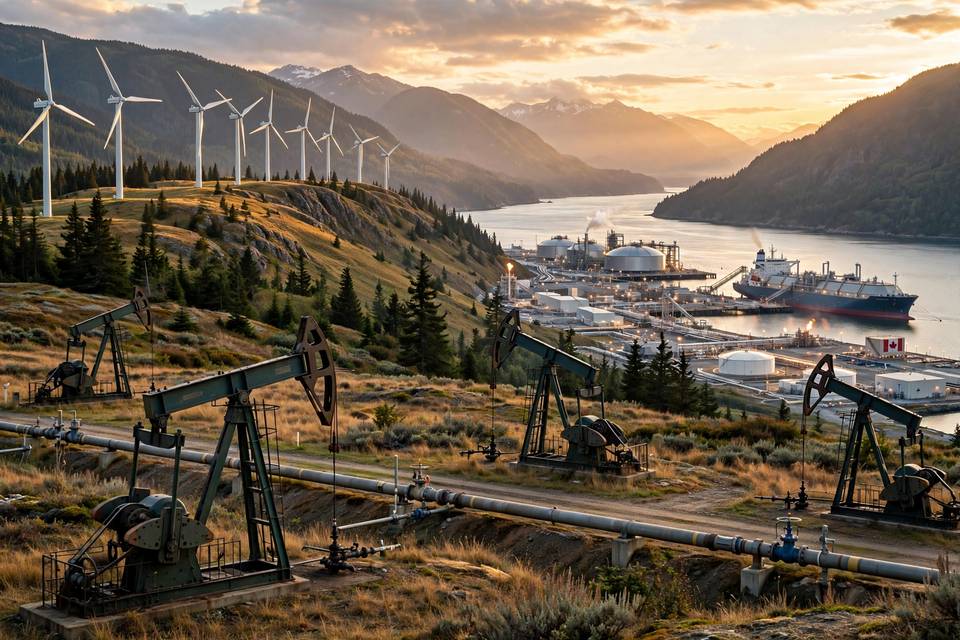
Canada exported 39.7% of its natural gas production, but the opening of the LNG export facility in Kitimat, B.C. has begun to change that.
In 2025, Canadian natural gas reached non-U.S. buyers for the first time.
The breakthrough is still relatively small. Just 3.3% of Canada's total natural gas exports went to the non-U.S. market. But the direction is changing. Statistics Canada says growth in LNG exports beyond the United States continued through the first three quarters of 2026.
For an industry historically tied to one major export market, that is an important shift.
Canada still imports energy, too
Despite being a major energy producer and exporter, Canada continued buying energy from abroad.
Imports increased 2.3% to 3,868 petajoules in 2025.
Crude oil accounted for 45.0% of imports, followed by natural gas at 30.2%.
The apparent contradiction has a practical explanation: refinery configurations on both sides of the border still pull Canadian energy trade south even as new routes west open up.
What Canadians actually used
Energy production and exports weren't the only numbers moving upward.
Domestic consumption rose 2.3% to 8,577 petajoules.
Higher demand in residential buildings and commercial and institutional buildings drove the increase. Those are the kinds of buildings where heating and power costs land.
The Twikup Take
Canada hasn't stopped depending on the United States for energy trade. The numbers make that clear.
But 2025 marked the beginning of a different possibility: Canadian oil reaching Asian markets through Trans Mountain and gas leaving Kitimat for overseas buyers.
The overseas gas share is just 3.3% today.
Canada is still an energy neighbour to the United States. It's increasingly becoming an energy supplier to the world.
Image: Illustrative image.