
Key Takeaways
- Multiple compression happens when investors become willing to pay a lower valuation for each dollar of a company's earnings.
- Earnings growth does not guarantee positive stock returns because a falling P/E multiple can outweigh higher profits.
- Interest rates, investor expectations, business risks and starting valuations can all influence how much investors are willing to pay.
The Multiple Compression Problem: Why Can a Growing Company Still Lose You Money?
Imagine buying shares in a company because its earnings are growing rapidly. Revenue is increasing, profits are improving and management keeps delivering better results. Yet, several months later, your investment is down 20%.
What went wrong?
The business may not have become weaker. Instead, investors may have changed how much they are willing to pay for its earnings. This is called multiple compression, and it can turn an apparently successful company into a disappointing investment.
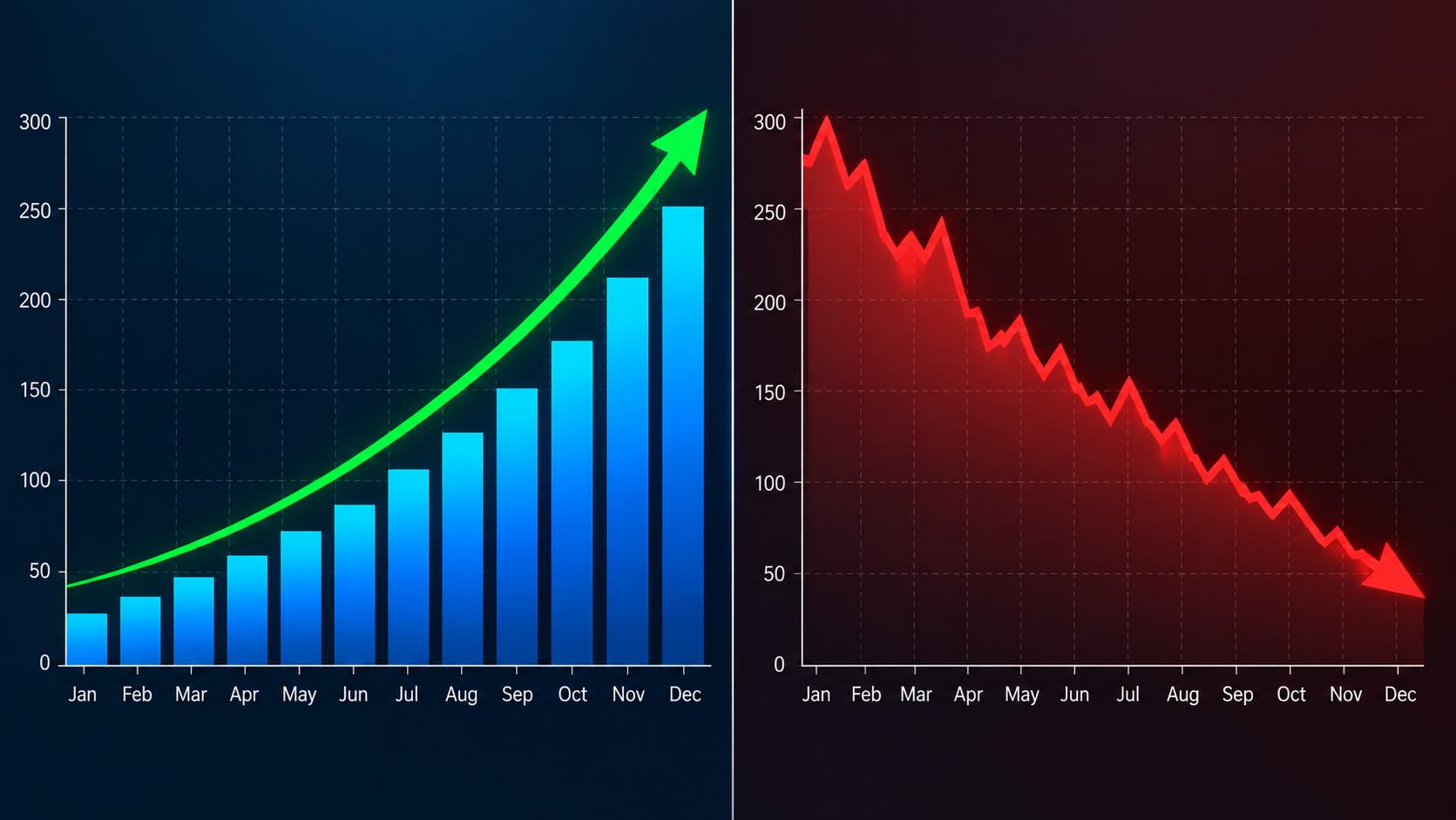
The short answer: Multiple compression occurs when a stock's valuation multiple, such as its price-to-earnings (P/E) ratio, declines. Even if earnings increase, the share price can fall when investors assign a sufficiently lower multiple to those earnings.
Understanding this relationship is essential because buying a growing business and buying its shares at an attractive price are two different decisions.
What Is Multiple Compression in Stock Valuation?
A valuation multiple compares a company's market value with a financial measure, such as earnings, sales or cash flow.
The P/E ratio is one of the most widely followed examples:
P/E Ratio = Share Price ÷ Earnings Per Share (EPS)
Suppose a company earns $5 per share and trades at $150. Its P/E ratio is 30.
Investors are effectively paying $30 for every $1 of annual earnings.
Now imagine the market becomes less optimistic about the company's future. Investors might decide that 30 times earnings is too expensive and become willing to pay only 20 times earnings.
That reduction from 30x to 20x is multiple compression.
Importantly, the company does not necessarily need to report falling profits for this to happen. A change in expectations, interest rates or perceived risk can reduce the valuation investors are prepared to accept.
How Can Earnings Grow While a Stock Price Falls?
Here is where the problem becomes clear.
Consider a hypothetical growth company:
| Financial Measure | Before | After |
|---|---|---|
| Earnings per share | $5 | $6 |
| P/E ratio | 30x | 20x |
| Share price | $150 | $120 |
Initially, the company earns $5 per share and trades at 30 times earnings.
Later, earnings increase to $6, representing 20% growth. However, its P/E ratio falls to 20.
The resulting share price is:
$6 EPS × 20 P/E = $120
The stock has declined from $150 to $120, a 20% price loss, despite 20% earnings growth.
This example excludes dividends and assumes the market applies the stated P/E multiples to the respective earnings figures.
The lesson is simple: business performance and stock performance are connected, but they are not identical. Investors can own a company that is improving financially while still losing money because they originally paid too much for its expected growth.
Why Do Valuation Multiples Fall?
Multiple compression can happen for several reasons. Interest rates are important, but they are not the only explanation.
1. Higher interest rates
When interest rates and bond yields rise, investors may demand a better potential return from stocks. Future earnings and cash flows become less valuable when discounted at a higher rate.
This can particularly affect growth companies whose expected profits are concentrated further into the future.
The Federal Reserve explains that asset prices reflect the discounted value of expected future payments. A higher discount rate can therefore reduce present valuations.
2. Expectations become less optimistic
A company might deliver strong earnings but still disappoint investors if results fall short of unusually high expectations.
For example, a business expected to grow earnings by 35% may report 22% growth. That is still impressive, but investors could lower the multiple because the growth outlook has weakened.
3. Business risks increase
Rising competition, regulatory pressure, weaker margins or uncertain demand can make future earnings less predictable. Investors may respond by paying a lower multiple.
4. The starting valuation is too expensive
Sometimes the biggest problem is not the business. It is the price investors paid.
A company trading at 40 times earnings has less room for disappointment than a similar business trading at 18 times earnings, assuming other factors are comparable.
How Do Interest Rates Affect Growth Stock Valuations?
Growth stocks can be especially sensitive to changes in interest rates because a significant portion of their expected value may depend on profits generated years into the future.
When discount rates rise, those distant cash flows are worth less in today's money.
Goldman Sachs Research has highlighted this relationship in its analysis of Treasury yields and equity valuations. Its September 2026 discussion noted that the S&P 500 forward P/E ratio had declined from 22x at the beginning of the year to 19x, with rising interest rates among the factors contributing to valuation pressure.
However, higher rates do not automatically mean every stock must fall. The reason behind the rate increase matters. Stronger economic growth can support corporate earnings, while rapidly rising yields driven by inflation or other financial concerns may create a tougher environment for valuations.
Investors should therefore examine both the direction of interest rates and the earnings outlook.
How Can Investors Identify Multiple Compression Risk?
No indicator can predict every valuation decline, but several checks can help investors understand the risk before buying.
- Check the current P/E ratio: Compare the valuation with the company's historical range and relevant industry peers.
- Examine earnings expectations: Ask whether projected growth is realistic and supported by revenue, margins and cash generation.
- Watch interest rates: Consider whether higher bond yields could pressure the valuation investors are willing to pay.
- Review business risks: Competition, debt, customer concentration and weaker profitability can reduce confidence in future earnings.
- Compare valuation with growth: A high P/E may be harder to justify if earnings growth is slowing.
- Consider different valuation measures: P/E alone may be misleading for companies with unusual earnings, significant debt or substantial non-cash expenses.
Investors should also remember that historical valuation ranges are not guaranteed fair-value estimates. A company may deserve a higher or lower multiple as its business model, risk profile and growth opportunities change.
Does Multiple Compression Always Mean a Bad Investment?
Not necessarily.
A declining valuation multiple can create an opportunity if the market becomes excessively pessimistic while the company's long-term earnings potential remains intact.
For example, a business trading at 30 times earnings might become available at 22 times earnings after a market-wide sell-off. If its competitive position, cash generation and growth prospects remain healthy, the lower valuation may deserve further research.
However, a falling multiple can also reflect genuine deterioration. Slowing demand, declining margins or an unsustainable business model should not be mistaken for a temporary market overreaction.
This is why valuation needs to be considered alongside business quality. Investors comparing apparently cheap stocks can also read our guide, Is a Low P/E Stock Really Cheap? 7 Things Investors Must Check Before Buying, which explains why a low earnings multiple does not automatically make a stock attractive.
TwikUp's Perspective
One of the easiest mistakes in investing is confusing a growing company with a guaranteed winning stock.
Earnings growth matters, but the valuation paid for that growth matters just as much. When expectations become too optimistic, even a healthy business can struggle to deliver attractive shareholder returns.
Investors should focus on three questions: How fast can earnings realistically grow? What price already reflects those expectations? And what happens to the investment if the market becomes less optimistic?
A strong company purchased at an excessive valuation can still produce disappointing returns. Sometimes, the biggest investment risk is not that the business stops growing. It is that investors stop paying a premium for that growth.
Disclaimer
This article is intended for educational and informational purposes only and does not constitute financial, investment or personalized investment advice. All company figures and calculations are hypothetical and do not represent actual business results. Valuation multiples depend on market conditions, earnings expectations, interest rates and company-specific risks. Investors should conduct independent research and consider their financial circumstances and risk tolerance before making investment decisions. TwikUp does not guarantee investment returns or recommend buying or selling any particular security.