
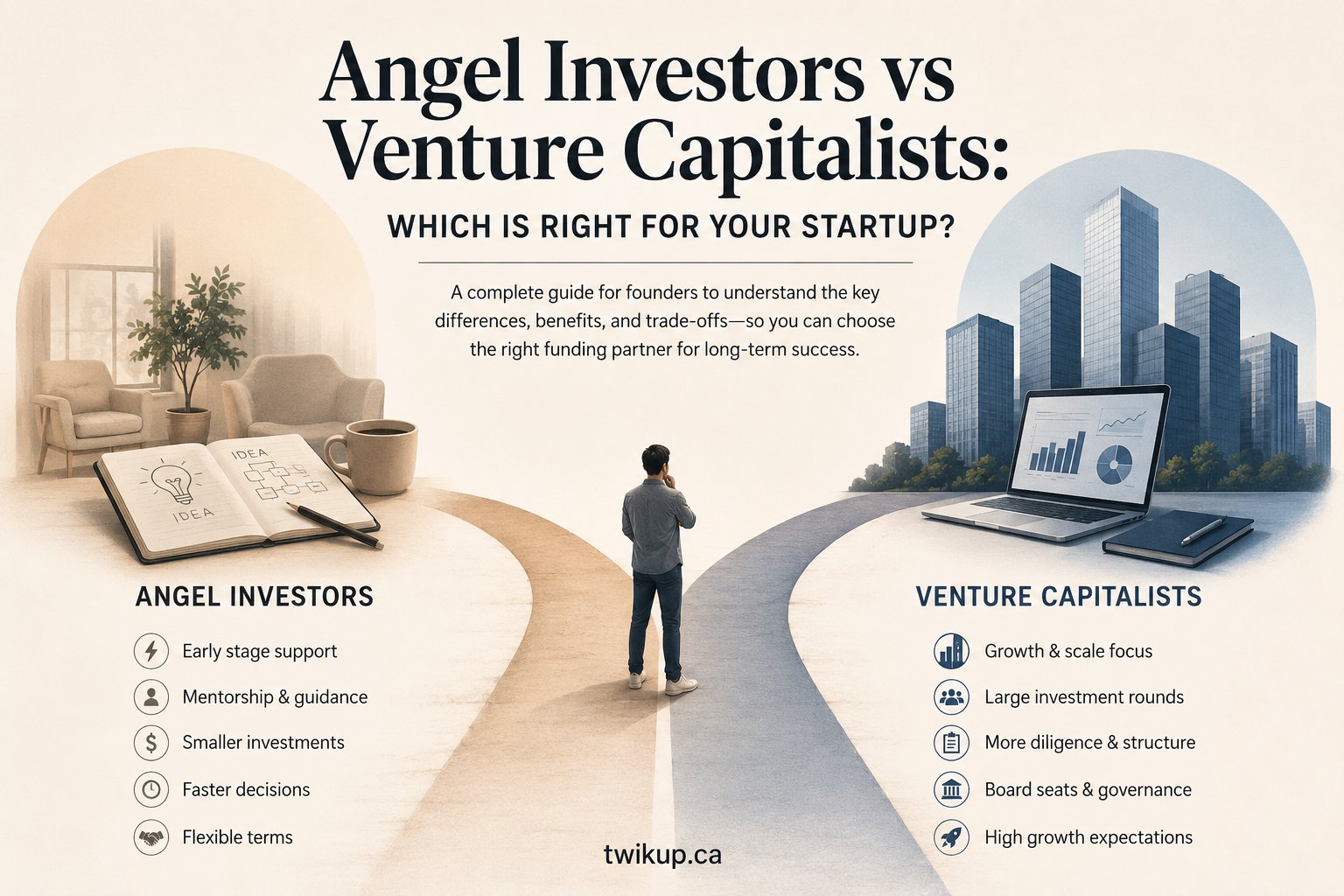
Key Takeaways
- Angel investors usually fund startups during the idea, prototype, or early revenue stage.
- Venture capital firms typically invest after startups demonstrate product-market fit and measurable growth.
- Angel investors invest their own money, while venture capitalists invest funds belonging to limited partners.
Angel Investors vs Venture Capitalists: Who Should You Trust With Your Startup?
Imagine two investors sitting across from you.
The first offers $100,000, promises to introduce you to potential customers, and says you can take your time figuring out what works.
The second offers $5 million, access to an impressive network, and enough money to hire an entire team. But there's a catch: they expect your company to grow into something enormous.
Which offer would you accept?
For many first-time founders, the $5 million cheque sounds like an obvious winner.
After all, more money means more employees, better technology, bigger marketing budgets, and fewer sleepless nights worrying about payroll.
Except there's one problem.
The investor offering the most money isn't necessarily offering the best deal.
A business that could comfortably become profitable with $100,000 might struggle under the expectations attached to a multimillion-dollar investment.
And a startup trying to compete in a global market might fail because it raised too little.
That's why understanding angel investors and venture capitalists isn't just about knowing where the money comes from. It's about understanding what happens to your business after the money arrives.
Angel Investors vs Venture Capitalists: What's the Actual Difference?
An angel investor is usually a wealthy individual investing personal money into a startup.
They might be a former entrepreneur, a successful executive, or someone who built and sold a business. Many invest early, sometimes before the startup has meaningful revenue.
A venture capitalist (VC), meanwhile, typically invests money managed through a professional investment fund.
That fund may be backed by pension funds, institutions, family offices, and wealthy investors. The VC firm's job is to invest that capital in companies capable of producing substantial returns.
Both want their investments to succeed.
But their financial structures often create different expectations.
| Category | Angel Investor | Venture Capitalist |
|---|---|---|
| Money invested | Usually personal wealth | Professionally managed fund |
| Typical investment | Thousands to hundreds of thousands | Hundreds of thousands to millions |
| Startup stage | Often pre-seed or seed | Pre-seed through growth |
| Decision-making | Often faster | Usually more structured |
| Main advantage | Early capital and mentorship | Larger funding and scaling support |
| Founder oversight | Often lighter | More formal governance possible |
| Follow-on funding | May be limited | Often greater capacity |
| Growth expectations | Vary by investor | Usually venture-scale |
| Best suited for | Early validation | High-growth opportunities |
These are common patterns, not universal rules. Some angel syndicates invest millions, while specialized VC funds make relatively small pre-seed investments.
The important difference isn't simply the cheque size.
It's what each investor needs your company to become.
Why $100,000 Could Be Better Than $5 Million
Consider two fictional founders.
Sarah is building software that helps independent restaurants manage inventory. She already has a working prototype and needs $100,000 to improve the product, attract paying customers, and test whether restaurants will actually use it.
Daniel is building an enterprise cybersecurity platform. His product works, several large companies are interested, and he needs millions to hire engineers, meet security requirements, and expand internationally.
Sarah may benefit from an angel investor who understands restaurant operations and can introduce her to business owners.
Daniel may benefit from a VC firm capable of financing rapid expansion and helping him recruit experienced executives.
Now imagine reversing their funding strategies.
Sarah raises $5 million before discovering whether customers are willing to pay. She hires aggressively, expands into several cities, and builds features nobody requested.
Daniel raises only $100,000. He has a promising product but cannot hire the specialists needed to serve major customers.
Both founders could struggle—not because their ideas were bad, but because their funding didn't match their business needs.
The right amount of capital is the amount that helps a startup reach its next meaningful milestone without creating unnecessary financial pressure.
And that brings us to something founders frequently underestimate: ownership.
The Hidden Cost of Raising Money: How Much of Your Company Are You Selling?
Suppose you build a startup valued at $2 million before receiving any investment.
An angel offers $100,000.
Your company's post-money valuation becomes $2.1 million, meaning the investor receives approximately 4.76% ownership.
You retain about 95.24%, assuming you owned the entire company beforehand.
Now consider a different offer.
A VC firm wants to invest $2 million at an $8 million pre-money valuation.
After the investment, your company is valued at $10 million, and the VC owns 20%.
You retain 80%, before accounting for any other shareholders or employee equity.
| Angel Deal | VC Deal | |
|---|---|---|
| Investment | $100,000 | $2 million |
| Pre-money valuation | $2 million | $8 million |
| Post-money valuation | $2.1 million | $10 million |
| Investor ownership | 4.76% | 20% |
| Founder ownership | 95.24% | 80% |
These are illustrative transactions, not market averages.
The VC deal gives you substantially more money and a higher valuation, but it also sells a larger percentage of the business.
Does that make it worse?
Not necessarily.
Owning 80% of a company worth $100 million is financially better than owning 95% of a company worth $5 million.
The question is whether the additional funding can realistically create that growth.
And equity isn't the only consideration.
Investors may negotiate liquidation preferences, protective provisions, board representation, and other rights that affect what founders ultimately receive or control.
TwikUp Insight: Selling part of your company isn't automatically a mistake. Selling ownership without a credible plan to create greater value is where the danger begins.
The Investor Who Gives You Money May Also Influence Your Decisions
Imagine you've spent three years building a profitable software company.
Revenue is growing steadily. Customers are happy. You have a small, capable team.
You want to expand carefully, protect profitability, and avoid unnecessary risks.
Your investor, however, wants you to enter five new markets, double hiring, and prioritize growth over short-term profits.
Suddenly, you and your investor disagree about what success should look like.
This is one of the most important differences between angel funding and venture capital.
An angel investing personal wealth may be comfortable with a relatively modest but profitable outcome. Another angel may demand aggressive growth.
A VC fund, meanwhile, usually needs a portfolio containing companies capable of producing exceptionally large returns.
Why?
Because many startup investments fail, and a relatively small number of winners often account for a substantial share of a venture fund's performance.
A business that becomes worth $20 million could be a life-changing success for its founder.
For a large VC fund, that same outcome may be financially insignificant.
Neither perspective is inherently wrong.
But combining two incompatible expectations can create serious problems.
Before accepting money, founders should understand whether the investor's definition of success matches their own.
What Do You Actually Get Besides the Money?
A good investor should contribute more than a bank transfer.
But the type of support you receive can differ significantly.
An experienced angel investor might help you avoid hiring mistakes, introduce your first customers, improve your pricing strategy, or explain why your original business model isn't working.
Imagine an angel who previously operated 50 restaurants investing in a restaurant software startup.
Their introductions and industry knowledge could be more valuable than their initial cheque.
A venture capital firm may offer a different advantage.
It might help recruit senior executives, introduce enterprise customers, prepare future fundraising rounds, or support international expansion.
Some VC firms also have dedicated teams for hiring, marketing, business development, and operational support.
However, having an impressive investor logo on your website doesn't guarantee meaningful assistance.
Before accepting an offer, ask the investor:
- Which companies have you helped solve problems similar to mine?
- Can I speak with founders you've previously funded?
- How involved will you be when the business struggles?
- Can you support future fundraising if we achieve our milestones?
Pay particular attention to the third question.
Almost every investor is supportive when revenue is rising.
The relationship becomes much more revealing when growth slows, customers leave, or the next funding round becomes difficult.
Why Some Great Businesses Should Never Raise Venture Capital
Here's something that gets lost in startup success stories.
A business doesn't need to become a billion-dollar company to be a remarkable success.
Imagine someone builds a niche software platform generating $2 million in annual revenue with $600,000 in annual profit.
The founder owns most of the company, employs a small team, and has no pressure to expand internationally.
That's a potentially excellent business.
But would a large VC fund necessarily want to invest?
Probably not, unless it sees a credible opportunity for substantially greater growth.
Venture capital is generally designed for businesses with the potential to scale dramatically.
That might include software platforms, biotechnology companies, advanced technology businesses, and other companies targeting large markets.
Other businesses—such as specialized agencies, regional services, niche software products, and profitable online businesses—may be better suited to angel funding, customer-funded growth, or bootstrapping.
Of course, companies in any of these industries can become venture-scale if their business models support it.
The distinction is about growth potential, not the industry label.
And remember: venture capital isn't free money.
A company that raises a large round may eventually need additional rounds, increasing valuations, and a significant exit to satisfy investor expectations.
That path can create extraordinary businesses.
It can also encourage companies to pursue growth before they've built a sustainable foundation.
TwikUp Insight: Founders sometimes chase venture capital because raising money looks like success. But a profitable business that never raises a dollar may create more lasting wealth for its owner than a heavily funded startup that eventually fails.
So Which Investor Is Right for Your Startup?
Instead of asking which investor is more prestigious, consider three situations.
Situation 1: You have an idea but very little proof it works.
You've identified a problem, built an early prototype, and spoken with potential customers. You need enough money to test demand.
An angel investor, accelerator, or specialized pre-seed fund may be appropriate.
Your priority is proving the business works—not building a large organization.
Situation 2: Customers are paying, but growth requires more capital.
Your product has traction. Customers keep coming back, and you understand how to acquire more of them.
Now you need funding to expand your team, improve infrastructure, and reach new markets.
A seed-stage VC firm or a larger angel syndicate may be a reasonable fit.
Your priority is demonstrating that growth can be repeated efficiently.
Situation 3: Your business is profitable, and you don't need outside money.
You have steady revenue, satisfied customers, and enough cash to finance expansion.
In this situation, the best investor might be no investor at all.
Bootstrapping allows founders to retain ownership and make decisions without external shareholder pressure.
That doesn't mean avoiding investors forever.
It means raising capital only when it offers a compelling advantage over growing independently.
The Final Decision: Bigger Cheque or Better Partner?
Angel investors and venture capitalists can both help build extraordinary companies.
Angels often provide the early capital, experience, and flexibility founders need when their ideas are still unproven.
VC firms can provide the resources and institutional support required to build companies operating at a much larger scale.
But neither funding model guarantees success.
An angel can become a difficult shareholder. A VC can become an exceptional long-term partner. And a startup with the wrong investor can struggle even when the business itself is promising.
The smartest founders don't automatically choose the investor offering the most money or the highest valuation.
They choose funding that matches the company they're trying to build.
Because the goal isn't to win the fundraising announcement.
It's to build a business worth owning after the fundraising is over.
Continue to Part 2
In Part 2, we explore the practical side of fundraising: how to approach investors, what makes them reject startups, the Canadian funding landscape, common fundraising mistakes, and a checklist to help founders evaluate their options.