
Key Takeaways
- A bank draft is drawn against the issuing bank's own account, while a certified cheque remains the customer's cheque.
- Both methods provide stronger payment assurance than an ordinary personal cheque, but their availability and handling procedures differ.
- The recipient's requirements should determine which instrument you request, particularly for property transactions and other major purchases.
Bank Draft vs Certified Cheque: What Is the Difference?
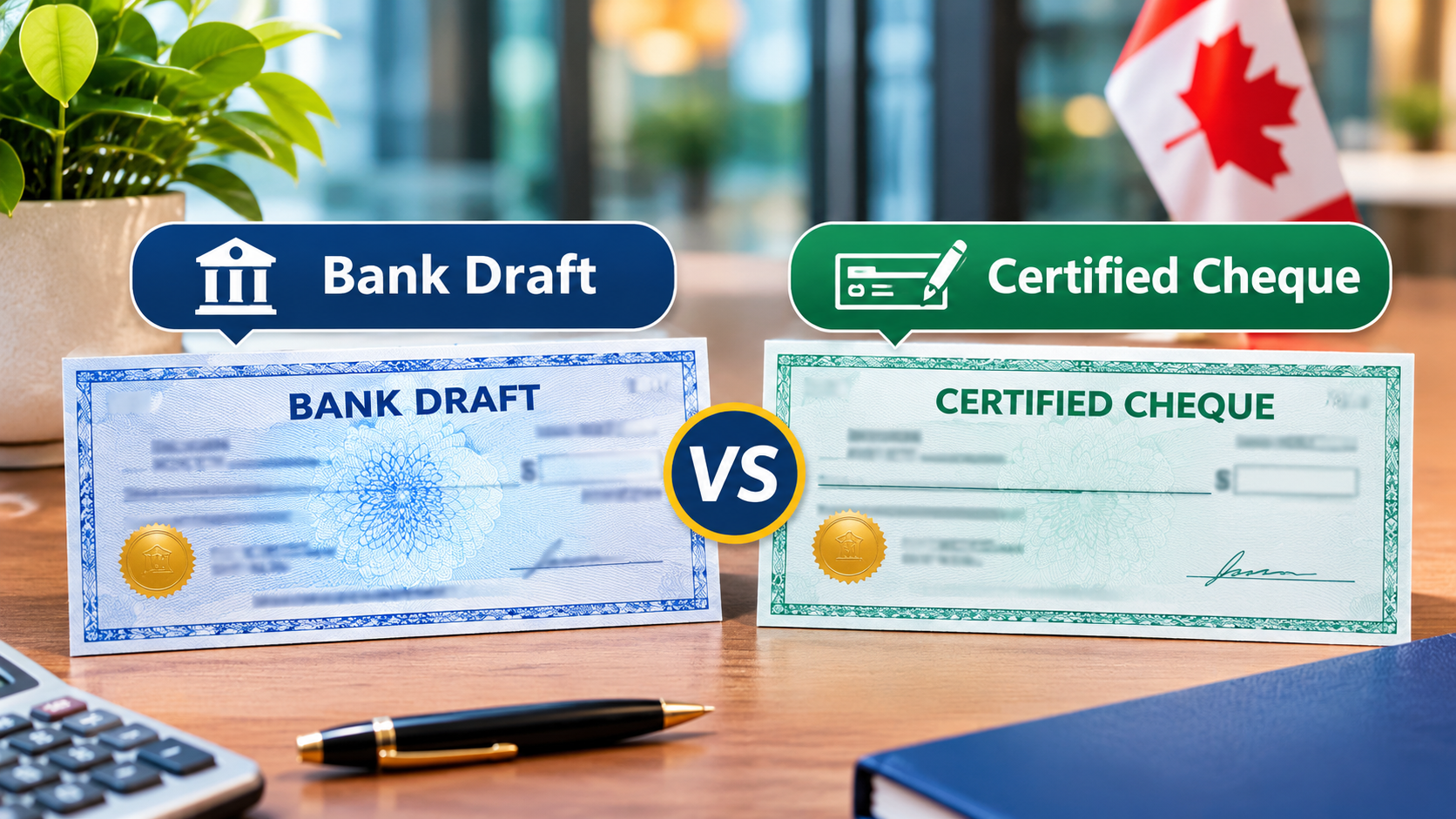
A bank draft and a certified cheque are both used when a recipient wants greater payment assurance than an ordinary personal cheque provides. However, they are not the same instrument.
The main difference is who issues the payment. A bank draft is drawn by the financial institution against its own account. A certified cheque is the customer's cheque that the bank verifies and certifies, confirming that the required funds are available.
Payments Canada recognises these as separate payment instruments. The distinction matters because it affects how the payment is prepared, how money is handled in the customer's account and which services a bank offers.
How Does a Bank Draft Work?
When you request a bank draft, your financial institution prepares a payment document for a specified amount and named recipient. The bank takes the required money from your account and holds it separately so that the funds are available when the draft is presented.
For example, imagine you need to pay a property seller $25,000. You ask your bank to issue a draft payable to the seller. The bank withdraws $25,000 from your account, prepares the document and gives it to you to deliver.
Because the draft is drawn against the bank's own account, the recipient does not rely on an ordinary personal cheque backed by your remaining account balance.
Bank drafts are commonly used for property transactions, vehicle purchases and other large payments. You generally request one through your bank, often at a branch. The bank may require identification, the exact payment amount and the recipient's full legal name.
How Does a Certified Cheque Work?
A certified cheque starts as a cheque drawn on the customer's account. The financial institution checks the account and certifies the cheque, confirming that the required funds are available.
The bank then protects the amount according to its certification procedure. Depending on the institution, the money may be placed on hold or withdrawn from the customer's available balance.
Consider a customer who needs to pay a contractor $8,000. Instead of requesting a bank draft, the customer writes a cheque for that amount and asks the bank to certify it. The certified document provides the contractor with stronger assurance that the payment is backed by the bank's verification.
However, certified cheques are not offered by every financial institution. Some banks have reduced or discontinued this service, so customers should confirm availability before relying on it.
Bank Draft vs Certified Cheque: Key Differences
| Comparison | Bank Draft | Certified Cheque |
|---|---|---|
| Issued by | Financial institution | Customer, then certified by bank |
| Drawn against | Bank's own account | Customer's account |
| Funds | Withdrawn and held by bank | Protected through bank's certification process |
| Availability | Commonly offered | Not available at every bank |
| Typical use | Large payments | Payments requiring a certified customer cheque |
| Fees | Vary by institution and account | Vary by institution and account |
Both instruments are designed to provide payment assurance. Neither should be confused with an ordinary personal cheque.
Which Option Should You Use?
A bank draft is often the more practical choice when you are paying a large amount and the recipient specifically requests one. It is commonly used for real estate transactions, vehicle purchases and payments where the recipient wants a document issued directly by a financial institution.
A certified cheque can make sense when the recipient accepts it and your bank still provides certification services. It may be convenient if you already have a cheque account and the required payment amount available.
Before choosing, ask the recipient exactly what they will accept. A real estate lawyer, dealership, landlord or business may have its own payment instructions. Choosing the wrong instrument could delay a transaction even when you have enough money.
What Do Bank Drafts and Certified Cheques Cost?
There is no single fee across Canadian banks. Charges depend on the institution, account package, currency and service requested.
For example, TD's published fee schedule lists a $9.95 bank draft charge for the savings accounts shown on its fee page. This is one institution's published example, not a nationwide price. Account packages may also include fee waivers.
Certified cheque charges should be checked separately because certification may be priced differently from issuing a draft. Ask your bank about the fee, branch requirements, identification and processing time before arranging the payment.
Can These Payments Be Cancelled or Forged?
Neither instrument should be treated as risk-free. A genuine bank draft or certified cheque provides payment assurance, but a counterfeit document can imitate one.
If you receive a draft or certified cheque, verify it with the issuing financial institution before releasing valuable goods or completing an important transaction. Use contact details obtained independently, rather than relying only on a telephone number printed on the document.
If your own bank draft is lost, stolen or damaged, contact the issuing institution immediately. It will explain its replacement or recovery procedure. Do not assume that you can simply stop or cancel the payment like an ordinary cheque.
The Canadian Anti-Fraud Centre also warns about fraudulent cheques deposited by victims who are then asked to forward money before the original payment has cleared.
TwikUp's Perspective: Let the Recipient Set the Payment Rules
The cheapest payment instrument is not necessarily the best one if it creates delays during an important transaction. A buyer arranging a vehicle purchase, for example, should confirm the dealership's payment instructions before withdrawing money or requesting a bank document.
For larger transactions, timing and verification deserve as much attention as the fee. It is also worth planning ahead so that money needed for an upcoming purchase is not locked into an investment with an inconvenient maturity date. Our guide to GIC Ladder Strategy Canada: How to Earn Interest Without Locking Away Savings explains how staggered GIC maturity dates can help savers plan access to their money.
Confirm the exact payee name, payment amount and delivery arrangements in writing. Keep the receipt and the draft's purchase record separately, especially when the document will change hands before the transaction is complete.
Disclaimer
This article provides general educational information about Canadian banking and payment instruments. Bank policies, fees, certification procedures and cancellation or replacement requirements vary. Confirm the applicable terms directly with your financial institution and recipient before making a payment.