
Key Takeaways
- Never ignore required minimum payments while building savings or making extra debt repayments.
- High-interest credit card balances usually deserve priority once you have a basic emergency cushion.
- Your repayment and savings balance should reflect income stability, essential expenses and the risk of needing to borrow again.
You Have $500 Left. Your Credit Card and Savings Account Both Want It.
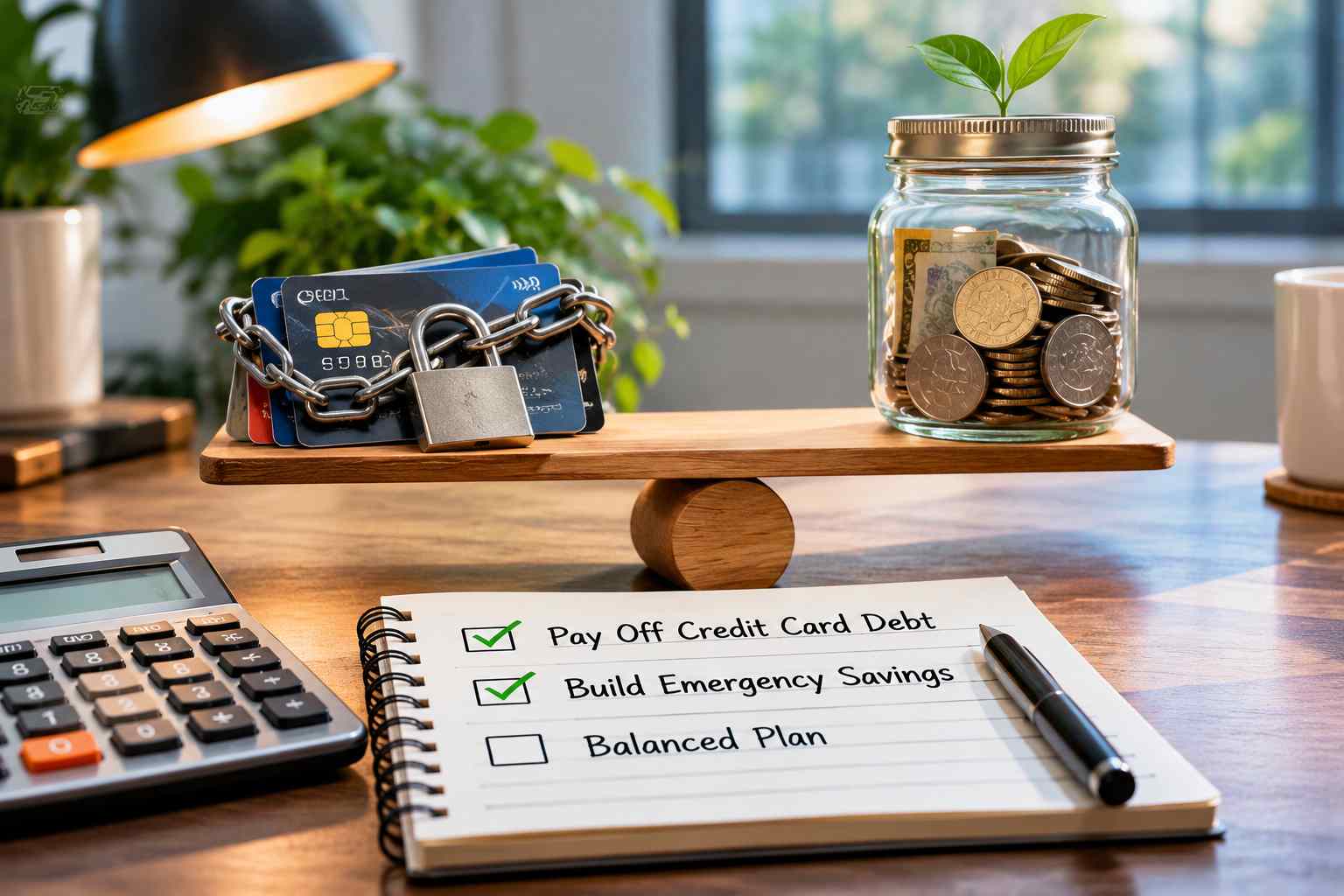
You have $500 left after paying your bills. Your credit card balance is growing because of interest, and your savings are too low for comfort. Should you pay off your credit card or save money first?
For many households, the most practical answer is to do both — but not equally.
Keep required payments current, build a small emergency reserve, then direct most extra money to high-interest debt before expanding your savings. This balanced approach helps you make progress without leaving yourself exposed to the next unexpected expense.
Why Paying Off Debt Isn't Always the First Move
Debt repayment offers a financial benefit because it reduces the interest charged on your outstanding balance. Savings offer a different kind of benefit because they reduce the chance that an emergency will push you further into debt.
Bankrate's 2026 US survey found that 29% of Americans had more credit card debt than emergency savings. In the same survey, 31% said they had no credit card debt but also had no savings.
Using every available dollar to repay debt can leave you vulnerable to a car repair, medical bill, or income drop. Relying on a credit card again may simply restart the cycle. Similarly, keeping too much cash in a low-return savings account while high-interest debt compounds may increase your total cost.
The 24% vs. 4% Problem: Compare Credit Card Interest With Savings Returns
Start by comparing the interest rate on your card with the return on your savings account.
Imagine you have $1,000 available. Your credit card charges 24% annual interest, while your savings account earns 4%. The difference between the two rates may be more important than the dollar amounts themselves.
As a simplified illustration:
- $1,000 of debt at 24% represents about $240 in annual interest if the balance remains unpaid for a year.
- $1,000 in savings earning 4% would return about $40.
These figures are not predictions. They show why comparing interest rates can be a helpful starting point when deciding where extra money should go.
Actual credit card interest depends on payment timing, daily balances, fees, and card terms. Savings interest is calculated differently and may vary with account type and promotional offers.
Build a Basic Emergency Cushion Before Aggressive Repayment
Before sending every spare dollar to your credit card, consider what would happen if your car needed repairs or your income dipped. A basic emergency reserve gives you money to handle smaller surprises without immediately borrowing again.
A widely suggested starter range is $500 to $1,000. However, the amount depends on your essential expenses, income stability, and access to other support. This cushion is not a replacement for a longer-term fund. Instead, it protects your debt-repayment plan from being interrupted by a minor setback.
If your income is irregular, you support dependants, or your job is uncertain, keeping a larger cash buffer may be appropriate. If your income is steady and expenses are low, a smaller cushion may be reasonable.
Do not confuse this initial cushion with a fully funded three-to-six-month emergency fund. You can build that larger reserve after your highest-interest balances are under control.
Avalanche or Snowball: Which Credit Card Debt Should You Pay First?
Once your basic cash reserve is in place, focus on the interest rates attached to your balances.
The Debt Avalanche Method
The debt avalanche method directs extra payments toward the card with the highest interest rate while keeping minimum payments current on the others. This approach may reduce total interest over time.
The Debt Snowball Method
The debt snowball method starts with the smallest balance. Clearing one account quickly can create momentum and make progress feel more achievable.
If your main goal is reducing borrowing costs, the avalanche method is usually the stronger mathematical choice. If staying motivated is the bigger challenge, the snowball method may be more practical. Neither strategy works particularly well if you're continually adding new balances.
Canada and USA: What Should You Know?
In Canada
In Canada, the Financial Consumer Agency of Canada recommends listing debts, interest rates, and minimum payments before choosing a repayment strategy. It also encourages people to understand their payment options and seek help early if they are struggling.
Canadian cardholders can also use the FCAC's credit card payment calculator to compare how different payment amounts and timelines affect the cost of carrying a balance.
In the United States
In the United States, the Consumer Financial Protection Bureau explains that missing a minimum payment can lead to a late fee and harm your credit score. It also provides tools to compare credit cards and understand how interest accumulates over time.
The exact terms depend on your card agreement and local rules. Don't assume that Canadian and American protections are identical.
A Simple 5-Step Plan for Balancing Both Goals
Use this sequence when money is limited:
- Cover essential living costs and keep every required debt payment current.
- Set aside a manageable emergency reserve based on your immediate risks.
- Stop adding avoidable purchases to cards carrying balances.
- Put most remaining extra money toward the highest-interest card.
- Review your budget regularly and increase savings contributions as debt falls.
If you cannot afford even the minimum payment, contact your card issuer promptly. Ask whether a temporary hardship program or adjusted payment plan is available. How Much Emergency Savings Do You Really Need? Calculate Your 3–6 Month Target explains how to size your first safety net, and How Much Money Should You Save Each Month? A Realistic Canadian Guide shows how to set a monthly target you can sustain.
The Twikup Take
Start by comparing the interest rate on your card with the return on your savings account. Understand how the difference affects your total cost, build a small emergency cushion, and then focus extra payments on the highest-interest balance. In this way, you protect yourself against short-term emergencies while steadily reducing the cost of your debt. Read How Much Emergency Savings Do You Really Need? Calculate Your 3–6 Month Target to calculate your own target before deciding how much extra to send to your card.
Disclaimer This article is for general educational purposes only and is not individualized financial, credit or debt-management advice. Interest rates, fees, repayment terms and consumer protections vary by financial institution and country.