
Quick Answer
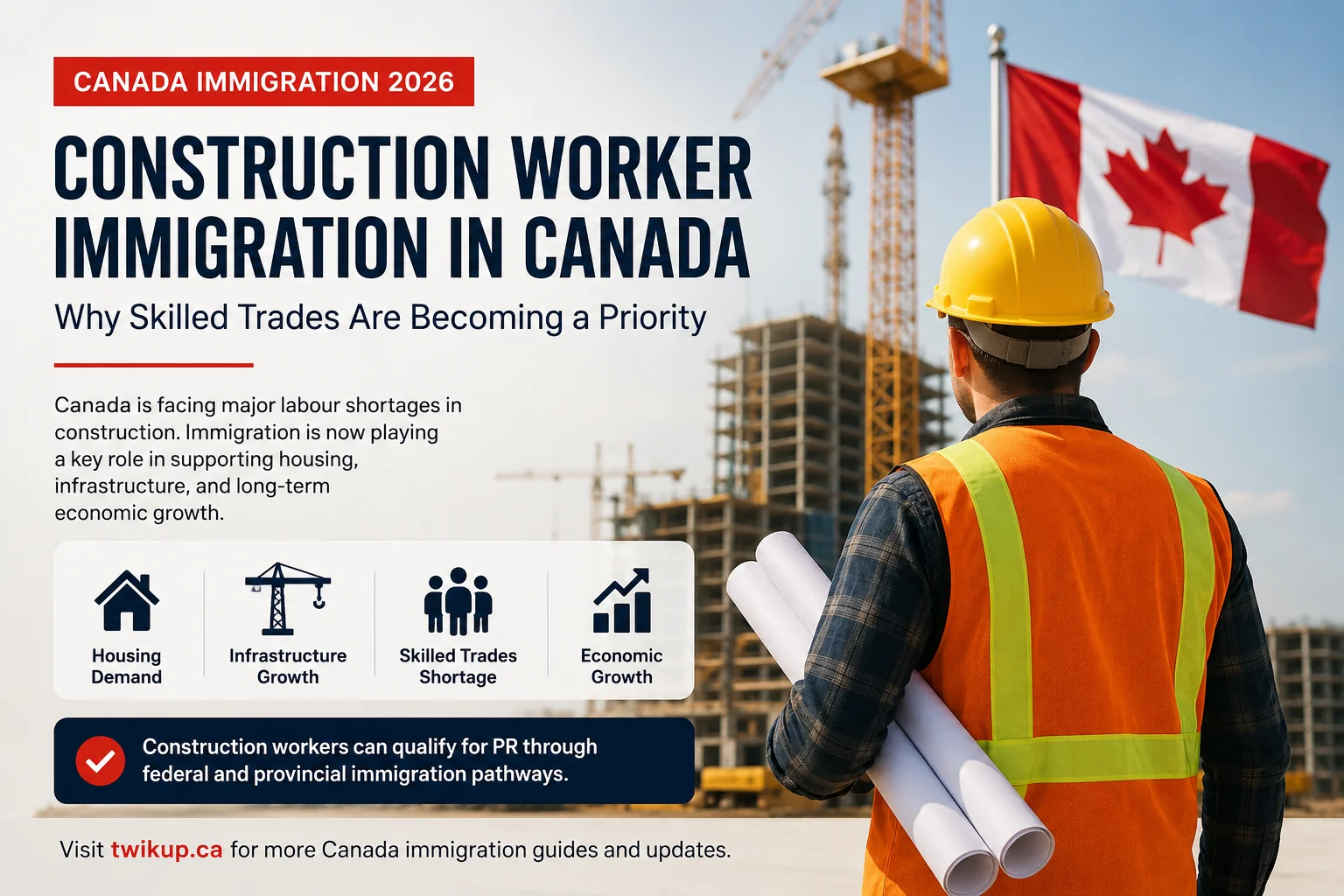
Canada does not currently have a standalone permanent residence (PR) program exclusively for construction workers. However, skilled trades are becoming an increasingly important immigration priority as Canada works to address housing shortages, infrastructure projects, and labour gaps. Construction workers may qualify for permanent residence through existing federal and provincial immigration pathways, depending on their occupation, work experience, and eligibility.
Twikup Insight
Canada's immigration strategy is shifting beyond simply increasing newcomer numbers. Increasingly, immigration is being used to solve specific economic challenges, with housing supply sitting at the centre of that conversation.
Construction workers are among the occupations that directly influence Canada's ability to build homes, complete infrastructure projects, and support economic growth. While there is no dedicated "Construction Worker PR Program," future immigration policies are expected to continue favouring occupations that address critical labour shortages.
For workers already living and working in Canada, this means keeping a close eye on both federal and provincial immigration announcements could become increasingly important.
| Date | Invitations | CRS Cut-off | Category |
|---|---|---|---|
| April 2, 2026 | 3,000 | 477 | Trades Occupations (includes many eligible construction trades) |
Which Construction Jobs Are Most Needed in Canada?
While labour demand varies by province, skilled trades remain essential across Canada's construction sector. Common occupations include:
- Carpenters
- Electricians
- Plumbers
- Welders
- Heavy equipment operators
- Bricklayers
- Roofers
- Concrete finishers
- Construction estimators
- Construction supervisors
Demand can differ significantly between provinces, making provincial immigration programs an important consideration for many applicants.
If you're comparing where opportunities may be strongest, our guide to Provinces Offering the Most Immigration Opportunities explains how provincial demand differs across Canada:
Which Immigration Pathways Can Construction Workers Use?
Although there is no construction-specific PR stream, eligible workers may qualify through existing immigration programs depending on their occupation, work experience, language ability, and province.
Potential pathways include:
- Express Entry
- Provincial Nominee Programs (PNPs)
- Skilled Trades pathways
- Employer-supported immigration streams
- Regional immigration programs
If you're unsure which option may fit your situation, see our guide:
Top 10 Fastest Immigration Pathways to Canada Right Now
https://twikup.ca/immigration/pr-pathways/top-10-fastest-immigration-pathways-to-canada-right-now
Can Temporary Foreign Workers Become Permanent Residents?
Yes.
Many construction workers first arrive in Canada on temporary work permits before eventually applying for permanent residence through federal or provincial programs.
Applicants who already have Canadian work experience may have additional immigration options available depending on their circumstances.
If you're currently studying or working in Ontario after graduation, our complete guide explains how many workers transition from temporary status to permanent residence:
PGWP to PR in Ontario: Complete Pathways Explained
https://twikup.ca/immigration/pr-pathways/pgwp-to-pr-in-ontario-complete-pathways-explained-for-2026
Why Housing Is Driving Immigration Policy
Canada continues to face significant housing supply challenges.
Several factors are increasing demand for skilled construction workers:
- Population growth
- Housing shortages
- Major infrastructure investments
- Retirement of experienced trades workers
- Ongoing labour shortages across skilled trades
Because of this, immigration policy is increasingly being aligned with workforce needs rather than population growth alone.
Construction workers play an important role in helping Canada meet long-term housing and infrastructure goals.
How Province Choice Can Affect Your PR Journey
Not every province experiences the same labour shortages.
Some provinces actively recruit skilled workers based on regional economic needs, while others focus on specific occupations.
Comparing provincial immigration opportunities before applying can significantly improve your chances of success.
You may also find these guides helpful:
Easiest Province to Get Canada PR in 2026
Canada PR in 2026: What CRS Score Is Really Needed
https://twikup.ca/canada/economy/canada-pr-in-2026-what-crs-score-is-really-needed
Construction Workers and Express Entry
Some construction occupations may qualify under federal immigration programs depending on the occupation, eligibility criteria, and future category-based selection priorities announced by Immigration, Refugees and Citizenship Canada (IRCC).
Applicants should regularly monitor official government announcements since eligibility requirements and selection priorities can change.
At a Glance
| Question | Answer |
|---|---|
| Dedicated Construction PR Program? | No |
| Construction Labour Shortage? | Yes |
| Housing Linked to Immigration? | Yes |
| Can Temporary Workers Become PR? | Often possible through existing pathways if eligible |
| Provincial Programs Available? | Yes |
| Should Province Selection Matter? | Absolutely |
Related Immigration Guides
If you're exploring different immigration options, these Twikup guides may also help:
-
Top 10 Fastest Immigration Pathways to Canada Right Now
https://twikup.ca/immigration/pr-pathways/top-10-fastest-immigration-pathways-to-canada-right-now -
Easiest Province to Get Canada PR in 2026
https://twikup.ca/immigration/pr-pathways/easiest-province-to-get-canada-pr-in-2026-lowest-crs-scores-best-provinces-compared -
Canada PR in 2026: What CRS Score Is Really Needed
https://twikup.ca/canada/economy/canada-pr-in-2026-what-crs-score-is-really-needed -
Provinces Offering the Most Immigration Opportunities
https://twikup.ca/immigration/provincial-nominee-program/provinces-offering-the-most-immigration-opportunities -
Ontario PR for Software Engineers
https://twikup.ca/immigration/pr-pathways/ontario-pr-for-software-engineers-eligibility-and-pathways-in-2026 -
BC PNP Tech Immigration Guide
https://twikup.ca/immigration/pr-pathways/bc-tech-stream-complete-guide-to-bc-pnp-tech-immigration-in-2026 -
Best Province for Truck Drivers in Canada
https://twikup.ca/immigration/pr-pathways/best-province-for-truck-drivers-in-canada-2026-alberta-vs-ontario-vs-manitoba-vs-saskatchewan-compared
FAQ
Is there a dedicated construction worker PR program?
No. Canada currently does not offer a permanent residence program exclusively for construction workers. Eligible applicants typically apply through existing federal or provincial immigration pathways.
Can construction workers apply through Express Entry?
Depending on their occupation and eligibility, some construction workers may qualify through Express Entry or other federal immigration pathways.
Which provinces hire the most construction workers?
Demand varies by province and economic conditions. Provincial Nominee Programs often target occupations experiencing local labour shortages.
Can temporary foreign construction workers become permanent residents?
Many temporary foreign workers successfully transition to permanent residence after gaining eligible Canadian work experience and meeting program requirements.
Why is Canada prioritizing construction workers?
Canada needs more skilled trades workers to support housing construction, infrastructure projects, and long-term economic growth.
Sources
-
Immigration, Refugees and Citizenship Canada (IRCC) – Newsroom
https://www.canada.ca/en/immigration-refugees-citizenship/news.html -
Immigration, Refugees and Citizenship Canada – Express Entry
https://www.canada.ca/en/immigration-refugees-citizenship/services/immigrate-canada/express-entry.html -
Immigration, Refugees and Citizenship Canada – Provincial Nominee Program
https://www.canada.ca/en/immigration-refugees-citizenship/services/immigrate-canada/provincial-nominees.html -
Government of Canada – Housing Action Plan
https://www.canada.ca/en/department-finance/news/2024/04/solving-the-housing-crisis-canadas-housing-plan.html -
Government of Canada – Job Bank Labour Market Information
https://www.jobbank.gc.ca/ -
Prime Minister of Canada – News Releases
https://www.pm.gc.ca/en/news