
A founder has $18,000 in savings, three early customers, and a product that still breaks every Friday afternoon.
An investor offers $750,000.
The offer sounds like success. The founder could hire developers, launch a major marketing campaign, move faster than competitors, and finally stop using a personal credit card to pay software bills.
But the investment comes with conditions: ownership dilution, a board seat, aggressive growth targets, regular reporting, and the expectation that the company will eventually deliver a major financial return.
Should the founder take the money?
There is no universal answer.
Some startups become stronger because venture capital allows them to scale before competitors catch up. Others raise too early, spend too quickly, lose strategic freedom, and discover that they built a company designed for investors rather than customers.
Meanwhile, bootstrapped founders preserve ownership and control—but may move slowly, miss market opportunities, exhaust their savings, or become trapped doing everything themselves.
The real question is not whether bootstrapping is better than venture capital.
The real question is:
What type of company are you building, how quickly must it grow, and what risks are you prepared to accept?
Quick Answer
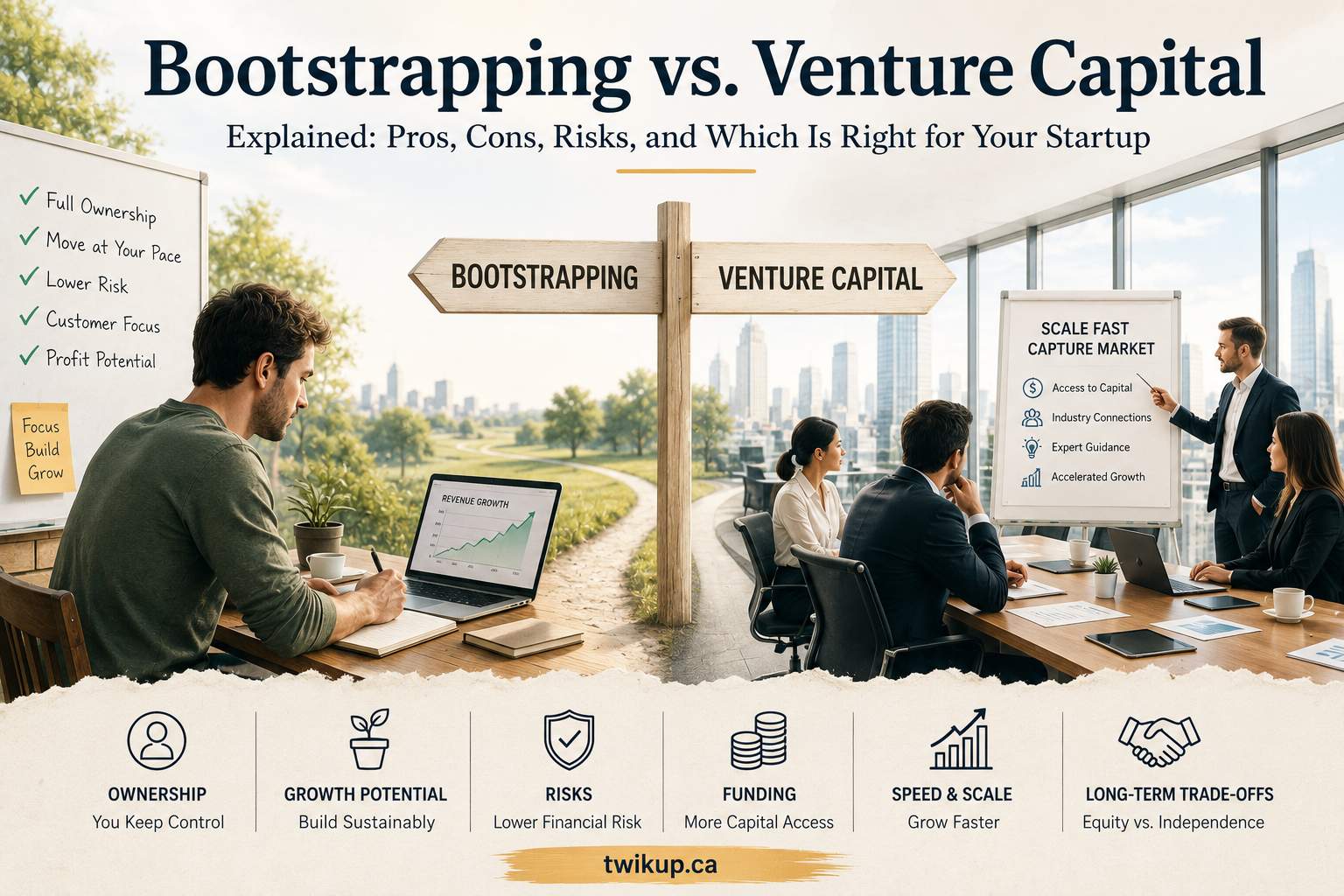
Bootstrapping means building a startup primarily with the founder’s own money, customer revenue, reinvested profits, or limited non-equity financing. It allows founders to retain more ownership and control, but usually provides less capital and may slow growth.
Venture capital means raising money from professional investors in exchange for equity. It can help a startup hire faster, build technology, enter markets, and pursue rapid growth—but founders give up ownership, accept investor expectations, and often place the company on a high-growth path that requires a significant future exit.
Bootstrapping may be the better choice when:
- The startup can begin with limited capital.
- Customers can generate revenue early.
- Growth can be funded through cash flow.
- The founder values control and long-term independence.
- The market does not require immediate scale.
Venture capital may be more appropriate when:
- The opportunity is extremely large.
- Speed is essential.
- Product development requires substantial upfront investment.
- The company must build infrastructure before earning meaningful revenue.
- Competitors are aggressively funded.
- The business could realistically produce venture-scale returns.
Many founders should not treat the decision as permanent. A startup can bootstrap through validation, build evidence of demand, and raise capital later from a stronger negotiating position.
TwikUp Insight
The biggest mistake founders make is comparing bootstrapping and venture capital as though they are simply two different ways to obtain money.
They are often two different ways to build a company.
A bootstrapped company is usually designed around:
- Capital efficiency
- Early revenue
- Sustainable operations
- Founder control
- Flexible growth
- Long-term profitability
A venture-backed company is usually designed around:
- Rapid expansion
- Market leadership
- Large addressable markets
- Aggressive hiring
- Repeated fundraising
- A future acquisition, public offering, or other liquidity event
Neither path is automatically superior.
However, the wrong financing model can create a dangerous mismatch.
A founder may raise venture capital for a business that could become profitable but never large enough to satisfy a venture fund. Another founder may bootstrap a capital-intensive opportunity and move so slowly that a better-funded competitor captures the market.
The best financing decision begins with the business model—not with the prestige attached to raising money.
What Does Bootstrapping a Startup Mean?
Bootstrapping means building a company without relying heavily on outside equity investors.
The founder may finance the business through:
- Personal savings
- Income from another job
- Customer payments
- Pre-orders
- Consulting or service revenue
- Reinvested profits
- Friends-and-family support
- Grants or government programs
- Loans or lines of credit
- Crowdfunding
Bootstrapping does not always mean that no external money is used.
A founder who uses a small business loan, government support program, or customer prepayment may still be considered bootstrapped if outside investors do not own a meaningful portion of the company.
The defining characteristic is usually ownership.
The founders maintain control because they have not sold a significant equity stake to professional investors.
A Simple Bootstrapping Story
Imagine two software developers who build an appointment-management tool for dental clinics.
Instead of raising money immediately, they contact 30 local clinics and convince four to pay for an early version. The product is imperfect, so the founders manually complete several tasks behind the scenes.
The first customers generate $1,200 per month.
That revenue pays for hosting and software tools. The founders continue working evenings while improving the product. After one year, the business earns $12,000 per month. They hire a part-time support employee and begin paying themselves modest salaries.
Growth is slower than it might have been with a large investment. But the founders still own the company and understand exactly what customers are willing to purchase.
That is bootstrapping at its best: customers finance the development of a business they genuinely need.
What Is Venture Capital?
Venture capital is equity financing generally provided to startups and young companies believed to have substantial growth potential.
A venture capital firm raises money from outside investors and deploys that capital into a portfolio of companies. In exchange for funding, the firm receives shares or another form of ownership interest.
Unlike a traditional business loan, venture capital generally does not require fixed monthly repayment.
But that does not make the money free.
The startup gives investors:
- Ownership
- Certain legal rights
- Financial information
- Influence over major decisions
- An expectation of substantial future growth
- A potential return through an acquisition, share sale, or public listing
Venture capital investors are not normally looking for a stable business that produces modest annual profits indefinitely. Their investment model generally depends on a smaller number of major winners compensating for investments that fail or return little.
This is why venture investors may like a founder, admire a product, and still refuse to invest. The opportunity may be good—but not large enough for the fund’s return requirements.
Read more: Why Investors Say No Even When They Like Your Startup
A Simple Venture Capital Story
Now imagine a startup developing software that helps large manufacturers reduce energy consumption across hundreds of facilities.
The founders have several pilot customers, but the product requires:
- A larger engineering team
- Enterprise-grade cybersecurity
- Regulatory expertise
- International sales staff
- Complex integrations
- Years of product development
Bootstrapping could take too long. Major competitors are already entering the market, and customers expect sophisticated capabilities before signing large contracts.
The startup raises $4 million from a venture capital fund.
The money gives it the ability to hire quickly and compete for major enterprise customers. But the company must now pursue much faster growth. The founders report to a board, manage a formal budget, and prepare for another financing round before the cash runs out.
The investment did not merely strengthen the balance sheet.
It changed the company’s speed, expectations, governance, and definition of success.
Bootstrapping vs. Venture Capital: The Core Difference
The basic difference appears simple:
- Bootstrapping uses founder resources and customer-generated cash.
- Venture capital exchanges ownership for investor money.
But the deeper distinction is the kind of pressure each model creates.
Bootstrapped companies primarily face cash-flow pressure.
Venture-backed companies face cash-flow pressure and growth pressure.
A bootstrapped founder may ask:
Can we remain profitable while growing 25% this year?
A venture-backed founder may be expected to ask:
What resources are required to grow several times faster and become the category leader?
The following comparison shows how the two approaches differ.
| Factor | Bootstrapping | Venture Capital |
|---|---|---|
| Primary funding | Founder money and revenue | Outside equity investors |
| Ownership | Founders retain more | Founders are diluted |
| Control | Usually greater | Shared with investors and board |
| Growth speed | Often measured | Often aggressive |
| Financial discipline | Typically high from the beginning | Can be delayed by abundant capital |
| Personal financial risk | May be substantial | May be lower after funding |
| Reporting | Informal or internally determined | Formal investor and board reporting |
| Exit pressure | Usually limited | Often significant |
| Market expectations | Profitability or sustainability | Large-scale growth and returns |
| Fundraising time | Usually minimal | Can consume months |
| Ability to pivot | Often high | May require investor alignment |
| Failure pattern | Running out of personal or operating cash | Running out of investor-funded runway |
The Advantages of Bootstrapping
1. You Retain More Ownership
Ownership is one of the most obvious benefits of bootstrapping.
Suppose two founders each own 50% of a startup. After several fundraising rounds, employee option grants, and investor dilution, their combined ownership may fall substantially.
That is not necessarily bad. Owning a smaller part of a much larger company can produce a better financial outcome than owning all of a small one.
But dilution matters.
It affects:
- Economic returns
- Voting power
- Control over major decisions
- Board influence
- Negotiating leverage
- The founder’s ability to reject an acquisition or financing proposal
A bootstrapped founder usually avoids major dilution during the company’s earliest and most uncertain stage.
If capital is raised later—after the company has customers, revenue, intellectual property, and evidence of growth—the founder may receive a better valuation and give up less ownership for the same amount of money.
2. You Maintain Greater Strategic Control
Bootstrapped founders generally decide:
- How quickly the company grows
- Which customers it serves
- Where it operates
- When it becomes profitable
- Whether dividends are paid
- Whether the company is sold
- Whether a new product is launched
- How much risk the business accepts
This freedom can be particularly valuable when a founder wants to build a durable, privately held company rather than pursue an acquisition or public offering.
Control also allows founders to make decisions that may reduce short-term growth but improve long-term resilience.
For example, a founder may decline an unprofitable enterprise contract, avoid entering an expensive foreign market, or pause hiring during uncertain conditions.
A venture-backed founder may retain operational authority, but significant decisions can be affected by board approval, investor rights, financing conditions, and future fundraising needs.
Before accepting an investment, founders should understand every major clause in the proposed agreement.
Read more: Startup Term Sheets Explained: Every Clause Founders Must Understand Before Raising Investment
3. Customer Demand Becomes the Main Test
Bootstrapping forces a startup to answer a difficult question early:
Will customers actually pay for this?
Without a large pool of investor cash, the company cannot hide weak demand behind hiring announcements, free trials, expensive marketing, or impressive presentation slides.
Customer revenue becomes the central source of validation.
This pressure can improve the business by forcing founders to:
- Speak to customers frequently
- Charge earlier
- Reduce unnecessary features
- Focus on urgent problems
- Improve retention
- Control customer-acquisition costs
- Build products people value enough to purchase
A startup can attract investor interest without having a proven business model. It cannot remain bootstrapped for long without eventually generating cash.
4. Scarcity Can Create Financial Discipline
Limited resources can make a company more thoughtful.
A bootstrapped startup may ask:
- Do we need this employee now?
- Can this process be automated?
- Which marketing channel produces paying customers?
- Is this software subscription necessary?
- Will this feature improve revenue or retention?
- Can we negotiate better supplier terms?
This does not mean underfunding is always beneficial. Extreme scarcity can damage product quality, exhaust founders, and delay critical investments.
But reasonable constraints can prevent the culture of careless spending that sometimes develops after a large financing round.
Fundraising headlines often celebrate how much a company raised. Customers and founders eventually discover that the more important number is how effectively the money was used.
5. You Can Build at a Sustainable Pace
Not every company needs to become a global category leader within five years.
Some founders want to build:
- A profitable software company
- A regional service platform
- A specialized marketplace
- A respected agency
- A niche media business
- A family-owned company
- A durable small or medium-sized enterprise
Bootstrapping gives founders more freedom to choose a pace aligned with their market and personal goals.
The company can grow based on:
- Customer demand
- Available talent
- Operating capacity
- Founder lifestyle
- Profitability
- Market conditions
Venture capital can accelerate growth, but acceleration is only useful when the company is heading in the right direction.
6. You Avoid the Fundraising Cycle
Fundraising can consume enormous amounts of founder attention.
The process may involve:
- Preparing a pitch deck
- Building financial projections
- Contacting investors
- Attending introductory meetings
- Answering follow-up questions
- Sharing a data room
- Negotiating valuation
- Completing due diligence
- Reviewing legal documents
- Coordinating existing shareholders
- Managing closing conditions
A founder may spend several months raising money instead of improving the product or speaking with customers.
Due diligence can be particularly demanding because investors may examine the company’s finances, contracts, ownership, intellectual property, team, customers, risks, and legal history.
A prepared company can manage this process effectively. An unprepared one may discover serious problems when a financing round is already underway.
The Disadvantages and Risks of Bootstrapping
1. Growth May Be Too Slow
Capital allows companies to purchase time.
With enough money, a startup can hire engineers, launch marketing, enter markets, build inventory, complete certifications, and improve infrastructure faster than it could using revenue alone.
A bootstrapped company may have an excellent product but still lose because it cannot move quickly enough.
This is especially dangerous when:
- Network effects reward the largest platform.
- Customer switching costs become stronger over time.
- A regulatory window is temporarily open.
- Several funded competitors are entering the market.
- Technology is changing rapidly.
- The first credible brand may become the category leader.
Patience is an advantage in some industries. In others, hesitation is fatal.
2. The Founder Bears More Personal Financial Risk
Bootstrapping is often presented as independence, but independence can be expensive.
Founders may invest:
- Personal savings
- Retirement funds
- Home-equity borrowing
- Credit-card debt
- Unpaid labour
- Income sacrificed by leaving a job
- Money borrowed from family
This concentration of risk can be severe.
A venture investor spreads risk across a portfolio. A bootstrapped founder may place much of their financial life inside one company.
Founders should distinguish between disciplined commitment and dangerous overexposure. A business should not be funded through personal obligations that the founder cannot reasonably survive if the startup fails.
3. Underinvestment Can Damage the Product
Capital efficiency is valuable. Chronic underinvestment is not.
A company may need to spend meaningfully on:
- Product security
- Legal compliance
- Insurance
- Employee expertise
- Customer support
- Infrastructure
- Data protection
- Manufacturing quality
- Regulatory approval
- Brand credibility
A founder who refuses all outside capital may unintentionally create a fragile business.
Saving money on non-essential office furniture is discipline. Saving money by delaying cybersecurity protections for sensitive customer data may be reckless.
Bootstrapping should mean using capital intelligently—not avoiding every necessary expense.
4. The Founder Can Become the Bottleneck
The bootstrapped founder often becomes:
- Chief executive
- Salesperson
- Product manager
- Recruiter
- Customer support representative
- Bookkeeper
- Marketing manager
- Operations lead
At first, this creates valuable learning.
Eventually, it can prevent growth.
The company depends on one person for too many decisions, relationships, and tasks. Customers wait. Employees lack direction. Important projects remain unfinished because the founder is managing emergencies.
The founder may technically retain full control while becoming controlled by the business.
5. Cash-Flow Problems Can Destroy a Profitable Company
Profit and cash flow are not the same.
A company may be profitable on paper while waiting 60 or 90 days for customers to pay invoices. Meanwhile, payroll, rent, suppliers, taxes, and software bills remain due.
Bootstrapped companies are especially vulnerable to:
- Slow-paying customers
- Seasonal revenue
- Inventory purchases
- Unexpected refunds
- Customer concentration
- Equipment failures
- Supplier price increases
- Tax obligations
- Rapid hiring before revenue arrives
Founders should understand both burn rate and runway—even when they are financing the company themselves.
Read more: What Is Startup Burn Rate? How to Calculate Burn Rate and Cash Runway
The Advantages of Venture Capital
1. Capital Can Accelerate Growth
The most important benefit of venture capital is speed.
A well-funded startup may be able to:
- Hire experienced employees
- Build a more complete product
- Enter several markets
- Acquire customers aggressively
- Invest in research
- Obtain regulatory approvals
- Expand infrastructure
- Purchase inventory
- Strengthen security
- Develop partnerships
- Acquire smaller competitors
Speed can produce a compounding advantage.
More capital may lead to a stronger product. A stronger product attracts more customers. More customers generate data, referrals, credibility, and revenue. Those advantages can then support another financing round.
When the market rewards scale, capital can help a startup reach it before competitors.
2. Investors Can Provide More Than Money
Strong venture investors may contribute:
- Recruitment support
- Industry expertise
- Strategic advice
- Introductions to customers
- Relationships with future investors
- Governance experience
- Help with acquisitions
- Market intelligence
- Credibility with partners
- Guidance during crises
The value of these resources depends heavily on the investor.
A famous fund name does not guarantee meaningful support. Some investors are deeply involved and helpful. Others provide capital but limited operational value. A few may create unnecessary pressure or interfere without understanding the company.
Founders should perform due diligence on investors just as investors investigate startups.
Speak with founders from:
- Successful portfolio companies
- Struggling portfolio companies
- Companies that shut down
- Companies where the investor declined to participate in later rounds
- Companies that disagreed with the investor
The investor’s behaviour during difficult periods is more informative than their behaviour during the pitch process.
3. Venture Capital Can Fund Businesses Before They Produce Revenue
Some startups cannot reach meaningful revenue without substantial investment.
Examples may include businesses developing:
- New medicines
- Advanced manufacturing systems
- Semiconductors
- Climate technologies
- Large financial platforms
- Robotics
- Aerospace technology
- Complex artificial intelligence infrastructure
These companies may require years of research, engineering, certification, or infrastructure before commercial revenue becomes significant.
Bootstrapping may be unrealistic.
Venture capital can absorb risks that many traditional lenders will not accept, particularly when a startup lacks predictable cash flow, established assets, or a long operating history.
4. Funding Can Improve Recruiting
Talented employees may hesitate to join a startup that appears financially fragile.
A strong financing round can signal that the company has:
- Capital to pay salaries
- Resources to execute its plan
- Support from credible investors
- A longer operating runway
- Potential for rapid career growth
Capital also allows the startup to recruit specialized employees earlier.
But funding alone does not create a strong employer. Poor leadership, unclear strategy, excessive workloads, and constant reorganizations can quickly damage morale—regardless of how much money the company raised.
5. Investors Can Help Prepare the Company for Scale
A startup operating with five employees can rely on informal conversations and founder instinct.
A company with 100 employees cannot.
Experienced investors and board members may encourage founders to establish:
- Financial controls
- Clear reporting
- Leadership structures
- Strategic planning
- Compensation policies
- Risk management
- Hiring processes
- Governance practices
- Performance measurement
These systems can make the company more durable.
The danger arises when bureaucracy develops faster than the underlying business.
The Disadvantages and Risks of Venture Capital
1. Founders Give Up Ownership
Venture capital dilutes existing shareholders.
Imagine a founder owns 100% of a company valued at $4 million before investment. An investor contributes $1 million at that valuation.
The post-money value becomes $5 million, and the investor owns 20%.
The founder now owns 80%.
Future rounds, employee option pools, convertible securities, and other issuances may reduce the founder’s percentage further.
Again, dilution is not automatically harmful.
Eighty percent of a $5 million company is worth more on paper than 100% of a $4 million company. Ten percent of a billion-dollar company can be transformative.
But valuation is only one part of the equation.
Founders must also understand:
- Liquidation preferences
- Anti-dilution provisions
- Voting rights
- Board composition
- Protective provisions
- Founder vesting
- Option-pool treatment
- Participation rights
- Drag-along provisions
- Redemption rights
A high headline valuation can still accompany founder-unfriendly terms.
2. The Startup Must Usually Pursue Venture-Scale Growth
Venture capital firms typically invest with the expectation that a small number of companies will generate a large portion of the fund’s returns.
This creates a particular kind of pressure.
A startup that becomes profitable at $8 million in annual revenue may create an excellent outcome for its founders. But it may be too small to materially affect a large venture fund.
Therefore, investors may push the company to pursue a much larger opportunity.
That could mean:
- Entering more countries
- Hiring faster
- Spending heavily on growth
- Expanding the product
- Acquiring competitors
- Raising additional rounds
- Accepting greater operating losses
This strategy may create a category leader.
It may also turn a viable business into an unstable one.
To understand why investors sometimes encourage riskier growth, founders should understand how venture firms obtain and return capital.
Read more: Who Funds Venture Capitalists? How VC Firms Get Money and How VCs Make Money
3. Raising Money Creates a New Clock
Once a startup raises venture capital, it normally has a limited runway.
The company spends cash on employees, marketing, operations, and product development. Unless revenue grows fast enough to cover expenses, the startup must eventually:
- Raise another round
- Reduce spending
- Borrow money
- Find a buyer
- Become profitable
- Shut down
This creates dependence on future capital-market conditions.
A company may perform reasonably well but struggle to raise because:
- Investor sentiment changed.
- Interest rates increased.
- The sector lost popularity.
- Comparable-company valuations declined.
- Growth fell below expectations.
- The previous valuation was too high.
- Existing investors declined to participate.
- The company failed to reach milestones.
A founder who raises money should assume that the next round will be harder—not easier.
Understanding runway is therefore essential.
Read more: You Raised Millions—Here’s What Happens Next and Where Many Founders Go Wrong
4. Founders Lose Some Decision-Making Freedom
Investors may receive rights covering major company actions, including:
- Issuing new shares
- Selling the company
- Raising debt
- Changing the business model
- Approving budgets
- Hiring or dismissing senior executives
- Entering major contracts
- Acquiring another company
- Changing executive compensation
These rights are often intended to protect investor capital. They can also limit the founder’s independence.
The relationship works best when founders and investors agree on:
- The size of the opportunity
- The growth strategy
- The expected timeline
- The acceptable level of risk
- The possibility of an exit
- The company’s capital requirements
Misalignment may remain hidden while the company is growing. It becomes obvious when the business misses targets or receives an unexpected acquisition offer.
5. Abundant Capital Can Hide Weaknesses
Money can make progress look better than it is.
A startup may report:
- Rapid customer growth
- A large team
- Multiple offices
- Strong website traffic
- Major advertising campaigns
- Impressive partnerships
But these achievements may be financed rather than earned.
The more important questions are:
- Do customers stay?
- Does usage deepen?
- Are gross margins improving?
- Can acquisition costs be recovered?
- Does the product solve an urgent problem?
- Is the company building a durable advantage?
- Can growth eventually become economically sustainable?
Capital is an amplifier.
It can accelerate a strong business model. It can also accelerate a weak one toward failure.
6. The Company May Become Difficult to Sell
Suppose a founder builds a startup that receives an acquisition offer of $25 million.
That may appear to be an excellent outcome.
But if the company previously raised large rounds at aggressive valuations, investors may consider the offer disappointing. Depending on ownership, investor rights, and liquidation preferences, the founder may have limited power—or receive less from the sale than expected.
Startup valuation is not simply a trophy number.
A valuation establishes future expectations.
Read more: Your Startup Isn’t Worth What You Think—Here’s How Investors Actually Value It
The Hidden Question: What Kind of Outcome Do You Want?
Consider two founders.
Founder A: The Independent Builder
Founder A wants to build software for a specialized professional industry.
The market is profitable but limited. The founder believes the company could eventually earn $5 million to $10 million in annual revenue, employ 30 people, and generate healthy profits.
That could be a remarkable business.
But it may not be large enough for traditional venture capital.
If Founder A raises from investors expecting a billion-dollar outcome, pressure may develop to enter unrelated markets, hire too quickly, or change the product for a much broader audience.
Bootstrapping may better match the founder’s desired destination.
Founder B: The Market-Capture Founder
Founder B is developing infrastructure for a new global technology market.
The company needs to integrate with major platforms, hire rare technical experts, meet strict security standards, and expand internationally before competitors establish dominant positions.
The potential market is enormous, but so are the capital requirements.
Bootstrapping may preserve ownership while dramatically reducing the probability of winning.
Venture capital may be a rational trade: the founder owns less of the company but gives the company a greater chance to capture the opportunity.
The right choice depends partly on the destination.
You cannot select the right vehicle until you know where you are trying to go.
When Bootstrapping Is Usually the Better Choice
Bootstrapping may be more suitable when several of the following are true.
You Can Launch Inexpensively
The product can be built using existing software, limited inventory, a small team, or founder labour.
Customers Can Pay Early
The startup does not need years of development before it can earn revenue.
The Market Is Stable
The opportunity is unlikely to disappear simply because the company grows at a measured pace.
The Business Can Reach Profitability
Gross margins and operating economics make it possible to finance future growth from customer revenue.
You Want Long-Term Independence
You may prefer to retain control, distribute profits, operate privately, or build the company without planning for an exit.
The Market Is Too Small for Venture Capital
The company may still become highly profitable, but its potential size may not satisfy institutional venture investors.
You Are Still Validating the Idea
Bootstrapping during the earliest stage can prevent premature scaling and help founders gather evidence before selling equity.
When Venture Capital May Be the Better Choice
Venture capital may be appropriate when the following conditions exist.
The Market Could Be Extremely Large
The company has a credible opportunity to generate the kind of return required by venture investors.
Speed Is Critical
Delaying growth could allow competitors to establish an irreversible advantage.
The Product Requires Major Upfront Investment
Research, engineering, regulation, manufacturing, or infrastructure costs make self-funding unrealistic.
The Startup Has Strong Early Evidence
Customers, usage, pilots, retention, revenue, or technical results suggest the company has found a meaningful opportunity.
Capital Can Produce Measurable Growth
The founders can clearly explain how money will be deployed and what milestones it should achieve.
The Team Wants a High-Growth Journey
The founders understand that venture backing may involve dilution, governance, aggressive targets, repeated fundraising, and eventual exit expectations.
The Business Has a Defensible Advantage
Capital can strengthen technology, distribution, data, brand, regulatory positioning, network effects, or another meaningful competitive barrier.
When You Should Probably Not Raise Venture Capital
A founder should be cautious about raising when:
- The business model remains unclear.
- Customers are not using the product consistently.
- The market is too limited for venture returns.
- Funding is primarily needed to avoid difficult decisions.
- The founder does not want an exit.
- The team is raising because competitors raised.
- The money has no specific milestone attached to it.
- The proposed valuation could make the next round difficult.
- The founders do not understand the term sheet.
- The investor relationship feels misaligned.
- The company could reach profitability without selling significant ownership.
- The founders are unwilling to accept external governance.
Fundraising is not evidence that the company is successful.
It is evidence that investors believe the company may become valuable enough to justify the risk.
The actual test begins after the money arrives.
Can You Bootstrap First and Raise Venture Capital Later?
Yes—and for many companies, this is the strongest strategy.
A startup can bootstrap until it proves:
- A real customer problem
- A functioning product
- Early willingness to pay
- Strong customer retention
- Attractive unit economics
- A repeatable sales process
- A credible growth opportunity
The company can then raise capital to accelerate an engine that already works.
This approach may give founders:
- A higher valuation
- Less dilution
- Better investor interest
- Stronger negotiating leverage
- Greater clarity about capital requirements
- More confidence that funding will be productive
The Bootstrap-to-VC Story
Imagine a founder builds a compliance platform for small financial firms.
For the first 18 months, the founder uses consulting revenue to finance product development. Ten firms become paying customers. Retention is strong, and several larger institutions ask for enterprise features.
The founder now faces a choice.
Continuing to bootstrap could grow the company steadily. But building enterprise security, integrations, and a sales organization would take several years.
Instead of raising capital based on an idea, the founder raises based on evidence.
The pitch is no longer:
“We think financial firms need this.”
It becomes:
“Customers already pay us, most remain after one year, enterprise buyers are requesting additional capabilities, and this investment will help us move into a much larger market.”
That is a fundamentally stronger fundraising position.
The Hybrid Financing Strategy
The decision does not have to be purely bootstrapping versus venture capital.
Startups may combine several sources of financing.
A hybrid plan could include:
- Founder savings for initial research
- Customer prepayments for development
- Government grants for eligible innovation
- A business loan for equipment
- Revenue to cover operations
- Angel funding for early hiring
- Venture capital for international expansion
- Venture debt after equity financing
This approach can reduce dilution while ensuring the company is not starved of capital.
However, each financing type creates different obligations.
Debt must generally be repaid. Grants may contain eligibility and reporting requirements. Equity affects ownership. Customer prepayments create delivery commitments.
Founders should evaluate the entire capital structure rather than treating each funding source independently.
For later-stage companies that want additional capital without immediately selling more equity, venture debt may sometimes be considered—but it introduces repayment obligations and can become dangerous when revenue or future fundraising is uncertain.
Read more: What Is Venture Debt? The Complete Guide to Startup Debt Financing Without Equity Dilution
How Much Money Should You Raise?
A dangerous answer is:
As much as investors are willing to give us.
The better answer begins with milestones.
A startup should estimate how much capital is required to reach a specific point, such as:
- Completing the product
- Achieving regulatory approval
- Reaching a revenue target
- Proving customer retention
- Expanding into a new market
- Establishing repeatable sales
- Reaching profitability
- Becoming ready for the next financing round
The calculation should include:
- Expected monthly expenses
- Existing cash
- Expected revenue
- Hiring plans
- One-time costs
- A margin for delays and unexpected expenses
- The time required to raise the next round
Founders should avoid both extremes.
Raising too little can force the company back into fundraising before it creates meaningful progress.
Raising too much can cause unnecessary dilution, inflated expectations, and careless spending.
A detailed fundraising plan can help founders understand when outside capital belongs in the broader company journey.
Read more: The Complete Startup Fundraising Roadmap: From Idea to IPO
A Five-Part Decision Framework
Founders can evaluate bootstrapping versus venture capital through five questions.
1. How Large Can the Business Realistically Become?
Estimate the potential market without relying on exaggerated industry reports.
Ask:
- Who specifically pays?
- How many credible buyers exist?
- What will they pay annually?
- How much of the market can the startup realistically capture?
- Can the company expand into adjacent products or regions?
- Is the opportunity large enough for institutional investors?
A strong small business and a venture-scale startup are not the same thing.
Both can be valuable. They require different financing models.
2. How Much Capital Is Required Before the Business Works?
Separate essential capital from optional acceleration.
Essential capital may be needed for:
- Product development
- Regulatory work
- Manufacturing
- Security
- Inventory
- Licences
- Initial hiring
Acceleration capital may be used for:
- Faster sales expansion
- More marketing
- International growth
- Acquisitions
- Additional product lines
If the company needs millions before it can validate demand, venture investment may be necessary.
If it can validate demand for $25,000, raising millions immediately may introduce more risk than value.
3. How Important Is Speed?
Ask what happens if the company grows slowly for two years.
Will:
- Competitors capture the market?
- Technology become obsolete?
- Customer acquisition become more expensive?
- Regulation change?
- A platform owner enter the category?
- Network effects lock in the leader?
- The opportunity remain largely unchanged?
“Move fast” is not a strategy unless delay has a real cost.
4. What Control Are You Willing to Give Up?
Founders should decide in advance how they feel about:
- Board oversight
- Investor reporting
- Equity dilution
- Growth targets
- Executive hiring
- Possible replacement as CEO
- Acquisition decisions
- Future fundraising
- Exit expectations
Founders frequently focus on valuation because it is easy to compare.
Control rights can be more important.
5. What Happens if the Plan Fails?
Bootstrapped and venture-backed companies fail differently.
For a bootstrapped company, ask:
- How much personal capital is at risk?
- How long can the founder work without salary?
- Could debt create lasting financial damage?
- What expenses can be reduced?
- Can the company survive a revenue decline?
For a venture-backed company, ask:
- When does the runway end?
- What happens if the next round is unavailable?
- Can the company become profitable?
- Can spending be reduced without destroying growth?
- Do investors have liquidation preferences?
- Is an acquisition realistic?
- Could the company survive a down round?
A financing model should be judged not only by what happens if everything works, but by what happens when assumptions fail.
Founder Scenario: The Offer That Looked Impossible to Refuse
Consider a fictional founder named Maya.
Maya builds workflow software for independent veterinary clinics. She has 70 paying customers and $420,000 in annual recurring revenue. The company is growing using customer revenue and is close to profitability.
A venture fund offers to invest $3 million.
The investor believes Maya can expand into every major English-speaking market, develop payment processing, launch insurance products, and sell to large veterinary groups.
Maya is excited. The company could hire a full sales team and grow much faster.
But she studies the decision carefully.
Her current market is attractive, yet not enormous. The new growth plan would require her to enter several unfamiliar industries. She would likely need to raise another round within 18 to 24 months. The company would move from a sustainable software business toward a much riskier platform strategy.
Maya declines the full investment.
Instead, she raises a smaller amount from an experienced angel investor and combines it with company revenue. She hires two developers, improves sales, and preserves the option to pursue venture capital later.
Was that the correct decision?
There is no way to know with certainty.
But Maya matched the financing to the company she actually wanted to build rather than accepting the largest available cheque.
That is the principle founders should remember.
Common Myths About Bootstrapping and Venture Capital
Myth 1: Bootstrapped Companies Lack Ambition
Some of the most disciplined founders choose to bootstrap because they believe customer revenue can finance growth.
Ambition should be measured by what the company builds—not by how much capital it raises.
Myth 2: Venture Capital Is Free Money
Venture capital generally has no fixed monthly repayment, but founders exchange ownership, rights, and future economic value for the investment.
Myth 3: Raising Money Proves Product-Market Fit
Investors can be wrong.
Funding proves that someone agreed to invest. Product-market fit must be demonstrated through customer behaviour.
Myth 4: Founders Should Never Give Up Equity
Giving up equity can be rational when capital dramatically increases the company’s probability of success or ultimate value.
Myth 5: Bootstrapping Is Always Safer
Bootstrapping can concentrate financial and emotional risk on the founder. A poorly financed company may be extremely fragile.
Myth 6: Venture Capital Investors Control Everything
The degree of control depends on ownership, board structure, legal terms, financing stage, and the relationship between investors and founders.
Myth 7: You Must Choose One Path Forever
Companies can bootstrap, raise angel financing, use loans, obtain grants, raise venture capital later, or return toward profitability after a funded growth phase.
Questions to Ask Before Accepting Venture Capital
Before signing an investment agreement, founders should ask:
- What percentage of the company will we own after the round?
- How will the employee option pool affect dilution?
- What board seat or observer rights will investors receive?
- What decisions require investor approval?
- What liquidation preference applies?
- Does the investor participate after receiving its preference?
- What happens during a down round?
- What milestones are expected before the next financing?
- How much follow-on capital does the investor reserve?
- What happens if the company becomes profitable but grows slowly?
- What exit size would satisfy the investor?
- Has the fund supported founders during difficult periods?
- What happens if the founder and board disagree?
- Could the founder be removed from the CEO role?
- What legal fees and closing conditions apply?
Founders should obtain qualified legal and financial advice before executing financing documents. A term that appears minor in the excitement of fundraising can become extremely important during a sale, down round, or conflict.
Questions to Ask Before Bootstrapping
Bootstrapping deserves the same level of scrutiny.
Ask:
- How much personal money can I afford to lose?
- How many months can I operate without salary?
- Can customers pay before the product is complete?
- How quickly can the company generate revenue?
- What expenses are genuinely necessary?
- What happens if the largest customer leaves?
- Am I underinvesting in security, compliance, or quality?
- Can I hire before becoming overwhelmed?
- Will slow growth allow competitors to win?
- Can debt be repaid if revenue falls?
- Does this business require more capital than I am willing to admit?
- Am I protecting ownership at the cost of the opportunity?
Refusing investment is not automatically disciplined. Sometimes it is fear disguised as financial caution.
Bootstrapping vs. Venture Capital by Startup Type
| Startup type | Likely starting approach | Why |
|---|---|---|
| Consulting company | Bootstrapping | Can generate revenue quickly |
| Niche software tool | Often bootstrapping | Low initial costs and recurring revenue potential |
| Local marketplace | Bootstrapping or angel funding | Depends on customer-acquisition and network costs |
| Consumer social platform | Often venture capital | Network effects and scale may be critical |
| Biotechnology company | Often venture capital | Long research period and high upfront costs |
| E-commerce brand | Bootstrapping, loans, or equity | Inventory and marketing requirements vary |
| Advanced manufacturing | Mixed financing | Equipment and working-capital needs can be significant |
| Media business | Often bootstrapping | Can launch with relatively limited capital |
| Fintech infrastructure | Often venture capital | Security, regulation, integrations, and scale require investment |
| Professional service marketplace | Hybrid | Can validate manually before financing technology and expansion |
| Artificial intelligence application | Depends heavily on model | Some are inexpensive to launch; others require major infrastructure |
| Restaurant or local retail | Usually debt or owner capital | Often not suited to traditional venture-return expectations |
These are not rules. The business model, market, founder, and timing matter more than the category label.
A Practical Strategy for Undecided Founders
When the choice remains unclear, founders can follow a staged approach.
Stage 1: Validate Without Major Dilution
Use limited resources to confirm:
- The problem exists.
- Customers care.
- Buyers will pay.
- The founders can deliver a solution.
- The market may be large enough.
Stage 2: Build Evidence
Track:
- Revenue
- Retention
- Customer-acquisition cost
- Gross margin
- Sales-cycle length
- Usage
- Referrals
- Expansion revenue
- Churn
- Cash burn
Stage 3: Identify the Constraint
Determine what is actually preventing growth.
Is it:
- Lack of product quality?
- Lack of market demand?
- Limited founder time?
- Insufficient sales capacity?
- A long regulatory process?
- Missing technical talent?
- Lack of capital?
Money solves capital constraints. It does not automatically solve weak demand, unclear positioning, or poor execution.
Stage 4: Compare Financing Options
Consider:
- Customer revenue
- Grants
- Loans
- Angel investment
- Strategic investors
- Crowdfunding
- Venture capital
- Venture debt
- Partnerships
Stage 5: Raise Only With a Clear Use of Funds
Every dollar should have a role in reaching a meaningful milestone.
“Growing the company” is not specific enough.
Final Verdict: Bootstrapping or Venture Capital?
Choose bootstrapping when the company can reach customers and generate revenue without enormous upfront investment, when growth does not need to be immediate, and when maintaining control is central to your goals.
Consider venture capital when the startup addresses a very large market, must move quickly, requires substantial investment before profitability, and has a credible path toward the scale and returns venture investors expect.
Consider a hybrid strategy when you can validate the business using founder capital and customer revenue, then raise external funding only after capital becomes the main constraint.
The best founders do not ask:
“How can I raise the most money?”
They ask:
“What kind of company are we building, what does it need to succeed, and which source of capital creates the best trade-off?”
A bootstrapped company can fail because it moved too cautiously.
A venture-backed company can fail because it moved too aggressively.
Capital is not the strategy.
Capital should serve the strategy.
Frequently Asked Questions
Is bootstrapping better than venture capital?
Bootstrapping is better when the business can grow through revenue, the founder wants to preserve ownership, and immediate scale is not essential. Venture capital may be better when substantial capital and speed are necessary to capture a large market. The right choice depends on the startup’s business model, capital requirements, market timing, and founder goals.
What is the biggest disadvantage of bootstrapping?
The biggest disadvantage is limited capital. A bootstrapped startup may grow slowly, underinvest in critical capabilities, place excessive financial pressure on the founder, or lose market share to funded competitors.
What is the biggest disadvantage of venture capital?
The biggest disadvantage is the combination of dilution and growth expectations. Founders give up ownership and may have to pursue a much larger, faster, and riskier outcome than they would have chosen independently.
Can a bootstrapped startup raise venture capital later?
Yes. Many companies first validate their product and generate revenue through bootstrapping, then raise venture capital to accelerate expansion. This can improve valuation and reduce dilution because the startup has stronger evidence of demand.
Do venture capital investments need to be repaid?
Venture capital is generally equity rather than a conventional loan, so it normally does not require fixed repayment. Investors receive ownership and seek a return through an acquisition, share transaction, public offering, or another liquidity event.
Can founders lose control after raising venture capital?
Yes. Control depends on share ownership, voting rights, board composition, protective provisions, and the terms of later financing rounds. Founders can remain the largest shareholders while still losing practical control over major decisions.
Is bootstrapping possible without personal savings?
It may be possible through customer prepayments, consulting revenue, grants, crowdfunding, partnerships, or a gradual part-time launch. However, most startups require some combination of money and unpaid founder labour before they become self-sustaining.
How do I know whether my startup is suitable for venture capital?
A venture-suitable startup usually operates in a large or rapidly expanding market, can scale significantly, has a defensible advantage, and could produce a major return for investors. A good profitable company is not automatically a good venture capital investment.
Should I raise money before launching my product?
Usually, founders should validate as much as possible before raising. However, startups requiring expensive research, certification, hardware, specialized talent, or infrastructure may need outside capital before a commercial launch.
What percentage of a startup should founders give investors?
There is no universal percentage. It depends on the company’s valuation, capital needs, stage, negotiating leverage, investor demand, option pool, and financing terms. Founders should evaluate both dilution and control—not only the headline valuation.
Sources
The following sources provide official or government-backed information about business financing, venture capital, incorporation, and entrepreneurship support in Canada:
- Government of Canada — Getting Business Support and Financing
- Innovation, Science and Economic Development Canada — Supports for Business
- Innovation, Science and Economic Development Canada — Canada Small Business Financing Program
- Innovation, Science and Economic Development Canada — Venture Capital Catalyst Initiative
- Innovation, Science and Economic Development Canada — Seed and Early-Stage Funding Environment in Canada
- Department of Finance Canada — Venture Capital and Angel Investment
- Corporations Canada — Federal Incorporation
- BDC — Sources of Start-Up Financing
Disclaimer: This article is provided for general educational purposes and does not constitute legal, accounting, investment, or financial advice. Startup financing terms can create significant legal and economic consequences. Founders should consult qualified legal, tax, and financial professionals before borrowing money, issuing shares, or signing investment documents.