
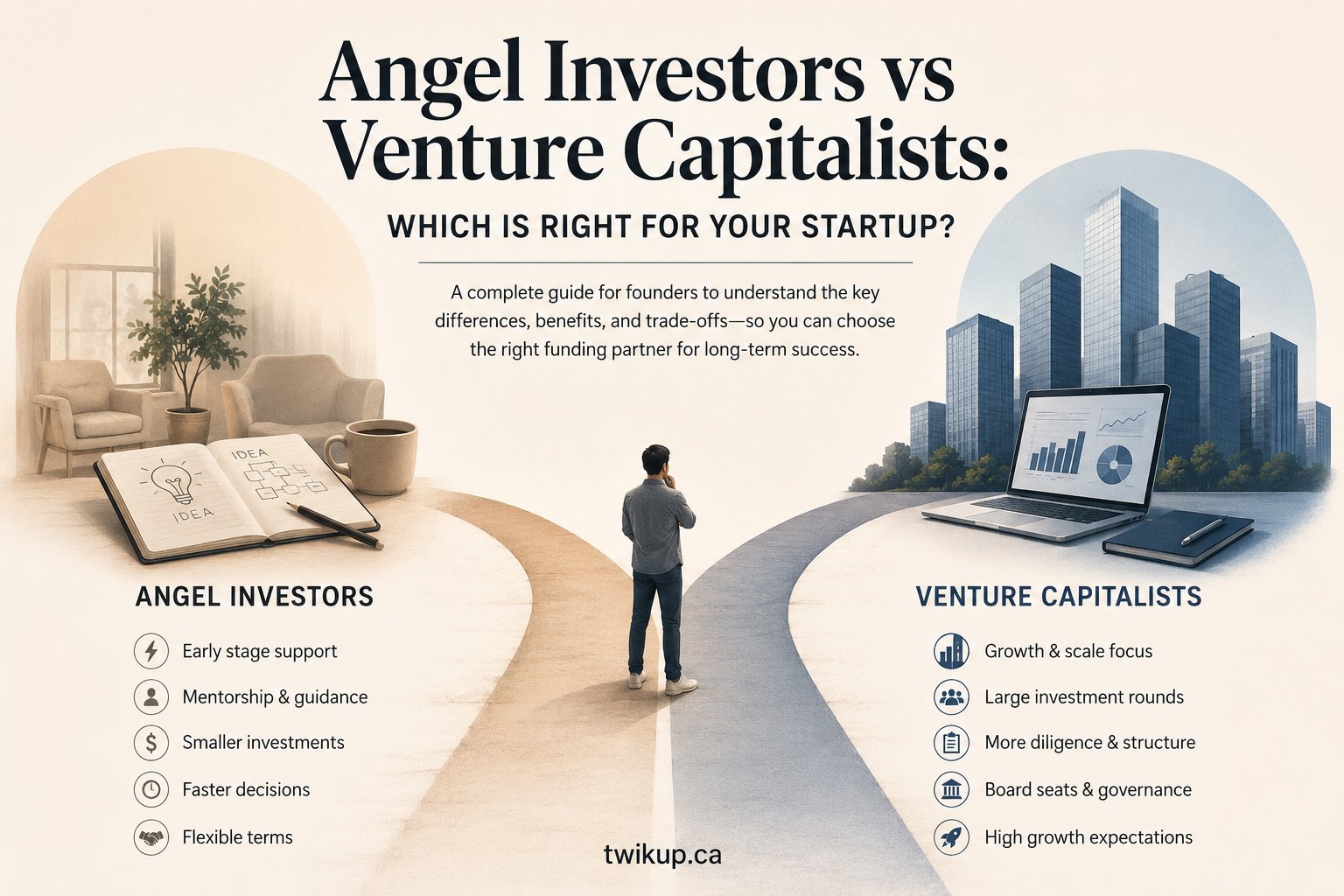
Angel Investors vs Venture Capitalists: How to Find Funding Without Making Costly Mistakes
Imagine spending six months preparing to pitch your startup.
You've built a working product, attracted paying customers, and created a detailed presentation showing how your company could eventually be worth $30 million.
You finally meet a venture capitalist.
The investor listens, asks questions, studies your numbers, and then says something unexpected:
"Your business looks promising. But it's not big enough for us."
Not big enough?
You're talking about building a $30 million company. How could that possibly be disappointing?
Here's what many first-time founders don't realize: An investor can believe your business will succeed and still refuse to invest.
The reason often has little to do with your product. It comes down to how investors make money.
In Part 1, we explored the differences between angel investors and venture capitalists. Now let's tackle the practical challenge: finding investors, convincing them to fund your business, and making sure the money doesn't create more problems than it solves.
Why a Venture Capitalist Might Reject a $30 Million Business
Imagine a venture capital firm manages a $200 million investment fund.
It invests $2 million in your startup for 20% ownership.
Five years later, your company sells for $30 million.
Assuming the VC still owns 20% and ignoring transaction costs and special shareholder rights, its stake would be worth $6 million.
That's three times its original investment.
Sounds excellent, right?
For an individual investor, tripling an investment could be a fantastic result.
But a $200 million venture fund needs much larger winners to generate strong overall returns, especially when some of its investments fail completely.
A $6 million payout contributes only a small amount toward returning the fund's total capital.
Now imagine the same investment eventually produces a $500 million company.
That 20% stake would be worth $100 million, assuming no dilution.
One successful investment could now return half the fund's original size.
That's why some venture capitalists focus on businesses capable of becoming enormous.
An angel investor managing personal wealth might be delighted with the first outcome. A large venture fund may need the second.
Neither investor is necessarily wrong.
The mistake is pitching a business to someone whose financial goals don't match what your company can realistically become.
Five Startups Need Money. Who Should They Approach?
Let's meet five fictional founders facing very different funding decisions.
| Startup | Current situation | Funding needed | Potential fit |
|---|---|---|---|
| Restaurant software | 25 customers, $8,000 monthly revenue | $250,000 | Angels or pre-seed funds |
| AI platform | $120,000 monthly recurring revenue, growing rapidly | $4 million | Venture capital |
| Local marketplace | Profitable in one province | $500,000 | Angels or strategic investors |
| Medical technology | Clinical trials and regulatory approvals ahead | $15 million | Specialized VC |
| Marketing agency | Profitable, no major expansion planned | None | Bootstrapping |
These examples are illustrative, not documented businesses.
The restaurant software founder needs money to improve the product and demonstrate that customers will continue paying. An angel with restaurant industry experience could be particularly valuable.
The AI company has substantial recurring revenue. If its customer retention, margins, and market opportunity are attractive, venture capital could help accelerate expansion.
The local marketplace has proven its concept in one province. But before raising $500,000, its founder should ask whether expansion can be financed through profits, strategic partnerships, or smaller investments.
The medical technology company faces a different challenge. Regulatory approvals, clinical research, and specialized development can require substantial funding long before meaningful revenue arrives.
And the profitable marketing agency?
Its founder might be better off keeping the business entirely.
TwikUp Insight: The right investor isn't necessarily the person willing to write the biggest cheque. It's the person whose capital, experience, and expectations match your next stage of growth.
Before Asking for $1 Million, Do This Calculation
Imagine you own a startup with the following monthly finances:
- Operating expenses: $25,000
- Cash coming in and available to cover those expenses: $10,000
- Net monthly cash burn: $15,000
You want enough funding to operate for another 18 months.
The calculation is straightforward:
$15,000 × 18 = $270,000
Now add $80,000 as a reserve for unexpected expenses, slower sales, or hiring delays.
Your estimated fundraising target becomes $350,000.
So why ask investors for $1 million?
Perhaps you genuinely need that much to accelerate growth. But if you can't explain how the additional money creates value, a larger raise may simply mean unnecessary dilution.
And remember, this calculation assumes your cash flows remain unchanged. Actual funding needs may also depend on existing cash reserves, fundraising costs, debt obligations, planned investments, and the time required to secure another round.
A good fundraising plan should answer three questions:
- How much capital do we actually need?
- What measurable milestone will this money help us reach?
- What happens if achieving that milestone takes six months longer than expected?
Investors aren't simply buying your business idea.
They're financing a plan to make that business more valuable.
The Cold Email That Gets Ignored — and the One Worth Reading
Imagine two founders approaching an investor who previously built a successful restaurant chain.
The first writes:
Weak pitch:
"Hi, I'm building an innovative AI-powered startup that will revolutionize the restaurant industry. We're raising $300,000. Are you interested?"
The investor has learned almost nothing.
What's the product? Who uses it? Does anyone pay? Why is this investor receiving the message?
Now consider another approach.
Stronger pitch:
"Hi, I'm building software that helps independent restaurants track inventory waste. We currently have 25 paying customers generating $8,000 in monthly revenue. We're raising $250,000 to expand our product and customer base. Given your experience operating restaurants, I'd appreciate the opportunity to share what we're building."
This message does four things immediately.
It identifies a real customer problem, provides evidence of demand, explains the funding request, and shows why the investor is relevant.
Does that guarantee a meeting?
Absolutely not.
But it's far more credible than asking a stranger for money based on enthusiasm alone.
For venture capital firms, the same principle applies, although expectations often become more demanding as funding rounds grow.
Investors may want evidence of revenue growth, customer retention, gross margins, customer acquisition costs, and market potential.
Before approaching investors, prepare a concise pitch deck, realistic financial projections, an accurate capitalization table, and supporting documents for your major claims.
One useful rule: Never put a number in your pitch that you cannot explain when someone asks where it came from.
How to Find Investors Who Might Actually Say Yes
Many founders waste months approaching investors who were never suitable for their businesses.
A medical technology startup pitching a fund that invests exclusively in consumer software is unlikely to get very far.
Before contacting anyone, investigate three things.
First, check their investment stage.
Do they invest in companies with only a prototype? Or do they expect established revenue and rapid growth?
Second, examine their investment focus.
Some investors specialize in healthcare, enterprise software, climate technology, financial services, or other sectors.
An investor who understands your industry may evaluate your business more effectively than someone unfamiliar with its challenges.
Third, look at their previous investments.
Have they funded businesses resembling yours? Do they typically invest amounts close to what you're raising?
Their portfolio may also reveal potential conflicts, particularly if they've already backed a direct competitor.
A practical starting point is to build a shortlist of 20 to 30 relevant investors rather than sending the same generic pitch to hundreds.
For each investor, record their typical investment stage, sector focus, recent activity, and whether a credible introduction is possible.
You can then prioritize the investors whose interests genuinely match your business.
Canadian Founders: Don't Overlook Funding That Doesn't Require Selling Shares
Imagine a Canadian technology founder needs $400,000 to develop a new product.
Their first instinct might be to sell part of the company to an angel investor.
But private equity funding isn't necessarily the only option.
Canada offers several programs that may support eligible businesses.
The National Research Council's Industrial Research Assistance Program (NRC IRAP) provides advisory services and potential financial support to qualifying innovative companies.
The Scientific Research and Experimental Development (SR&ED) tax incentive program supports eligible research and development activities through tax incentives.
Depending on the company, provincial programs, regional development agencies, and accelerators may provide other opportunities.
Canadian angel networks, including Golden Triangle Angel Network and Maple Leaf Angels, can also be relevant starting points for entrepreneurs seeking private investors.
But there's an important distinction.
A tax incentive is not the same thing as cash arriving in your bank account today.
Eligibility, application timing, qualifying expenditures, and payment schedules can differ significantly.
A company may still need working capital to cover expenses before receiving any eligible reimbursement or tax benefit.
Founders should also check whether combining programs affects the amount of assistance they can claim.
For the right business, however, a combination of public support, customer revenue, and private investment may reduce the amount of equity that needs to be sold.
The smartest financing strategy isn't always one source of money.
Sometimes it's the right combination.
Six Mistakes That Can Make an Investor Walk Away
A founder can have a promising business and still lose an investment opportunity.
Sometimes the problem isn't the startup.
It's how the founder presents or manages it.
1. Asking for money without knowing where it will go.
"We need $500,000 to grow" isn't a funding plan.
Explain what you'll spend, when you'll spend it, and which measurable outcomes you expect.
2. Claiming you have absolutely no competitors.
If customers already solve the problem using spreadsheets, manual processes, or another product, you have competition.
Investors want to understand why customers would switch to your solution.
3. Celebrating revenue while ignoring expenses.
A startup generating $100,000 monthly while spending $200,000 may be growing quickly, but it's also consuming cash.
Revenue matters. So do margins, cash flow, and the cost of acquiring customers.
4. Demanding a valuation you cannot defend.
A founder may believe their company is worth $20 million because another startup raised money at that valuation.
But investors will examine the business's actual performance, risks, market, and future prospects.
An inflated valuation can make fundraising difficult and create pressure in later rounds.
5. Waiting until the bank account is almost empty.
Imagine your startup has six weeks of cash remaining.
An interested investor asks for financial documents, customer data, and legal information.
You discover that negotiations and due diligence could take months.
Suddenly, you're negotiating from a position of desperation.
Begin preparing for fundraising well before your available runway becomes dangerously short.
6. Hiding problems you hope nobody notices.
Maybe your largest customer is preparing to leave.
Perhaps retention is declining or a legal dispute could affect the business.
Concealing material problems can destroy investor trust and create serious legal consequences.
Investors don't expect every startup to be perfect.
They do expect founders to understand their risks and communicate material facts accurately.
You Got an Offer. Now Read the Terms Before Celebrating
Imagine an investor offers you $1 million.
You're excited. Your startup finally has the money to hire employees, develop the product, and expand.
But before signing, consider what the investor receives in exchange.
A financing agreement may affect ownership, board representation, future fundraising, and how sale proceeds are distributed.
And two offers with the same headline valuation can have very different economic consequences.
For example, suppose an investor puts $1 million into your startup in exchange for preferred shares with a standard 1× non-participating liquidation preference.
If the company later sells for $800,000 and the investor's preference has priority over the founder's common shares, the investor could receive the entire $800,000, assuming no other claims or contractual complications.
The founder could receive nothing.
Now imagine the company sells for $10 million.
Depending on the investor's ownership percentage, the investor may choose to convert to common shares if that produces a larger payout.
The exact result depends on the agreement.
That's why founders need to understand more than the valuation printed at the top of a term sheet.
Before accepting an offer, ask:
- How much ownership am I giving up? Include potential dilution from future rounds and employee equity.
- Who controls important decisions? Review voting rights, board representation, and investor approval requirements.
- What happens if the business is sold? Understand liquidation preferences and the order in which shareholders receive money.
- What happens if we need another funding round? Consider future financing rights, dilution, and possible restrictions.
- Does this investor want the same future I do? Discuss growth expectations, profitability, timelines, and potential exits.
Some early-stage funding also uses instruments such as SAFEs or convertible notes rather than an immediate priced equity round. These can postpone the final ownership calculation, but they still have terms that affect future dilution and investor rights.
Have qualified startup legal counsel review investment documents before signing.
TwikUp Insight: The most expensive investment isn't necessarily the one where you sell the most shares. It may be the one whose terms you didn't fully understand.
Frequently Asked Questions
Can I approach angel investors without any revenue?
Yes. Some angels invest before a startup generates revenue, particularly when founders can demonstrate a credible market opportunity, working prototype, or early customer interest.
However, an idea alone is rarely enough to guarantee investment.
Can angels and venture capitalists invest together?
Yes. Angels and VC funds can participate in the same funding round, subject to the terms and investment structure.
How long does startup fundraising take?
There is no guaranteed timeline. The process can take weeks or several months, depending on investor interest, due diligence, market conditions, and the complexity of the transaction.
Founders should avoid assuming money will arrive immediately after receiving verbal interest.
Should I accept the investor offering the highest valuation?
Not automatically. Consider the investor's expertise, financing terms, governance rights, and ability to support the business.
A higher valuation isn't always the best overall deal.
What if no investor wants to fund my startup?
Rejection doesn't necessarily mean your business cannot succeed.
You may need stronger evidence of customer demand, a different investor category, a revised funding target, or an alternative financing strategy.
Some businesses can grow successfully through customer revenue without raising venture capital.
Final Thoughts: The Best Investor Isn't Always the Richest One
Remember the founder who was rejected despite presenting a business that could become worth $30 million?
That rejection might have felt devastating.
But imagine what happens next.
Instead of spending another six months trying to convince the same type of venture fund, the founder approaches investors who specialize in smaller, profitable businesses.
One of them understands the market, likes the company's realistic growth plan, and offers financing on terms the founder can accept.
The company grows steadily, becomes profitable, and eventually reaches its original goal.
The founder didn't need to promise a billion-dollar business.
They needed the right financial partner.
Of course, not every startup will achieve its projections, and finding a suitable investor is never guaranteed.
But the principle remains the same.
Fundraising isn't a competition to collect the biggest cheque. It's a decision about who gets to participate in your company's future.
Before accepting an investment, ask yourself one final question:
"If this investor wasn't offering money, would I still want them involved in my business?"
If the answer is yes, and the financing terms also make sense, you may have found something more valuable than a large cheque.
You may have found the right partner.
Original Sources and Further Reading
- National Research Council Canada — Industrial Research Assistance Program
- Canada Revenue Agency — Scientific Research and Experimental Development
- Golden Triangle Angel Network
- Maple Leaf Angels
- BDC — Business Development Bank of Canada
Editor's note: All founder stories, financing scenarios, valuations, and calculations are illustrative unless otherwise stated. They are intended to explain startup financing concepts, not describe documented investment transactions. The source links are provided for further reference; current program eligibility and terms should be verified before publication. This article is educational and does not constitute legal, tax, or investment advice.