
Quick Answer
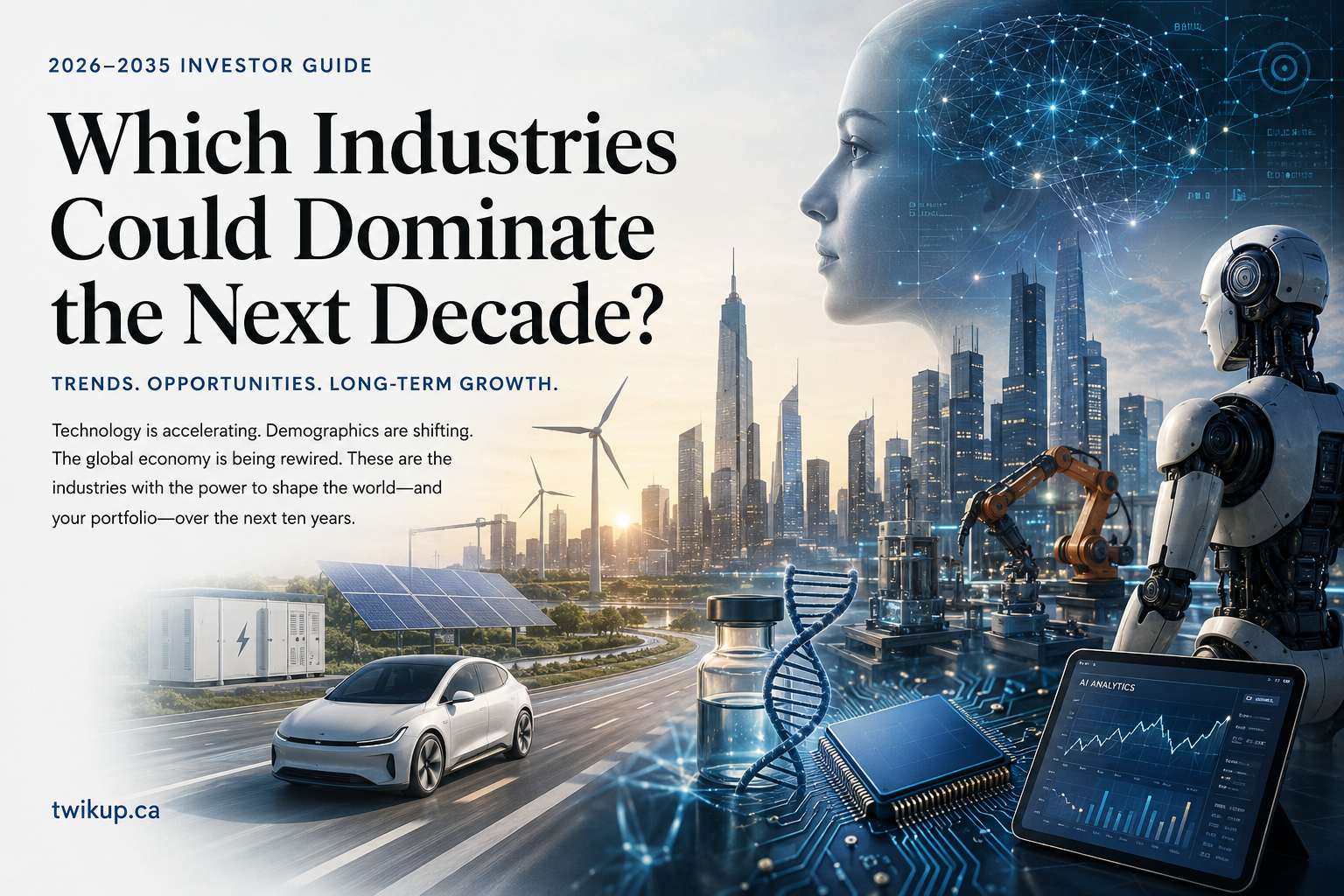
The industries most likely to dominate the next decade are those benefiting from long-term structural trends rather than short-term market cycles. Artificial Intelligence, semiconductors, robotics, healthcare innovation, cybersecurity, clean energy, digital infrastructure, biotechnology, advanced manufacturing, and the space economy are expected to receive trillions of dollars in investment between 2026 and 2035.
The biggest investment opportunities may not come from today's largest companies alone—but from the businesses building the infrastructure behind tomorrow's economy.
TwikUp Insight
Many investors spend years trying to predict the next winning stock.
Professional investors often do the opposite.
They first identify which industries are likely to grow dramatically over the next decade, then search for the strongest companies inside those industries.
History shows this approach works remarkably well.
Investors who recognized the rise of smartphones invested in semiconductor companies before the iPhone became mainstream.
Those who believed cloud computing would transform business found opportunities before millions of people even knew what cloud computing meant.
Today, we're entering another once-in-a-generation shift.
Artificial intelligence, robotics, energy, biotechnology, automation, and digital infrastructure are beginning to reshape almost every part of the global economy.
The biggest winners of the next decade may not even exist yet.
Imagine It's 2035...
Your alarm never rings.
An AI assistant notices you've already entered a light sleep phase and gently wakes you at the perfect moment.
Your coffee machine has already prepared breakfast because it knows your meeting starts early.
Outside, autonomous delivery robots quietly move through the neighborhood.
Traffic lights communicate with self-driving vehicles to eliminate congestion.
At the hospital nearby, cancer treatments are designed specifically for each patient's DNA.
Factories run almost entirely with robots supervised by a handful of engineers.
Your electricity bill is lower than it was ten years earlier because massive battery farms store renewable energy overnight.
Your financial advisor isn't a person anymore.
It's an AI system monitoring thousands of investments every second, adjusting your portfolio based on economic data arriving from around the world.
Space companies launch satellites almost every day.
Factories on Earth use AI-powered robots to manufacture products that once required thousands of workers.
Farmers rely on drones, autonomous tractors, and AI weather forecasting to maximize crop production while using less water.
Cybersecurity systems stop billions of attacks every day before humans even notice them.
None of this sounds impossible.
In fact, much of it is already happening.
The next decade won't simply introduce new technologies.
It will transform how humanity works, travels, receives healthcare, produces energy, builds companies, and creates wealth.
For investors, this matters enormously.
Because every major technological shift creates entirely new industries—and new market leaders.
The companies building tomorrow's economy could become the largest businesses in history.
The challenge is identifying them before everyone else does.
Why Investing in Industries Beats Chasing Individual Stocks
Every market cycle creates excitement around a handful of companies.
Twenty years ago, everyone talked about Nokia.
Then BlackBerry.
Later Facebook.
Today it's NVIDIA, Microsoft, Tesla, and dozens of AI companies.
But great investors usually think differently.
Instead of asking:
"Which company will win?"
They ask:
"Which industry is impossible to ignore over the next decade?"
That's a much more powerful question.
Industries create multiple winners.
The internet created:
- Amazon
- Meta
- Netflix
- Shopify
- Cloudflare
- PayPal
The smartphone revolution created:
- Apple
- Qualcomm
- TSMC
- ARM
- ASML
- Broadcom
Cloud computing created:
- Amazon AWS
- Microsoft Azure
- Google Cloud
- Snowflake
- Datadog
- ServiceNow
Very few investors predicted every winning company.
But many successfully recognized the industries that were changing the world.
That's the strategy we'll use throughout this guide.
What Creates a Trillion-Dollar Industry?
Not every exciting technology becomes a great investment.
History is full of innovations that attracted enormous attention before fading away.
The industries that generate extraordinary long-term returns usually share several characteristics.
1. Massive Global Demand
The best industries solve problems affecting billions of people.
Examples include:
- Computing
- Healthcare
- Energy
- Transportation
- Finance
- Communication
The larger the problem, the larger the potential market.
2. Long Growth Runway
Some industries experience explosive growth before slowing down.
Others continue expanding for decades.
The internet has been growing for over thirty years.
Cloud computing has expanded for nearly twenty years.
Artificial intelligence is likely still in its early stages.
Long growth cycles create more investment opportunities.
3. Government Support
Governments increasingly influence investment trends.
Large-scale spending now supports:
- AI infrastructure
- Semiconductor manufacturing
- Renewable energy
- Nuclear power
- Defense technology
- Medical research
- Critical minerals
Public investment often accelerates private investment.
4. Continuous Innovation
Industries producing constant breakthroughs tend to create lasting winners.
Innovation attracts talent.
Talent attracts investment.
Investment creates more innovation.
The cycle reinforces itself.
5. Global Scalability
Some businesses can only grow locally.
Others can reach every country on Earth.
Software.
AI.
Cloud services.
Cybersecurity.
Digital payments.
These industries scale globally with relatively low marginal costs.
That's one reason technology companies dominate today's stock market.
The Five Mega Forces Reshaping the World
Before examining specific industries, it's important to understand the forces driving nearly every investment opportunity between now and 2035.
Think of these as economic engines powering the next decade.
1. Artificial Intelligence Is Becoming Basic Infrastructure
AI is no longer just another software category.
It is becoming infrastructure.
Just as electricity transformed every business in the 20th century, AI is beginning to transform nearly every industry today.
Banks use AI.
Hospitals use AI.
Factories use AI.
Retailers use AI.
Governments use AI.
Manufacturers use AI.
Construction companies use AI.
Agriculture uses AI.
Even companies that don't sell AI increasingly depend on it.
That makes AI one of the broadest investment themes in modern history.
2. Aging Populations
People are living longer.
Birth rates continue falling across many developed countries.
Healthcare demand is rising.
Medical innovation becomes increasingly valuable.
The global economy must support hundreds of millions of older adults.
This trend affects:
- Pharmaceuticals
- Medical devices
- Robotics
- Home healthcare
- Biotechnology
- Insurance
- Diagnostics
3. Electrification
The world is replacing fossil-fuel systems with electricity.
Electric vehicles.
Battery storage.
Data centers.
Factories.
Homes.
Heat pumps.
Industrial equipment.
Everything requires more electricity.
That creates opportunities across the entire energy ecosystem—not just renewable energy companies.
4. Automation
Labour shortages continue affecting developed economies.
Businesses increasingly automate repetitive work.
Factories install robots.
Warehouses become autonomous.
AI replaces administrative tasks.
Construction adopts automated equipment.
Agriculture becomes more precise.
Automation isn't replacing every job.
It's changing how almost every job gets done.
5. Digital Infrastructure
Every AI model...
Every online payment...
Every cloud application...
Every streaming platform...
Every connected device...
Depends on digital infrastructure.
Without:
- Semiconductors
- Fiber networks
- Cloud computing
- Data centers
- Cybersecurity
Modern economies simply stop functioning.
These "behind-the-scenes" industries often generate enormous long-term investment opportunities because they power everything else.
Industry #1 — Artificial Intelligence
Why AI Could Become the Largest Investment Theme Since the Internet
Artificial intelligence has already changed how millions of people search for information, write documents, generate software, analyze data, and create content.
But today's AI boom may represent only the beginning.
Most businesses have barely started integrating AI into their daily operations.
Many experts compare today's AI adoption to the early internet in the late 1990s.
Back then, the internet looked exciting.
Today, it underpins almost every modern business.
AI could follow a similar path.
AI Is Becoming a Utility
Think about electricity.
Very few companies advertise that they use electricity.
It's simply expected.
AI may become equally invisible.
Banks won't market themselves as AI banks.
Hospitals won't promote AI hospitals.
Factories won't advertise AI manufacturing.
Instead, AI will quietly become part of everything.
That makes the investment opportunity much larger than consumer chatbots.
The AI Value Chain
One of the biggest mistakes investors make is assuming AI means only one type of company.
In reality, AI has an enormous ecosystem.
Hardware
Companies designing chips.
Graphics processors.
Networking equipment.
Memory systems.
Servers.
Semiconductor Manufacturing
Advanced fabrication plants.
Chip packaging.
Lithography equipment.
Precision manufacturing.
Cloud Infrastructure
Data centers.
Cloud platforms.
Storage.
Networking.
AI computing clusters.
Foundation Models
Large language models.
Enterprise AI platforms.
Reasoning systems.
AI operating systems.
AI Applications
Healthcare.
Finance.
Education.
Marketing.
Software development.
Legal research.
Manufacturing.
Agriculture.
Retail.
Every major industry increasingly develops specialized AI applications.
Why AI Could Produce Multiple Trillion-Dollar Companies
Previous technology waves usually created several winners.
Cloud computing produced multiple trillion-dollar businesses.
The smartphone revolution produced multiple trillion-dollar businesses.
Artificial intelligence could create even more.
Because nearly every sector will require AI infrastructure.
The companies supplying the "picks and shovels" may prove just as valuable as those selling consumer AI products.
Investment Risks
AI remains one of the fastest-changing industries in history.
Competition moves rapidly.
Regulation continues evolving.
Hardware requirements are enormous.
Energy consumption continues rising.
Some businesses will become major winners.
Others may disappear just as quickly.
Investors should avoid assuming every AI company will succeed simply because the industry is growing.
Industry #2 — Robotics & Intelligent Automation
Imagine ordering a product online.
Within minutes:
- An AI predicts inventory demand.
- A warehouse robot retrieves the item.
- Another robot packages it.
- Autonomous vehicles transport it.
- Delivery robots complete the final journey.
Almost every step becomes automated.
This isn't science fiction.
It's gradually becoming standard business practice.
Why Robotics Is Entering a New Era
Industrial robots have existed for decades.
What's changing is intelligence.
Modern robots increasingly combine:
- AI
- Computer vision
- Advanced sensors
- Faster processors
- Real-time decision making
Instead of repeating identical tasks, next-generation robots can adapt to changing environments.
That dramatically expands their usefulness.
The Global Labour Challenge
Many developed countries face ageing populations and labour shortages.
Businesses increasingly struggle to hire workers for repetitive, physically demanding, or dangerous jobs.
Robotics helps address these challenges by improving productivity rather than simply reducing labour costs.
Industries investing heavily include:
- Manufacturing
- Warehousing
- Agriculture
- Mining
- Healthcare
- Logistics
- Construction
Beyond Factory Robots
The next decade may bring robots into places that previously relied entirely on people.
Hospitals using robotic assistants.
Restaurants using automated kitchens.
Hotels deploying service robots.
Construction sites using autonomous machinery.
Agriculture powered by AI-driven equipment.
Even households could adopt affordable domestic robots for cleaning, maintenance, and elderly care.
Where Investors May Find Opportunity
The robotics opportunity extends far beyond robot manufacturers.
The ecosystem includes:
- Sensors
- Precision motors
- Industrial software
- Computer vision
- Machine learning
- Batteries
- Semiconductor companies
- Automation platforms
- Industrial networking
- Safety systems
As with AI, the infrastructure supporting robotics may prove just as valuable as the robots themselves.
Looking Ahead
Artificial intelligence provides the brain.
Robotics provides the hands.
Together, they may redefine productivity across the global economy over the next decade.
But neither industry can succeed without another critical foundation.
The world's most advanced chips.
And that's where our next industry begins.
Industry #3 — Semiconductors: The Foundation of the Digital Economy
Every major technological breakthrough of the next decade has one thing in common.
It needs more chips.
Artificial intelligence cannot function without advanced processors.
Robots cannot operate without sensors and embedded chips.
Electric vehicles require thousands of semiconductors.
Modern hospitals depend on medical imaging chips.
Cloud computing runs on millions of processors inside data centres.
Even your refrigerator, smartwatch and washing machine now contain semiconductors.
Most people never think about chips.
Yet almost every digital innovation depends on them.
That's why many analysts now call semiconductors the "new oil" of the digital economy.
Why Demand Is Exploding
For decades, semiconductor growth was driven primarily by personal computers and smartphones.
Today, entirely new demand is emerging.
Instead of one smartphone needing a few processors, a modern AI data centre may require hundreds of thousands of advanced GPUs connected through ultra-fast networking hardware.
The difference is enormous.
One AI model can consume more computing power than entire countries required just a decade ago.
Now multiply that across thousands of companies building AI systems.
Demand grows exponentially.
The Semiconductor Ecosystem
Many investors think semiconductor investing means buying chip designers.
In reality, the industry is much broader.
Chip Designers
These companies create processor architectures for AI, gaming, networking and cloud computing.
Foundries
Designing chips is only half the process.
Someone must manufacture them using some of the most advanced factories ever built.
Modern semiconductor fabrication plants cost tens of billions of dollars.
Very few companies possess the expertise to operate them.
Equipment Manufacturers
Every semiconductor factory depends on highly specialized equipment capable of producing components measured in nanometres.
Without these machines, advanced chips simply cannot exist.
Interestingly, some equipment manufacturers earn consistent revenue regardless of which chip company wins the race.
Materials & Chemicals
Behind every chip lies an enormous supply chain.
Ultra-pure silicon.
Industrial gases.
Specialized chemicals.
Advanced packaging materials.
These businesses rarely make headlines but remain essential.
Testing & Packaging
Modern AI processors are becoming increasingly complex.
Packaging multiple chips together is now as important as manufacturing the chips themselves.
Advanced packaging has become one of the fastest-growing parts of the semiconductor industry.
Why This Industry Could Grow for Decades
Unlike smartphones, semiconductors are not a single product category.
They power hundreds of industries simultaneously.
As AI expands...
Chip demand rises.
As robotics expands...
Chip demand rises.
As autonomous vehicles expand...
Chip demand rises.
As healthcare digitizes...
Chip demand rises.
The semiconductor industry benefits from almost every major technology trend discussed throughout this guide.
Risks Investors Should Consider
Semiconductors remain highly cyclical.
Periods of rapid growth are often followed by temporary oversupply.
The industry also faces geopolitical risks because manufacturing is concentrated in a relatively small number of countries.
Government subsidies, export restrictions and supply chain disruptions can all influence profitability.
Long-term demand appears exceptionally strong.
Short-term volatility is almost guaranteed.
Industry #4 — Energy: The World's Largest Transformation
Every technological revolution requires energy.
Artificial intelligence requires energy.
Cloud computing requires energy.
Electric vehicles require energy.
Factories require energy.
Homes require energy.
Data centres require enormous amounts of electricity.
The next decade isn't simply about producing more electricity.
It's about producing it differently.
Why Electricity Demand Is Rising Again
For many years, electricity demand grew steadily.
Artificial intelligence changed the equation.
Training advanced AI models consumes enormous computing resources.
Modern AI data centres can require as much electricity as entire cities.
At the same time, transportation continues shifting toward electric vehicles.
Buildings increasingly replace natural gas systems with electric alternatives.
Manufacturing becomes more automated.
The result is one of the largest increases in electricity demand in decades.
The New Energy Mix
The future will likely rely on multiple energy sources rather than a single solution.
These include:
- Solar power
- Wind energy
- Hydroelectricity
- Natural gas
- Nuclear energy
- Battery storage
Each plays a different role.
Reliable electricity matters more than choosing only one technology.
Why Nuclear Energy Is Returning
For years, nuclear power struggled with political opposition and high construction costs.
Today, attitudes are changing.
AI data centres need reliable electricity twenty-four hours a day.
Solar power depends on sunshine.
Wind depends on weather.
Nuclear provides consistent baseload electricity regardless of conditions.
Several countries are expanding nuclear investment once again.
Small Modular Reactors (SMRs) may also become commercially important during the next decade.
Modernizing the Grid
Generating electricity is only part of the challenge.
The electrical grid itself requires major upgrades.
Future grids must handle:
- Millions of electric vehicles
- Renewable energy fluctuations
- Battery storage systems
- Smart homes
- AI-powered demand forecasting
Utilities are investing billions to modernize transmission infrastructure.
For investors, these upgrades may become one of the decade's least-discussed opportunities.
Where Investors May Benefit
The opportunity extends far beyond utility companies.
Potential beneficiaries include:
- Grid equipment manufacturers
- Power management software
- Electrical infrastructure providers
- Nuclear technology companies
- Renewable developers
- Industrial engineering firms
The world isn't just producing more electricity.
It's rebuilding the entire energy system.
Industry #5 — Battery Storage: The Missing Piece of Clean Energy
Generating renewable energy is only half the challenge.
The other half is storing it.
The sun doesn't always shine.
The wind doesn't always blow.
Electricity demand constantly changes.
Battery storage solves this problem.
It allows electricity generated today to power homes tomorrow.
Why Batteries Matter
Think of battery storage as a savings account.
Instead of saving money...
It saves electricity.
Excess energy generated during periods of low demand can be stored and released later when demand increases.
This improves grid stability and reduces waste.
Beyond Electric Vehicles
Most investors associate batteries with cars.
That's only one part of the story.
Battery technology increasingly supports:
- National power grids
- Commercial buildings
- Data centres
- Industrial facilities
- Renewable energy projects
- Residential backup systems
Grid-scale batteries may become one of the fastest-growing infrastructure markets worldwide.
Supply Chains Matter
Battery production depends on critical minerals.
Including:
- Lithium
- Nickel
- Copper
- Graphite
- Rare earth materials
Demand for these materials continues increasing as electrification expands.
However, mining remains capital intensive and subject to commodity price swings.
Investors should understand that battery growth affects multiple industries simultaneously.
Industry #6 — Cybersecurity: Protecting the Digital World
As economies become more digital...
The value of cybersecurity increases.
Every connected device creates another potential entry point for attackers.
Banks.
Hospitals.
Governments.
Manufacturers.
Schools.
Cloud providers.
Everyone depends on secure systems.
Cybercrime Is Growing
Cyberattacks have become more sophisticated.
Artificial intelligence now enables both defenders and attackers.
Businesses increasingly assume cyberattacks are inevitable.
The focus shifts from prevention alone to rapid detection and recovery.
This creates continuous demand for cybersecurity solutions.
Why Cybersecurity Is Different
Unlike many technology purchases...
Cybersecurity isn't optional.
Companies cannot simply decide to stop protecting customer information.
Every year brings:
- New threats
- New regulations
- New software vulnerabilities
Security spending becomes an ongoing operational necessity rather than a one-time investment.
Emerging Areas
Future cybersecurity growth includes:
- AI-powered threat detection
- Identity management
- Cloud security
- Industrial cybersecurity
- Critical infrastructure protection
- Zero-trust networking
As AI expands, securing AI systems themselves becomes another major industry.
Industry #7 — Biotechnology & Precision Medicine
Imagine visiting your doctor in 2035.
Instead of prescribing the same medicine given to millions of other patients...
Treatment is designed specifically for your genetic profile.
Diseases are detected years before symptoms appear.
Cancer therapies become more personalized.
Drug development accelerates using artificial intelligence.
This future is gradually becoming reality.
Medicine Is Becoming Data-Driven
Healthcare has traditionally relied on averages.
Precision medicine changes that.
Doctors increasingly combine:
- Genetics
- Medical imaging
- AI analysis
- Biomarker testing
- Wearable health data
To develop individualized treatment plans.
AI Is Accelerating Drug Discovery
Developing new medicines traditionally required enormous time and expense.
Artificial intelligence can now analyze biological data far more quickly.
Researchers hope this reduces development timelines while improving success rates.
Although drug development remains highly uncertain, AI has introduced powerful new tools.
Beyond Pharmaceuticals
Biotechnology extends well beyond medicine.
It includes:
- Agricultural biotechnology
- Synthetic biology
- Gene editing
- Cell therapies
- Medical diagnostics
- Laboratory automation
Many of these fields remain relatively young, suggesting long-term growth potential.
Industry #8 — Longevity: Living Longer, Healthier Lives
Perhaps the biggest demographic trend of the next decade isn't technological.
It's human.
People are living longer.
By 2035, many countries will have significantly older populations than today.
This creates enormous economic opportunities.
Longevity Is More Than Healthcare
Helping people live longer affects almost every industry.
Including:
- Medical devices
- Pharmaceuticals
- Home healthcare
- Robotics
- Insurance
- Financial planning
- Assisted living
- Consumer wellness
Healthy aging may become one of the world's largest consumer markets.
The Rise of Preventive Healthcare
Healthcare increasingly focuses on preventing disease rather than treating illness.
Wearable devices continuously monitor health.
AI identifies risks earlier.
Genetic testing becomes more accessible.
Remote healthcare expands.
The healthcare industry gradually shifts from reactive treatment toward continuous monitoring.
Why Investors Should Pay Attention
Longevity isn't simply a healthcare story.
It's a demographic megatrend.
As populations age...
Demand grows for products and services supporting healthier, more independent lives.
Companies solving these challenges may experience decades of structural growth rather than temporary demand spikes.
Key Takeaways From Part 2
The industries we've covered share several important characteristics:
- They solve global problems.
- They benefit from long-term structural trends.
- They attract government and private investment.
- They support other fast-growing industries.
- Their growth is measured in decades rather than quarters.
Semiconductors power AI.
Energy powers semiconductors.
Battery storage supports renewable energy.
Cybersecurity protects digital infrastructure.
Biotechnology improves healthcare.
Longevity reshapes demographics.
Together, they form much of the foundation of tomorrow's economy.
But several equally important industries remain.
Some are already worth hundreds of billions of dollars.
Others are still emerging and could become the biggest surprises of the next decade.
Industry #9 — The Space Economy: From Science Fiction to Everyday Business
For decades, space exploration was driven almost entirely by governments.
Today, it is becoming a commercial industry.
Private companies are launching satellites, transporting cargo, building reusable rockets, providing global internet coverage, and even planning lunar missions.
Morgan Stanley has estimated that the global space economy could exceed $1 trillion over the coming decades.
For investors, the opportunity extends far beyond rocket launches.
Space Is Becoming Infrastructure
Every time you use:
- GPS navigation
- Weather forecasting
- International banking
- Airline tracking
- Global communications
- Disaster monitoring
You're relying on satellites.
As more industries become connected, satellite infrastructure becomes even more valuable.
Growth Areas
The next decade could see rapid expansion in:
- Satellite internet
- Earth observation
- Precision agriculture
- Climate monitoring
- Defense communications
- Navigation systems
- Space manufacturing
- Lunar infrastructure
Hidden Investment Opportunities
Many investors immediately think of rocket companies.
However, the ecosystem is much broader.
Potential beneficiaries include:
- Semiconductor manufacturers
- Aerospace suppliers
- Satellite component makers
- Communication equipment providers
- Data analytics companies
- Advanced materials manufacturers
As with AI, the infrastructure behind the industry may ultimately prove more profitable than the headline names.
Industry #10 — Defense Technology
Defense spending has entered a new era.
Governments around the world are increasing military budgets in response to geopolitical tensions, cyber threats, and technological competition.
But modern defense is no longer only about tanks and fighter jets.
It increasingly depends on software.
Artificial intelligence.
Autonomous systems.
Satellites.
Cybersecurity.
Drones.
The Nature of Defense Is Changing
Future conflicts may rely as much on algorithms as ammunition.
Military organizations are investing heavily in:
- AI-assisted intelligence
- Autonomous drones
- Cyber defense
- Space surveillance
- Secure communications
- Electronic warfare
Many technologies developed for defense later find commercial applications.
GPS and the internet are two famous examples.
Long-Term Demand
Unlike many industries, defense demand often remains relatively stable through economic cycles.
Governments continue investing regardless of consumer spending trends.
This can make parts of the sector more resilient during recessions.
Industry #11 — Climate Technology
Climate technology is much broader than solar panels.
It includes every innovation designed to reduce emissions, improve resource efficiency, or adapt to changing environmental conditions.
The opportunity spans almost every sector of the economy.
Beyond Renewable Energy
Climate technology includes:
- Carbon capture
- Water purification
- Sustainable agriculture
- Green building materials
- Smart irrigation
- Recycling technologies
- Industrial efficiency
- Alternative fuels
Many companies focus on helping existing industries become cleaner rather than replacing them entirely.
Why Investors Are Paying Attention
Governments and businesses continue committing hundreds of billions of dollars toward climate-related investments.
Corporate sustainability initiatives are also driving demand for new technologies.
Although not every climate startup will succeed, the broader trend appears long lasting.
Industry #12 — Financial Technology (FinTech)
Money itself is becoming digital.
Consumers increasingly expect:
- Instant payments
- Mobile banking
- Digital investing
- AI financial advice
- Automated budgeting
- Cross-border transfers within seconds
Financial services are evolving into software businesses.
AI Is Transforming Finance
Artificial intelligence is helping financial institutions:
- Detect fraud
- Approve loans
- Assess investment risk
- Improve customer service
- Personalize financial products
Retail investors also gain access to sophisticated analytical tools that were previously available only to institutional firms.
Financial Inclusion
Millions of people worldwide still lack access to traditional banking.
Digital financial platforms help expand access to savings, payments and investments.
This creates long-term growth opportunities across emerging markets.
Industry #13 — Quantum Computing
Quantum computing remains one of the most speculative industries in this guide.
But its potential is extraordinary.
Instead of replacing traditional computers, quantum systems aim to solve problems that today's most powerful supercomputers cannot.
Possible Applications
If commercially successful, quantum computing could revolutionize:
- Drug discovery
- Financial modelling
- Logistics optimization
- Climate simulations
- Material science
- Cryptography
- Artificial intelligence
Commercial adoption remains uncertain and likely years away.
However, many governments and technology companies continue investing billions into research.
For long-term investors, this is an industry worth watching closely.
Industry #14 — Digital Infrastructure
People often focus on the applications they use every day.
Behind every application lies an enormous digital infrastructure.
Without it:
Artificial intelligence stops.
Streaming services stop.
Online banking stops.
Cloud software stops.
Modern business stops.
What Counts as Digital Infrastructure?
This sector includes:
- Data centres
- Fiber-optic networks
- Cloud computing
- Edge computing
- Internet exchanges
- High-speed networking
- AI server infrastructure
As global internet usage and AI adoption continue growing, demand for these foundational assets is expected to increase significantly.
Data Centres Become Critical Assets
AI requires enormous computing power.
That means more:
- Servers
- Cooling systems
- Electricity
- Networking equipment
- Storage
Modern data centres increasingly resemble industrial infrastructure rather than traditional office buildings.
Many investors overlook these businesses despite their central role in the AI economy.
Which Industries Could Struggle?
Not every industry benefits equally from technological change.
Some sectors may face structural challenges during the next decade.
Potential headwinds include:
- Businesses heavily dependent on repetitive manual labour
- Companies slow to adopt AI
- Legacy software providers unable to innovate
- Traditional retail models lacking digital capabilities
- Businesses with outdated manufacturing processes
This doesn't mean every company within these industries will perform poorly.
Strong management and innovation can still create winners.
However, investors should carefully evaluate whether a business is adapting to long-term change.
How Investors Can Think About the Next Decade
One common mistake is trying to predict a single winning industry.
History suggests diversification across multiple structural trends often produces better long-term results.
Instead of asking:
"Which industry will dominate?"
A better question might be:
"Which industries are likely to keep growing regardless of short-term economic cycles?"
Several trends appear remarkably durable:
- Artificial Intelligence
- Semiconductors
- Digital Infrastructure
- Healthcare Innovation
- Robotics
- Cybersecurity
- Electrification
These sectors reinforce one another.
Growth in one often increases demand for another.
The Biggest Risks
Even the strongest long-term trends face uncertainty.
Investors should remember:
Valuation Matters
A great industry does not always mean a great investment if prices become disconnected from fundamentals.
Technology Changes Quickly
Today's leader may not dominate ten years from now.
Innovation creates winners—and disrupts incumbents.
Regulation
Governments increasingly influence AI, healthcare, finance, energy and technology.
Policy changes can significantly affect profitability.
Geopolitics
Global supply chains remain interconnected.
Trade restrictions, export controls and geopolitical tensions may reshape entire industries.
Diversification Remains Essential
No forecast is guaranteed.
Owning exposure across multiple industries reduces dependence on any single outcome.
Final Thoughts
Every generation experiences a handful of technological shifts that redefine the global economy.
Railroads transformed the 19th century.
Electricity reshaped the 20th.
The internet revolutionized the late 1990s and early 2000s.
Artificial intelligence, robotics, biotechnology, electrification and digital infrastructure may collectively define the decades ahead.
The next trillion-dollar companies may not simply build better products.
They will build the infrastructure that powers tomorrow's economy.
For long-term investors, the greatest opportunity may not come from predicting next quarter's earnings.
It may come from recognizing which industries are becoming impossible to live without.
History shows that societies rarely move backward.
They build.
They innovate.
They automate.
They digitize.
They discover.
The investors who understand these structural shifts early are often the ones best positioned to benefit over the long term.
Frequently Asked Questions
Which industries could dominate the next decade?
Artificial intelligence, semiconductors, robotics, cybersecurity, digital infrastructure, biotechnology, clean energy, battery storage, climate technology, fintech, defense technology and the space economy are among the industries expected to experience strong long-term growth between 2026 and 2035.
What is the best industry to invest in for the future?
There is no single "best" industry. Many professional investors diversify across several long-term themes instead of concentrating on one sector. AI, healthcare innovation, digital infrastructure and semiconductors are frequently viewed as foundational trends.
Why are semiconductors so important?
Semiconductors power almost every modern technology, including AI systems, smartphones, electric vehicles, cloud computing, robotics and medical equipment. As digital adoption increases, demand for advanced chips is expected to remain strong.
Will AI replace every industry?
No. AI is more likely to transform industries than replace them. Companies that successfully integrate AI into their operations may improve productivity, while businesses that fail to adapt could become less competitive.
Are future industries risk-free investments?
No investment is risk-free. Even industries with strong long-term growth prospects can experience periods of volatility, changing regulations and technological disruption. Investors should conduct their own research and maintain diversified portfolios.
Key Takeaways
- Structural trends often create bigger opportunities than short-term market headlines.
- Artificial intelligence is becoming foundational infrastructure rather than just another technology.
- Semiconductors, energy and digital infrastructure support nearly every future industry.
- Healthcare innovation and longevity benefit from powerful demographic changes.
- Robotics and automation help solve labour shortages while increasing productivity.
- Cybersecurity becomes more essential as economies become increasingly digital.
- Climate technology, fintech, defense technology and the space economy offer additional long-term growth opportunities.
- Diversification across multiple future industries can help reduce risk.
- Long-term investing requires patience, discipline and continuous learning.
- The next decade is likely to reward investors who focus on enduring economic transformations rather than temporary market excitement.
Investment Disclaimer
This article is provided for educational and informational purposes only and should not be considered financial, investment, tax or legal advice. Markets fluctuate, and all investments carry risk, including the potential loss of principal. Always perform your own research and consider consulting a qualified financial advisor before making investment decisions.
Sources
- International Energy Agency (IEA) – https://www.iea.org
- World Economic Forum – https://www.weforum.org
- McKinsey & Company Insights – https://www.mckinsey.com
- Morgan Stanley Research – https://www.morganstanley.com
- World Bank Data – https://www.worldbank.org
- OECD – https://www.oecd.org
- International Monetary Fund (IMF) – https://www.imf.org
- United Nations Population Division – https://population.un.org
- U.S. Energy Information Administration (EIA) – https://www.eia.gov
- NASA – https://www.nasa.gov