
Key Takeaways
- Adaptive reuse can turn underused offices, warehouses, churches and industrial buildings into residential or commercial properties.
- Building structure, renovation expenses, zoning permissions and financing determine whether a conversion is financially practical.
- Investors should compare redevelopment costs against expected rental income, property value and alternative-use potential before purchasing.
Can Adaptive Reuse Real Estate Investment in Canada Deliver Opportunities in 2027?
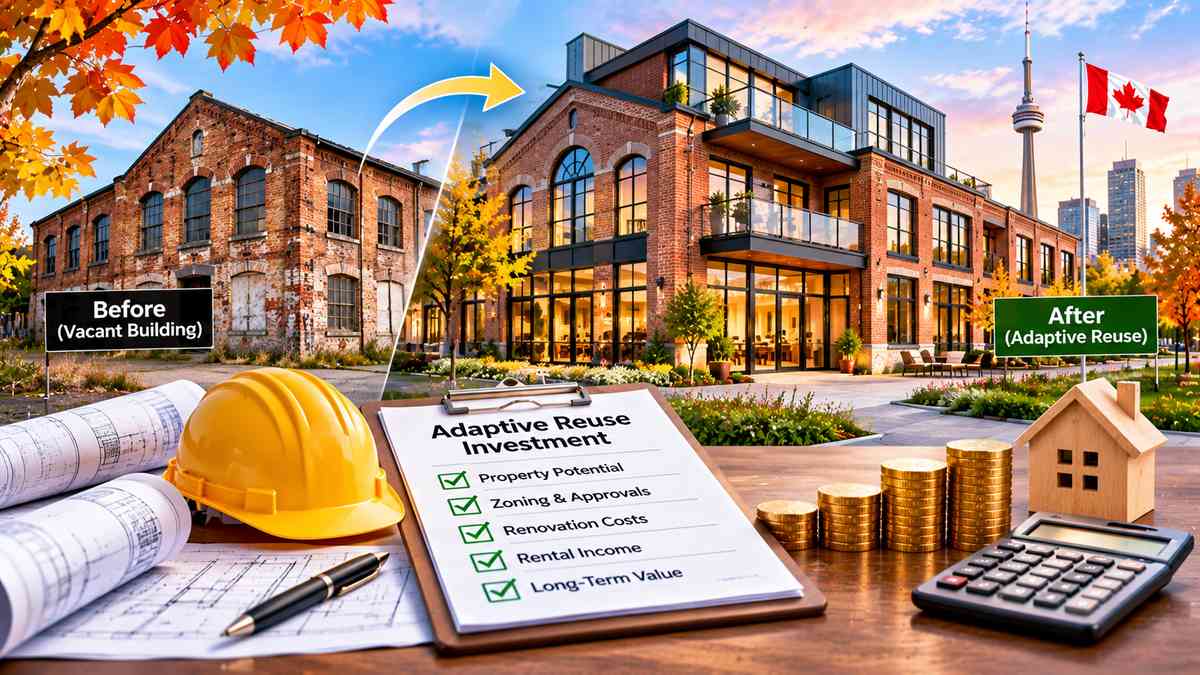
An old office tower, vacant warehouse or unused commercial building does not necessarily have to remain empty. With the right redevelopment strategy, an existing structure can become apartments, hotels, healthcare facilities, student housing or modern commercial space.
This approach, known as adaptive reuse, is attracting attention in Canada's real estate market because it allows developers to give underused properties a new purpose. For investors, however, the opportunity depends on more than buying an ageing building at a discounted price. The renovation budget, approval process and demand for its future use must all make financial sense.
Why Is Adaptive Reuse Gaining Attention in Canada?
Several Canadian cities are exploring ways to bring underused commercial buildings back into productive use.
Calgary's Downtown Office Conversion Program has supported 21 projects covering 2.68 million square feet of office space, with plans for 2,667 homes alongside hotel and hostel accommodation.
Québec City has also announced a project to transform an existing office building into 222 social and affordable housing units, with completion expected in 2028.
These projects show how adaptive reuse can address two challenges simultaneously: underused commercial properties and demand for alternative spaces.
Which Buildings Offer the Best Conversion Potential?
Not every old building is suitable for redevelopment. Former offices with adaptable floorplates, sufficient natural light, suitable ceiling heights and practical plumbing access may work for residential conversions.
Warehouses can sometimes accommodate storage, creative studios, commercial facilities or other industrial uses. Former churches and institutional buildings may offer opportunities for housing, community facilities and mixed-use developments.
Location remains equally important. A building close to public transportation, employment centres, educational institutions and everyday services may attract stronger demand than an isolated property.
Investors should commission an architectural and engineering feasibility assessment before deciding what an existing building can realistically become.
How Can Adaptive Reuse Generate Rental Income?
Investors can acquire an underused building, complete the redevelopment and lease the finished property to residential or commercial tenants.
Consider a hypothetical office conversion into 30 apartments, each generating $1,700 in monthly rent.
30 × $1,700 × 12 = $612,000
This represents potential annual gross rental income at full occupancy, not investment profit or a verified market benchmark.
The investor must still account for acquisition costs, construction, financing, insurance, property taxes, maintenance, management and vacancy.
Another approach is partnering with a developer or property owner. Investors may contribute capital while an experienced development team manages approvals and construction. The ownership structure and distribution of rental income must be clearly defined.
What Makes Adaptive Reuse Projects Difficult?
The biggest challenge is often the building itself. Older properties may have outdated electrical systems, plumbing, heating, ventilation, elevators or fire-safety infrastructure.
Residential conversions can also require additional windows, exits, accessibility improvements and sound insulation. Some buildings may have deep floorplates that limit natural light, making apartment layouts difficult.
Heritage designation can create further restrictions on exterior changes and protected architectural features.
Approval timelines also affect financing. Delays can increase interest expenses and postpone the date when rental income begins.
What Should Investors Check Before Buying?
Start with a detailed building inspection and independent redevelopment feasibility study. Confirm the proposed use with the municipality and investigate zoning, building-code requirements, heritage status and environmental concerns.
Next, prepare a realistic financial model that includes purchase price, renovation expenses, contingency reserves, financing costs and expected rental income.
Investigate local demand for the intended use rather than assuming that every vacant building should become residential housing.
Finally, examine available municipal incentives and financing programs. Calgary's conversion program demonstrates how public support can improve project economics, but application windows, eligibility conditions and funding availability can change.
TwikUp's Perspective
Adaptive reuse offers an alternative to conventional property development, particularly when existing buildings have useful structures and locations but no longer serve their original purpose.
Investors can compare this opportunity with distressed commercial property investment in Canada, where a discounted purchase price must be weighed against renovation and redevelopment risks.
TwikUp believes the strongest adaptive reuse opportunities are properties where the existing structure, purchase price, new permitted use and local demand support one another. An old building is not automatically a bargain. Its real investment value comes from what it can realistically become after all redevelopment costs are considered.
Disclaimer
This article is for educational and informational purposes only. It does not constitute financial, legal, tax or investment advice. Adaptive reuse projects involve risks, including construction overruns, zoning restrictions, heritage requirements, financing delays, environmental issues and uncertain rental demand. Investors should consult qualified real estate, legal, architectural, engineering and financial professionals before making decisions.