
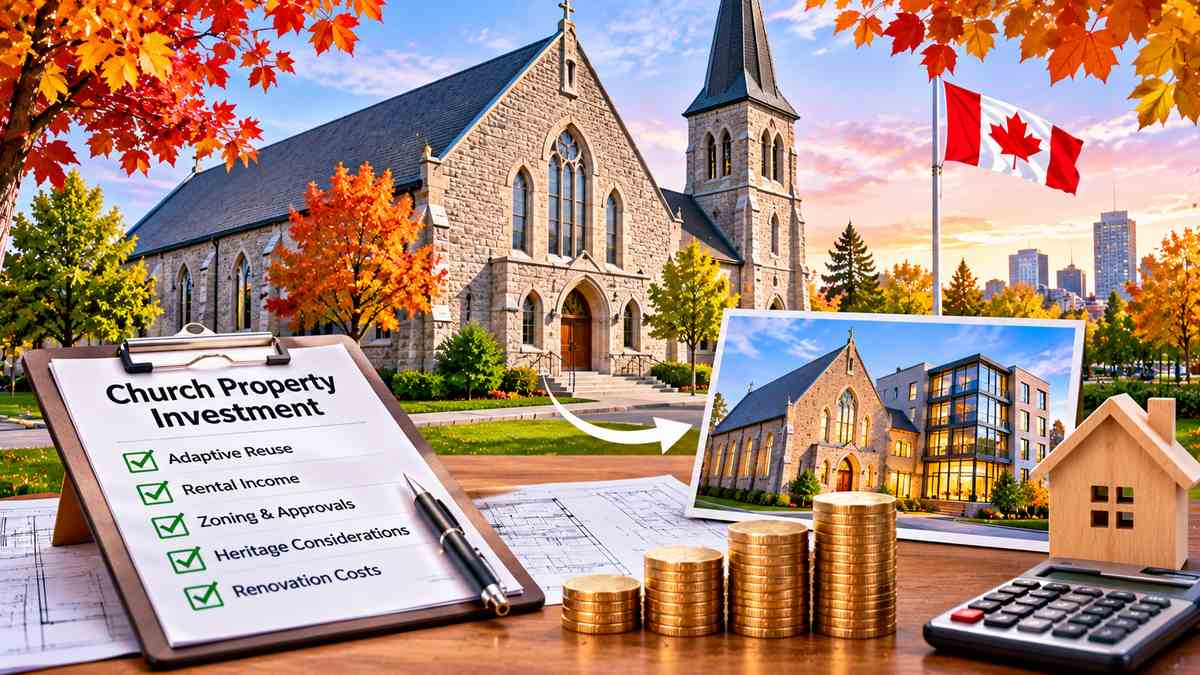
Key Takeaways
- Vacant churches may offer opportunities for residential, commercial and community redevelopment, depending on location and permitted use.
- Heritage restrictions, building condition, accessibility upgrades and zoning approvals can significantly affect conversion costs.
- Investors should examine ownership authority, redevelopment feasibility and potential rental demand before purchasing religious properties.
Can Church Property Investment in Canada Create Income Opportunities in 2027?
An empty church can look like an unusual property investment, but its potential goes beyond its original religious purpose. Large interiors, established neighbourhood locations, parking areas and additional land can make certain religious properties attractive for redevelopment.
In Canada, some former churches have already been converted into affordable apartments, community facilities and mixed-use spaces. For investors considering church property investment in Canada in 2027, the opportunity lies in identifying buildings that can serve a new purpose without requiring financially unrealistic renovation work.
Why Are Vacant Churches Attracting Property Investors?
Many older religious buildings occupy established neighbourhoods where vacant development land can be difficult to find. Some also include classrooms, kitchens, halls, offices and parking areas that could support alternative uses.
One example is WestEnd Commons in Winnipeg. A former century-old church was transformed into 26 affordable apartments, a neighbourhood resource centre, a commercial kitchen and a smaller worship space.
Another example is St. Peter's Lutheran redevelopment in Kitchener, where an underused church wing was converted into more than 40 studio apartments while the congregation retained its sanctuary.
These projects demonstrate the possibilities of adaptive reuse. They should not be treated as evidence that every vacant church can generate attractive returns.
What Can a Vacant Church Be Converted Into?
The most suitable conversion depends on the building's structure, location, zoning and local demand.
Potential uses include:
- Residential apartments or affordable housing
- Community centres and cultural facilities
- Professional offices or co-working spaces
- Educational and childcare facilities
- Restaurants, event venues or hospitality businesses
- Mixed-use developments combining housing and community services
A large sanctuary may provide impressive interior space, but converting it into individual rental units can require substantial structural changes, plumbing, heating, ventilation, fire-safety improvements and additional exits.
Investors should evaluate the intended use before assigning a purchase value to the property.
Can Church Properties Generate Rental Income?
There are several possible investment approaches. An investor can purchase a vacant church, complete the required redevelopment and lease the finished space. Another option is partnering with a religious organization that contributes land while a development partner funds and manages construction.
Consider a hypothetical conversion into 20 rental apartments, each generating $1,500 per month.
20 × $1,500 × 12 = $360,000
This represents potential annual gross rent at full occupancy, not profit or a verified market estimate. Construction, financing, taxes, insurance, maintenance, vacancy and management costs must all be deducted.
A development partnership may also distribute income according to agreed ownership shares, land leases or joint-venture arrangements.
What Legal and Heritage Issues Should Investors Check?
Zoning is one of the first issues to investigate. Permission to operate as a place of worship does not automatically allow residential or commercial redevelopment.
Heritage designation can create additional restrictions. Ontario's heritage guidance explains that changes affecting protected architectural features may require review and approval.
Ownership is equally important. Some religious properties are held through trustees or religious organizations with specific governance requirements. In Ontario, the Religious Organizations' Lands Act contains provisions governing the sale of land by religious organizations. Buyers should obtain legal confirmation that the seller has authority to complete the transaction.
Property-tax treatment may also change when a religious property is sold or converted. Investors should obtain professional tax advice rather than assume an existing exemption will continue.
What Risks Could Make a Church Property Investment Unprofitable?
Older churches may require expensive roof repairs, structural reinforcement, electrical upgrades, accessibility improvements and fire-safety modifications.
Conversion costs can also increase when the original building has unusual layouts, protected interiors or insufficient plumbing and ventilation for its proposed use.
Location is another concern. A beautiful building in an area with limited rental demand may struggle to justify its acquisition and renovation costs.
Investors should obtain building inspections, environmental assessments, zoning confirmation, heritage advice and a realistic redevelopment budget before purchasing.
TwikUp's Perspective
Vacant religious properties can represent an interesting corner of Canada's commercial real estate market, particularly where existing buildings and underused land can support new community or residential uses.
Investors can compare these opportunities with distressed commercial property investment in Canada, where the purchase discount must be weighed against renovation and redevelopment risks. The broader Canadian rental property investment market also offers useful context when assessing potential residential income.
TwikUp believes the real opportunity is not simply buying an unused church at a lower price. It is identifying a property with a realistic alternative use, manageable conversion costs and genuine local demand. Without those fundamentals, an architecturally impressive building can become a costly holding rather than a productive investment.
Disclaimer
This article is for general educational and informational purposes only. It does not constitute financial, legal, tax or investment advice. Religious property investments involve risks, including heritage restrictions, zoning limitations, ownership approvals, construction costs, financing challenges and uncertain redevelopment timelines. Consult qualified legal, financial, architectural and commercial real estate professionals before making investment decisions.