
Quick Answer
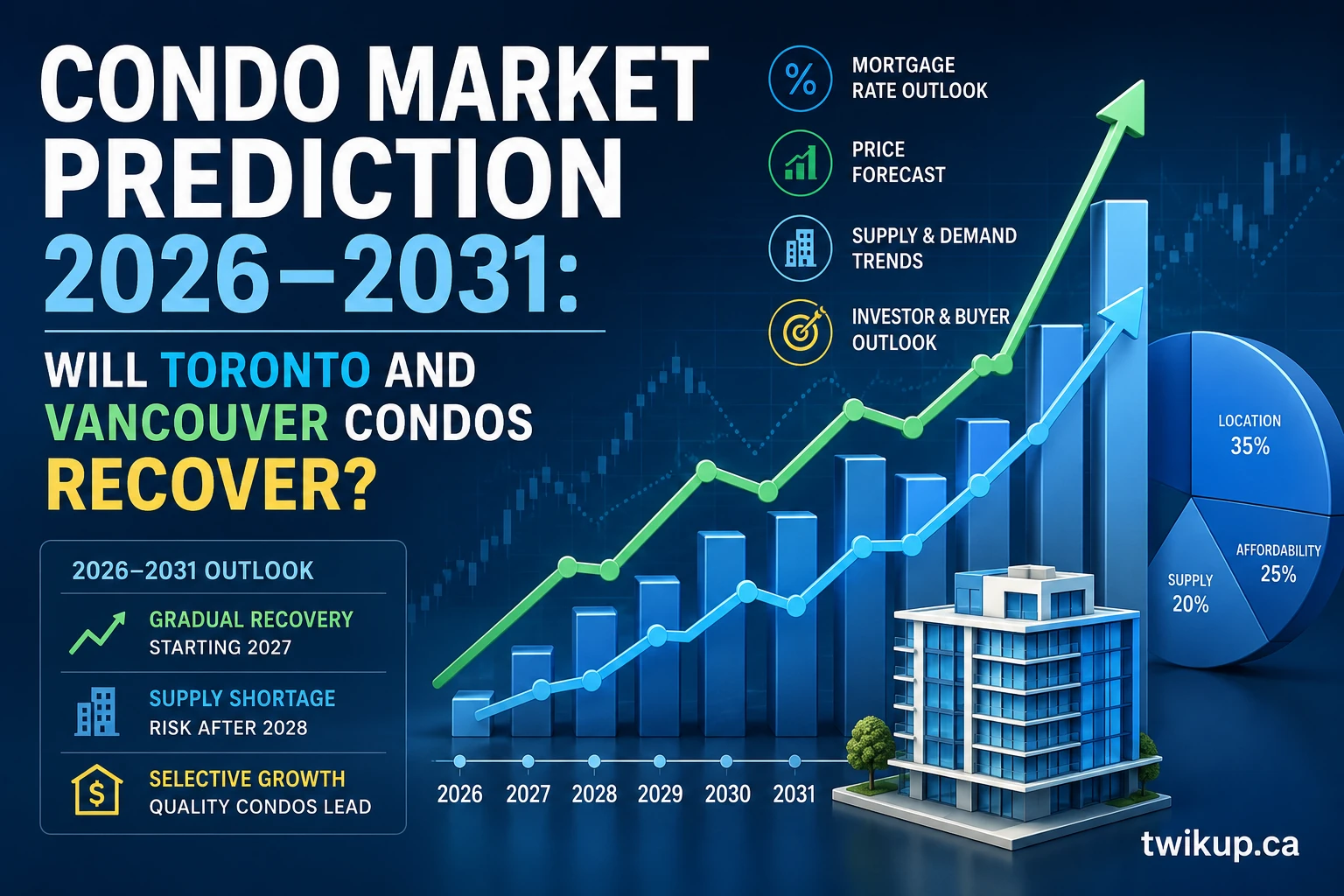
Toronto and Vancouver condos are unlikely to “crash” again in a straight line, but a fast recovery is also unlikely. The most likely 2026–2031 path is a slow bottoming phase in 2026, selective recovery from 2027–2028, and stronger performance after 2029 if mortgage rates ease, population growth stabilizes, and today’s weak condo construction creates future supply shortages.
Toronto condos may recover more slowly because investor-owned units, high inventory, weak pre-construction demand, and affordability pressure are still weighing on prices. Vancouver condos look more resilient long term because land scarcity, limited new supply, and strong lifestyle demand support prices, but affordability is still a major ceiling.
Twikup view: the next condo recovery will not lift every building equally. Newer, well-managed, transit-connected, livable condos may recover first. Tiny investor-style units, high-fee buildings, weak layouts, and poorly funded condo corporations may lag.
Twikup Insight
The condo market is not dead. It is resetting.
For years, condos in Toronto and Vancouver were treated like “automatic wealth machines.” Investors bought pre-construction units, rented them out, refinanced later, and assumed prices would keep rising.
That model broke when mortgage rates jumped, rents stopped rising fast enough to cover carrying costs, and resale inventory increased.
But the weakness in 2026 could quietly create the next supply problem. If developers cancel or delay condo projects now, Toronto and Vancouver may face fewer new condo completions near the end of the decade. That means today’s oversupply could slowly turn into tomorrow’s shortage.
The key question is not: Will condos recover?
The better question is: Which condos will recover first?
Condo Market Prediction 2026–2031: Toronto vs Vancouver
The Toronto and Vancouver condo markets are entering 2026 from a very different position than they were in during the pandemic boom.
Back then, cheap borrowing, investor demand, immigration growth, and fear of missing out pushed condo prices higher. By 2025 and 2026, the story changed. Mortgage payments became harder to carry, investors pulled back, pre-construction sales weakened, and many buyers started choosing patience over urgency.
That does not mean condos are finished. It means the market is being repriced.
For a broader Canadian housing outlook, read Twikup’s full guide here: Canada Real Estate Price Prediction 2026–2031: Will Home Prices Rise or Fall in the Next 5 Years
Why Condos Are Under Pressure in 2026
Condos are usually the first step into homeownership in expensive cities. That should make them attractive. But in 2026, several forces are still holding the market back.
1. Mortgage payments are still too high
Even if rates come down from their peak, buyers are still comparing today’s payments with what people paid during the low-rate era. A condo that looked affordable at 2% mortgage rates can feel expensive at 4% to 5%.
This matters because condo buyers are often first-time buyers. They are more sensitive to monthly payments, stress-test rules, down payments, and job uncertainty.
For rate context, read: Canada Mortgage Rate Prediction 2026–2030: Will Rates Fall Again—or Is 4% the New Normal?
2. Investor math is weaker
Many Toronto and Vancouver condos were bought by investors. The old strategy was simple: buy early, rent it out, hold long term, and let appreciation do the work.
But if rent does not cover the mortgage, condo fees, insurance, taxes, maintenance, and vacancy risk, investors become less aggressive.
That reduces demand.
3. Condo fees are becoming a bigger issue
A lower purchase price does not always mean a better deal. Some condos now come with higher monthly maintenance fees, special assessment risk, insurance pressure, and reserve-fund concerns.
This is important because buyers do not only qualify based on the purchase price. They also need to afford the full monthly ownership cost.
A $650,000 condo with a high condo fee can feel less affordable than expected.
4. Pre-construction demand is weak
One of the biggest warning signs is the slowdown in pre-construction condo sales. When buyers and investors stop buying pre-construction units, developers delay or cancel projects.
That hurts near-term construction. But it may also reduce future supply.
This is the strange part of the condo market: weakness today can create shortage later.
Toronto Condo Market Prediction 2026–2031
Toronto’s condo market is likely to recover, but not quickly.
The GTA has too much investor-style condo inventory in some pockets, and many buyers are still negotiating hard. Smaller units, poor layouts, high-fee buildings, and investor-heavy towers may take longer to rebound.
2026: Bottoming, not booming
Toronto condos may remain soft through much of 2026. Prices could stabilize in stronger neighbourhoods, but the overall market may still feel weak because buyers have choice.
The buyers who return first will likely be end-users, not investors. They will want livable layouts, transit access, reasonable condo fees, good building management, and realistic pricing.
2027: Early recovery if rates improve
If mortgage rates ease and buyer confidence improves, Toronto condos could start seeing better sales activity in 2027. But price recovery may still be uneven.
A downtown one-bedroom investor unit may not recover the same way as a two-bedroom condo near transit, schools, parks, and employment hubs.
2028–2029: Supply shortage risk begins
By 2028 and 2029, the impact of weak pre-construction sales could become clearer. If fewer projects are launched in 2026 and 2027, Toronto may face fewer new condo completions later.
That could support prices, especially for well-located resale condos.
2030–2031: Stronger recovery possible
By 2030 and 2031, Toronto condos could look attractive again if population growth, job growth, rental demand, and mortgage affordability improve.
But the next cycle may reward quality more than speculation.
Toronto condo forecast: slow recovery, selective price growth, stronger performance after 2028 if supply tightens.
Vancouver Condo Market Prediction 2026–2031
Vancouver condos are also under pressure, but the long-term supply story is different.
Metro Vancouver has limited land, strong lifestyle demand, global appeal, and high barriers to building enough housing. That does not protect prices from short-term declines, but it does support long-term value in good locations.
2026: Soft but resilient
Vancouver condos may remain soft in 2026, especially as affordability stays stretched. Buyers may continue to negotiate, and some sellers may need to adjust expectations.
But Vancouver’s land scarcity gives the condo market a stronger long-term floor than many other Canadian cities.
2027–2028: Gradual confidence return
If borrowing costs ease, Vancouver condo buyers may return gradually. The strongest demand may be for transit-connected, walkable, well-managed buildings in areas with limited new supply.
2029–2031: Supply constraints become more important
By the end of the decade, Vancouver’s biggest issue may again be supply. If construction slows while demand remains steady, condo prices could recover more strongly.
Vancouver condo forecast: near-term softness, medium-term stabilization, stronger long-term support from scarcity.
For city-by-city housing comparison, read: Canada Housing Market by City 2026–2031: Price Predictions for Toronto, Vancouver, Calgary, Ottawa, Montreal and More
Will Toronto and Vancouver Condos Recover?
Yes, but not equally.
The recovery will likely happen in stages:
| Period | Market Direction | What It Means |
|---|---|---|
| 2026 | Weak/stabilizing | Buyers have negotiating power |
| 2027 | Early recovery | Better affordability may bring demand back |
| 2028 | More balanced | Inventory may start tightening |
| 2029 | Stronger demand | Delayed construction may reduce future supply |
| 2030–2031 | Selective growth | Quality condos may outperform weak buildings |
The biggest mistake is assuming every condo will recover the same way.
A well-managed two-bedroom condo near transit may perform very differently from a tiny investor unit in a high-supply tower.
Best Condo Types for 2026–2031
The strongest condos may be:
- Larger one-bedroom plus den or two-bedroom units
- Buildings with reasonable condo fees
- Properties near subway, SkyTrain, GO Transit, or major employment hubs
- Buildings with strong reserve funds
- End-user-friendly layouts
- Condos in areas with limited future supply
- Units with parking, storage, outdoor space, or flexible work-from-home layouts
The weakest condos may be:
- Very small investor-style units
- Buildings with rising fees and weak reserve funds
- Areas with too much similar inventory
- Poor layouts with limited livability
- Buildings with frequent special assessments
- Units priced based on 2021 expectations
Should You Buy a Condo in 2026 or Wait?
If you are buying to live in the condo for 5 to 10 years, 2026 may offer better negotiating power than the boom years.
But if you are buying only because the price has dropped, be careful. The monthly cost matters more than the headline discount.
Before buying, compare:
- Mortgage payment
- Condo fees
- Property tax
- Insurance
- Utilities
- Parking cost
- Reserve fund health
- Special assessment risk
- Rent vs own cost
- Resale demand for that building type
For a broader buyer decision, read: Should You Buy a Home Now or Wait Until 2027? Canada Housing Market Outlook for Buyers
Will Condo Prices Crash Again?
A major condo crash is not the base case, but more weakness is possible in certain segments.
The biggest risks are:
- Mortgage rates staying higher for longer
- Job market weakness
- Investors continuing to sell
- Immigration and student demand slowing
- Condo fees rising faster than incomes
- Too much resale inventory in certain neighbourhoods
- Weak rent growth reducing investor demand
The strongest protection against a deeper crash is future supply shortage. If developers stop building now, the market may become tighter later.
For a broader national view, read: Will Canadian Home Prices Crash or Rise? Canada Housing Market Prediction 2026–2030
Toronto vs Vancouver Condos: Which Market Recovers First?
Vancouver may recover earlier in high-quality areas because supply is more constrained. Toronto may take longer because the GTA has more investor-heavy condo supply and more pre-construction weakness.
But Toronto could also offer better buying opportunities if prices overcorrect.
| Factor | Toronto Condos | Vancouver Condos |
|---|---|---|
| Near-term pressure | Higher | Moderate to high |
| Investor exposure | High | Moderate |
| Land scarcity | Medium-high | Very high |
| Affordability challenge | High | Very high |
| Recovery speed | Slower, selective | Gradual, scarcity-supported |
| Long-term demand | Strong | Strong |
| Best opportunity | Discounted quality units | Scarce, well-located units |
Final Prediction: 2026–2031 Condo Outlook
Toronto and Vancouver condos are likely near the reset phase of the cycle, not the end of the market.
The next few years may feel boring compared with the boom years. Prices may move sideways, buyers may negotiate harder, and investors may remain cautious.
But by 2028–2031, the market could look very different. If fewer condos are built today, future buyers may face tighter supply, especially in Toronto and Vancouver where long-term housing demand remains strong.
The winners will not be every condo owner.
The winners will likely be buyers who focus on quality, affordability, building health, location, layout, and long-term livability.
Bottom line: Toronto and Vancouver condos can recover by 2031, but the recovery will be slow, selective, and quality-driven — not a return to easy speculation.
Disclaimer: This article is provided for informational and educational purposes only and should not be considered financial, investment, mortgage, legal, or real estate advice. Market forecasts are based on current economic conditions and publicly available information available at the time of writing. Actual housing market performance may differ. Readers should conduct their own research and consult qualified professionals before making financial or real estate decisions.