
Key Takeaways
- The HypoAD atlas combines MRI data from 458 living adults with gene activity from 614,403 hypothalamus cells
- Subregions running metabolism, stress and circadian rhythms were the most vulnerable in Alzheimer's
- Microglia shifted to a pro-inflammatory state, and sleep/circadian neurons showed the deepest changes
The hypothalamus is not a bystander
Sleep problems and appetite changes often appear years before memory loss in Alzheimer's disease.
Now, a new atlas published in Nature may explain why.
The brain region that controls sleep, hunger and body clocks — the hypothalamus — is itself being rewired early in the disease.
The atlas, called HypoAD, combines detailed MRI measurements from 458 living adults with gene-activity readings from 614,403 individual cell nuclei taken from the hypothalami of 17 donors.
That group included seven people with mostly early-stage Alzheimer's and seven matched controls.
Researchers at the Buck Institute for Research on Aging and Washington University in St. Louis measured 13 hypothalamic subregions.
The damage, they found, is not spread evenly.
The subregions that take the hit: metabolism, stress and circadian rhythms
The subregions governing metabolism, stress and circadian rhythms were the most vulnerable.
They changed in both size and gene activity with ageing and Alzheimer's.
Interestingly, overall hypothalamic volume barely tracked age. Some subregions shrank, while others enlarged.
Two cellular findings stand out.
First, microglia — the brain's immune cells — had shifted into a pro-inflammatory state.
Second, the inhibitory neurons inside the sleep-regulating and circadian subregions showed the deepest gene-activity changes of any cells studied.
Machine-learning models pointed to inflammation and circadian-rhythm regulators as key predictors of Alzheimer's.
The study is cross-sectional, so it shows association, not cause.
The MRI and cell data also came from different people, compared side by side.
And the autopsy group was small, as is typical for this kind of work.
The Twikup Take
Alzheimer's research has long centred on memory circuits.
HypoAD makes the case that the disease also attacks the body's control centre for sleep, hunger and stress — which may be exactly why those symptoms arrive first, and why fixing sleep could matter more than we thought.
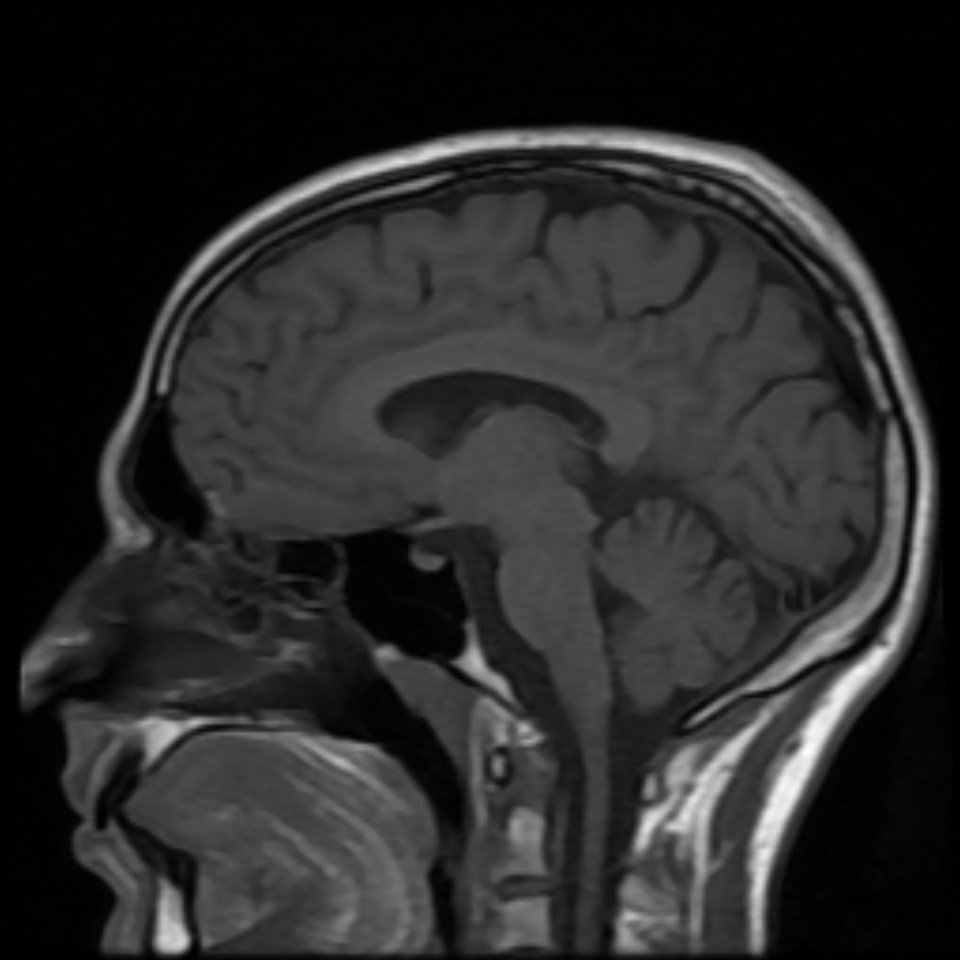
Image: Sagittal T1 MRI scan of the human brain, by 511KeV, CC BY-SA 4.0, via Wikimedia Commons.