
Key Takeaways
- Voyager 1 crossed one light-day from Earth at 5:16:07 a.m. EST on Nov. 18, 2026 — about 25.9 billion kilometres away.
- A radio signal now takes a full 24 hours to reach the spacecraft; a round trip takes two days.
- Launched in 1977, it is still sending data from four working instruments in interstellar space.
A full day away — at the speed of light
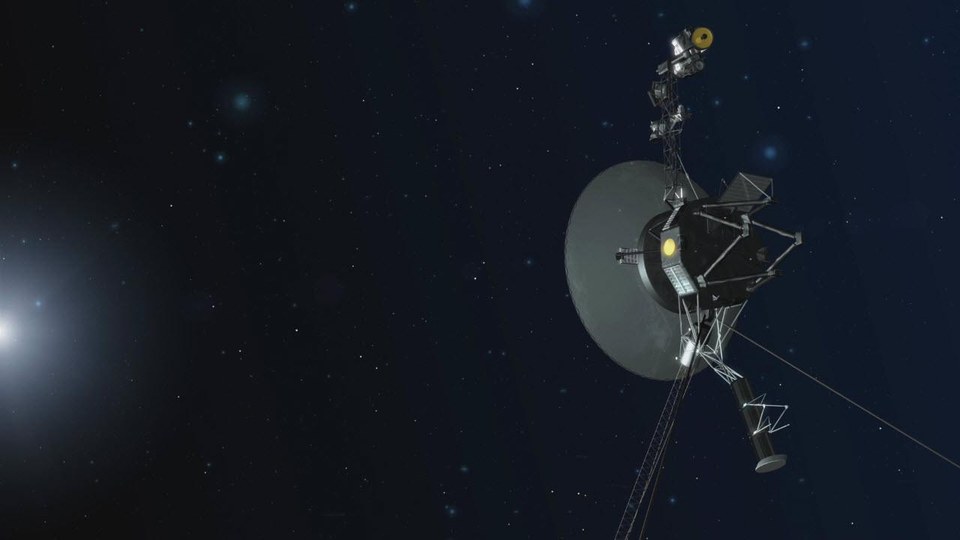
At 5:16:07 a.m. EST this morning, Voyager 1 reached a distance no human-made object has reached before: one light-day from Earth. That is roughly 25.9 billion kilometres — so far that light itself, and every radio signal NASA sends, needs a full 24 hours to make the one-way trip. A question sent to the spacecraft today would get its answer two days from now.
NASA says the journey to this point took the spacecraft 49 years, two months and 11 days. Voyager 1 launched from Cape Canaveral on September 5, 1977, flew past Jupiter and Saturn, and in August 2012 became the first object to enter interstellar space. It has been the most distant human-made object since 1998.
Still working, at 61,000 kilometres an hour
Voyager 1 is travelling at nearly 38,000 mph (about 61,000 km/h) and continues to send data to NASA's Deep Space Network from four still-functioning instruments — a cosmic ray telescope, a low-energy charged particles experiment, a magnetometer and a plasma waves experiment — measuring a region no other spacecraft has visited. It still carries the Golden Record, the phonograph record of Earth's sounds and images placed aboard before launch.
NASA marked the milestone by inviting the public to "Shine Bright for Voyager's Light-Day," flashing lights skyward after sunset on Tuesday to create a symbolic wave of golden light around the planet. Its twin is not close behind: Voyager 2 is not expected to reach one light-day until November 2035.
The Twikup Take
Every other distance record in space exploration was measured in kilometres. This one is measured in time: humanity now has a machine a full day away at the fastest speed the universe allows — and it is still answering, two days later.
Image: NASA (Voyager spacecraft in deep space, artist's concept).