
Key Takeaways
- Researchers directly observed about 30 submarine landslides in 18 days at the Homathko Delta in Bute Inlet, B.C. — the first direct observations of natural underwater landslides.
- The slides fail by "breaching," a slow, progressive process over minutes to hours, then become turbidity currents that travel kilometres.
- The findings change how hazards to offshore infrastructure and shorelines are assessed at sandy deltas worldwide.
Nobody Had Ever Watched the Seafloor Give Way — Until Now
Submarine landslides move more sediment than almost any other process on Earth, threaten offshore infrastructure and reshape coastlines — and until recently, no one had ever directly watched one happen. They occur in darkness, underwater, without warning.
A team led by the Monterey Bay Aquarium Research Institute (MBARI) and Durham University changed that in Bute Inlet, British Columbia. Working with the support of the Homalco First Nation, the researchers instrumented the Homathko Delta at the head of the inlet — where the glacier-fed Homathko River dumps sediment into a 50-kilometre submarine channel system — with sonar in the river mouth, repeated multibeam seafloor surveys and seafloor moorings, effectively watching the delta front continuously.
During an 18-day campaign in 2022, they observed about 30 submarine landslides, capturing three in detailed, direct observation — the first of their kind, published this month in Science.
What they saw overturns the default assumption. Instead of failing instantly, the way liquefied sediment does, these slides fail by "breaching": grains of water-saturated sediment shift apart, the water pressure between them drops and creates a suction that briefly strengthens the slope — and as the pressure normalizes, the sediment gives way slowly and progressively, over minutes to hours. The failed material then becomes a turbidity current, a dense slurry that can race several kilometres downslope.
That distinction is practical, not academic. A failure that develops over hours and sends hazards kilometres downslope requires different mitigation and different hazard assessments than an instant collapse — for the pipelines, cables and shoreline infrastructure near sandy deltas and canyon heads worldwide, from Bute Inlet to Monterey Bay. The slides also rapidly move carbon and pollutants offshore, kilometres at a time.
The Twikup Take
Some of the biggest geological events on the planet happen silently under fjords like Bute Inlet, dozens of times a month. Watching them properly for the first time turns a theoretical hazard into an engineering problem — one with a clock you can actually read.
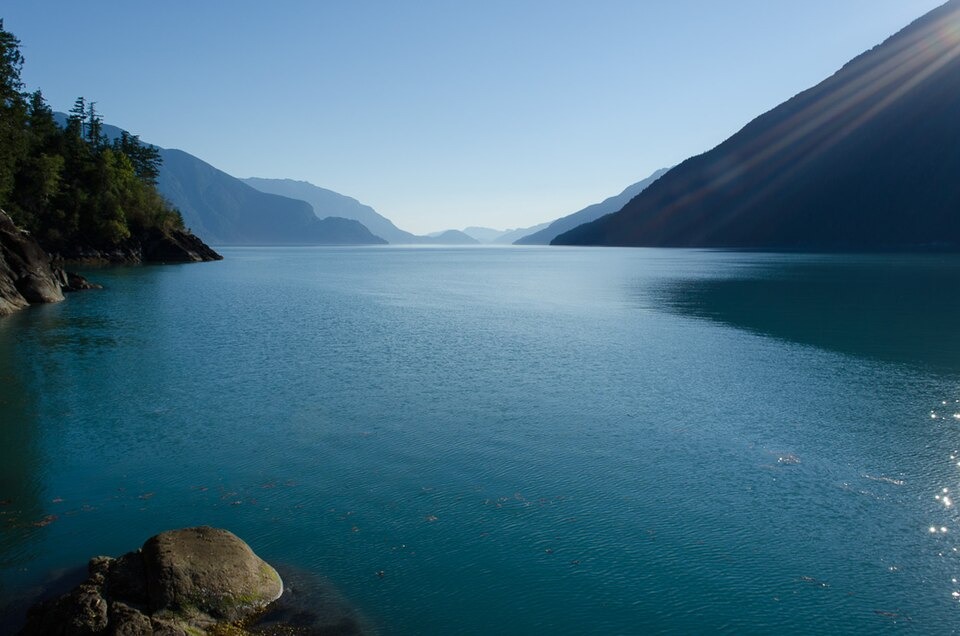
Photo: Bute Inlet by Dan Clancy, CC BY-SA 2.0.