
Key Takeaways
- Air rights can sometimes be separated from the underlying property and treated as a distinct real estate interest.
- British Columbia provides a defined statutory route for creating and transferring air space parcels, while local approvals remain essential.
- An attractive location does not guarantee a profitable project because construction costs, structural limits and planning restrictions can eliminate the expected value.
Could the Space Above a Building Become an Investment?
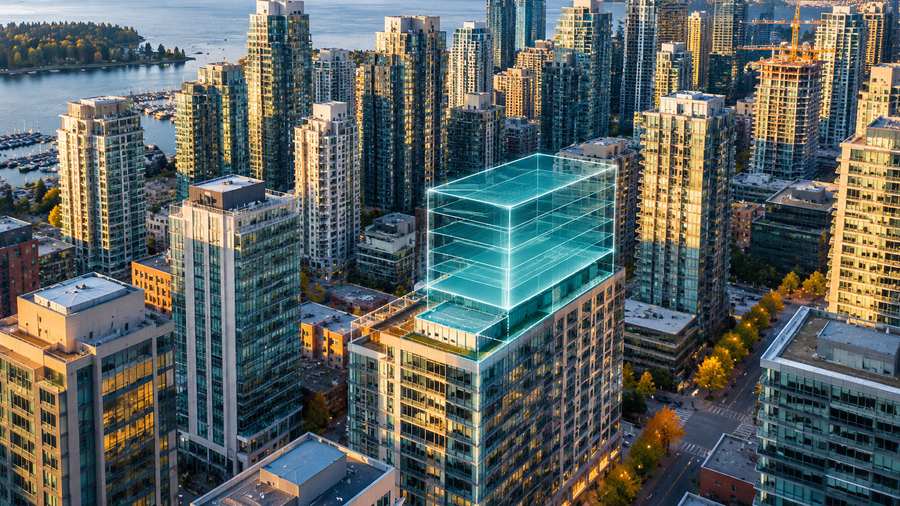
In crowded Canadian cities, valuable real estate does not always sit at street level. An older commercial property, railway corridor or low-rise building may occupy a site where additional development could be possible above the existing structure. This is where air rights investment Canada becomes an interesting, although highly specialized, property strategy.
Air rights generally refer to the legal interest in controlling and using defined space above a parcel of land. Depending on provincial law and the property's legal arrangements, that space may sometimes be separated from the underlying land and transferred to another owner. However, owning air rights does not automatically give an investor permission to construct a taller building.
How Does Air Rights Investment Work?
Imagine a commercial building occupying three floors in a busy downtown location. The owner may explore whether additional space above the existing structure can accommodate residential units, offices or another development.
A developer could negotiate to acquire or lease the relevant air space, subject to legal registration, planning approvals and technical requirements. The original property owner may receive a sale payment, lease income or another negotiated benefit, while the developer gains access to a potential development site without purchasing the entire underlying property.
Canada also has a related concept called transferable development rights. These concern permitted building density rather than ownership of a physical air space parcel. The Canada Revenue Agency distinguishes the two: air rights concern property interests in airspace, while density rights arise from municipal development controls.
Where Can Investors Find Opportunities?
British Columbia provides a particularly clear legal framework. Under its Land Title Act, owners can create air space parcels through a registered air space plan. These parcels can be transferred, leased or mortgaged in much the same way as other registered land.
Vancouver also operates an application process for air space subdivisions. Proposals must identify the separate volumetric parcels and explain their intended uses. The City recommends submitting applications eight to ten months before expected occupancy to allow time for review and legal arrangements.
Vancouver's transferable heritage density program offers another route to development value. Eligible heritage property owners may transfer approved unused density to qualifying receiving sites, subject to municipal conditions. This is not the same as selling an independently titled air space parcel.
In Ontario, air space interests can also be structured through legal property arrangements, but planning and subdivision approvals need careful review. Investors should not assume that a process accepted in one province will work identically elsewhere.
What Could Make an Air Rights Deal Profitable?
The investment case depends on what can actually be built. A developer may value an air space parcel if it creates a practical route to additional residential or commercial floor area in a location where acquiring another full site would be difficult.
For example, consider a hypothetical project involving 20,000 square feet of potential additional floor space. If the completed space could generate an estimated $500 per square foot in sale value, the projected gross value would be $10 million.
That figure is not the value of the air rights. Construction, financing, professional fees, approvals, taxes, access arrangements and contingency costs must all be deducted. The remaining amount, together with the developer's required return, determines what could reasonably be offered for the rights.
What Risks Should Investors Check?
The first concern is legal certainty. Buyers need to confirm exactly what is being transferred, whether the interest can be registered and whether existing mortgages, easements or agreements affect it.
Structural feasibility is equally important. An existing building may not support additional floors without major reinforcement. Foundations, fire exits, elevators, utilities, loading capacity and construction access can turn an apparently attractive proposal into an expensive project.
Municipal zoning is another major hurdle. Height limits, permitted uses, heritage protections, setbacks and density restrictions may prevent the proposed development. A transaction should never rely solely on a seller's estimate of unused development potential.
Tax treatment also requires professional advice. The CRA considers air rights real property for GST/HST purposes, but the tax consequences of a particular sale, lease or development arrangement depend on its structure.
TwikUp's Perspective
Air rights could become a useful part of Canada's urban redevelopment landscape, particularly where land is scarce and existing infrastructure offers room for carefully planned expansion. However, this is not a passive investment that can be valued simply by measuring empty space above a rooftop.
TwikUp believes investors should approach this market as a development-led opportunity. Legal title, municipal permission and engineering feasibility must be established before assigning a financial value to the proposed space. Readers comparing specialised property strategies can also explore Canadian real estate crowdfunding and Canada REIT investment opportunities. Both offer different ways to participate in real estate, with their own ownership structures and risks.
Disclaimer
This article is for general educational purposes only and is not legal, tax, engineering or investment advice. Air rights transactions are complex and depend on provincial legislation, municipal approvals, registered title and project-specific conditions. Consult qualified professionals before entering into a transaction.