
Key Takeaways
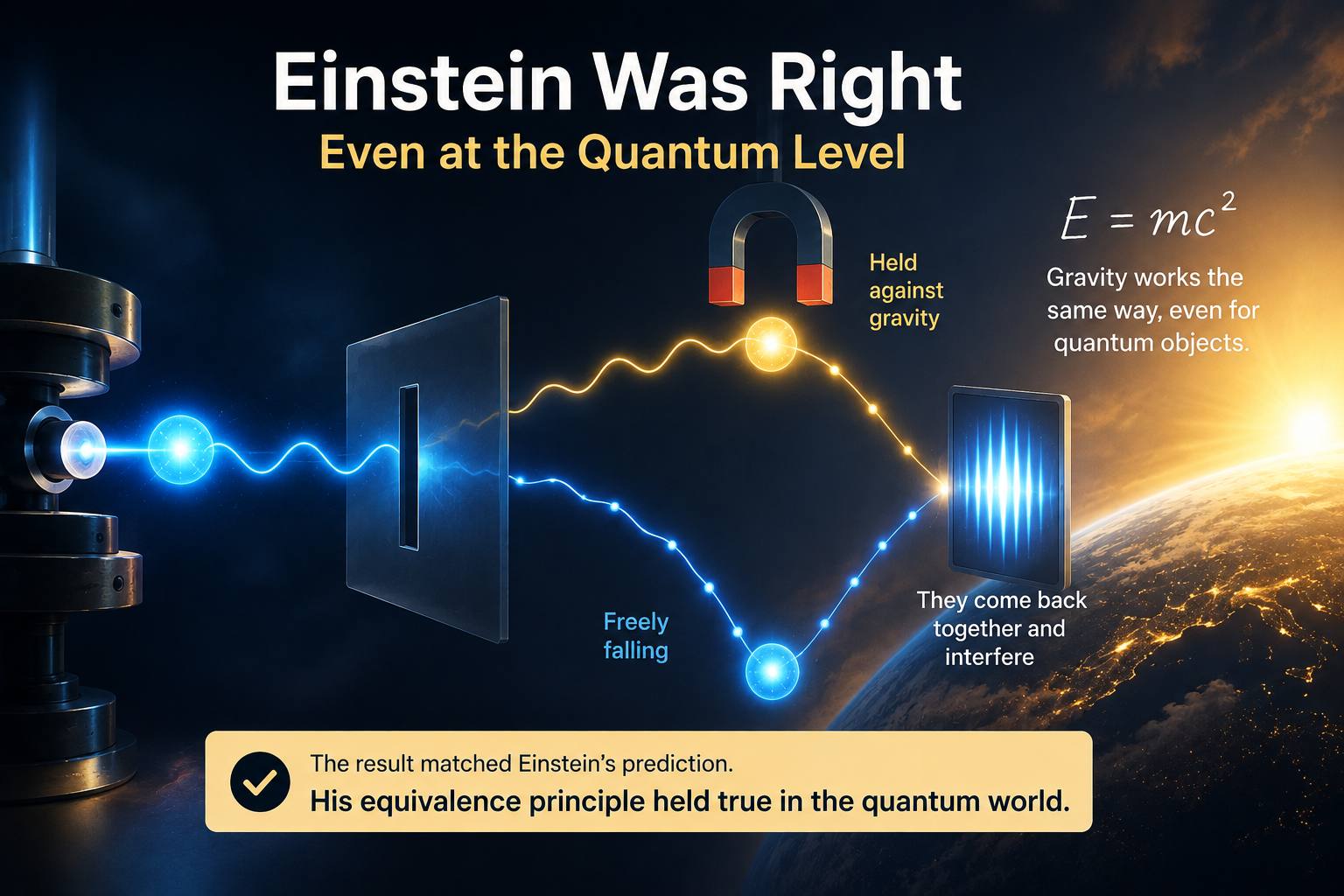
- Ultracold rubidium atoms were placed in a superposition, with one matter-wave path held still and the other allowed to free-fall.
- The recombined waves produced a quantum phase consistent with Einstein’s equivalence principle.
- The experiment does not solve quantum gravity, but heavier-object tests, including nanodiamonds, are being pursued.
For more than a century, physics has had a rather uncomfortable problem.
Quantum mechanics does an extraordinary job of explaining atoms and other tiny objects.
Einstein's theory of gravity does an extraordinary job of explaining falling objects, planets, stars and the universe.
But getting those two enormously successful descriptions of nature to fit neatly together?
Physicists are still working on that.
Now, an international team has performed an unusual experiment at the boundary between the two worlds.
They put ultracold atoms into a quantum superposition, effectively allowing their matter waves to travel along two different paths.
Then they held one path in place.
And let the other fall.
One Quantum Object, Two Very Different Journeys
The experiment used clouds of rubidium atoms cooled to just above absolute zero and manipulated near a specially designed atom chip.
Researchers first used microwave pulses to put the atoms into a quantum superposition.
In simple terms, the matter wave associated with each atom could effectively follow two different paths.
Then things got interesting.
Tiny electrical wires on the atom chip generated carefully controlled magnetic fields.
One part of the atomic wave was given an upward force that exactly counteracted Earth's gravitational pull.
That part stayed essentially stationary relative to the laboratory.
The other part got a very different trip.
Researchers pushed it upward with a controlled magnetic pulse and switched it into a state that was barely affected by the magnetic field.
Then they let gravity take over.
It followed a free-falling ballistic path — somewhat like throwing a ball into the air and watching it come back down.
Except this was an ultracold quantum matter wave.
Then They Brought the Two Paths Back Together
At the end of the fall, researchers used another magnetic pulse to reunite the two parts.
When the waves came back together, they interfered with each other.
That interference revealed a tiny difference in something called their quantum phase.
And that tiny measurement was the important part.
The researchers found that the measured phase matched the prediction obtained when Einstein's equivalence principle is applied to the quantum wave.
In other words, Einstein survived this test too.
What Does Einstein Have to Do With a Falling Atom?
The equivalence principle sits at the heart of Einstein's description of gravity.
One way to picture it is to imagine yourself inside a freely falling elevator.
As you and the elevator fall together, you would locally experience weightlessness.
The principle has survived extraordinarily precise experiments involving ordinary matter.
Quantum objects, however, make things considerably stranger.
They can behave like waves and exist in superpositions that effectively allow them to follow more than one path.
The researchers say their experiment produced the first direct measurement of the predicted quantum phase of a freely falling object.
And what they measured remained consistent with Einstein's equivalence principle.
No, Scientists Haven't Solved Quantum Gravity
This is where the brakes need to go on.
The experiment does not prove that gravity itself is quantum.
It does not finally unite quantum mechanics with Einstein's theory of gravity.
And it isn't evidence that scientists have discovered a complete theory of quantum gravity.
Instead, the result shows that Einstein's equivalence principle remains consistent with quantum mechanics in the regime tested by the experiment.
That's a narrower conclusion — but still a fascinating one.
Next Stop: Nanodiamonds?
The researchers don't want to stop with atoms.
They hope the technique could eventually help scientists perform similar experiments with much heavier quantum objects, including nanodiamonds.
That matters because study co-author Sir Roger Penrose has proposed that quantum mechanics could eventually break down for sufficiently massive objects kept in quantum superpositions for long enough.
This experiment did not reach the masses or timescales required to test that idea.
But the research team says an experiment involving heavier objects is already underway at Ben-Gurion University of the Negev.
So this time, scientists let an atomic matter wave take two paths and allowed one to fall.
Einstein's prediction held up.
The next experiments could ask an even stranger question:
What happens when the quantum object gets much heavier?